

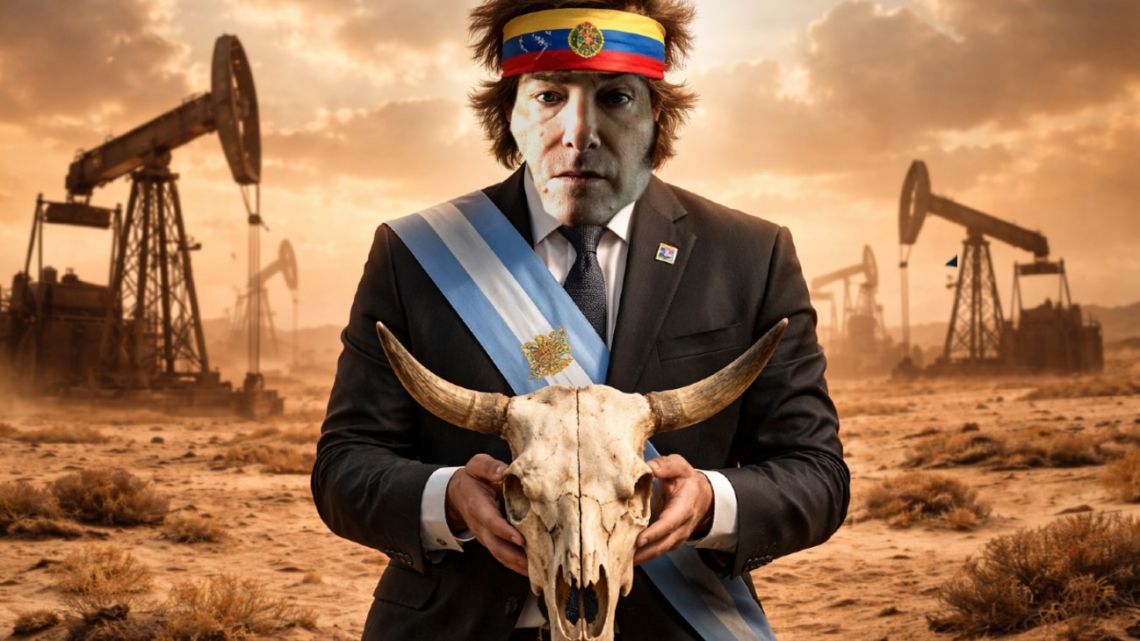
While it is still too early to say whether President Javier Milei will go down in history as having been on the right side of history by fanatically and unwaveringly endorsing the first-ever US bombing of a South American capital, he should at least be credited for being on the right side of power.
History and power do not always remain on the same side over time. There was a moment in history when siding with a lunatic like Adolf Hitler could have seemed rational and maybe even the only possible option. Things can change quickly.
Milei’s alignment with Trump is not only his obvious ideological choice but it is rational in the short term. The US president saved Argentina’s one from virtual financial collapse in October, when a run on the peso threatened to cost him the midterm election and possibly his entire economic programme.
The mere thought that the US Treasury would be the lender of last resort when Argentina needed to mitigate the fear that the country might not get the US$4.2 billion it paid to private bondholders yesterday is out of the norm. Economy Minister Luis Caputo needed a repo loan from banks to find the cash, but the market knew – with a degree of certainty – that, if push came to shove, Trump would rocket cash into Buenos Aires.

The fact is that the region fears Trump, after his unprecedented attack on Caracas. Milei, however, is enjoying the carrot of a major political victory. Trump remains, however, very unpredictable and so are his political relations – the situation of Venezuelan opposition leader María Corina Machado, who was warming up to take over the country after the January 3 strikes, is testimony to that.
Even if the short term works for Milei and he has Trump’s support for the rest of his term, bolstering his re-election chances in 2027, the president does not seem to have gauged the structural impact of the Venezuela situation on Argentina, especially on the country’s star economic sector: energy.
The Vaca Muerta shale formation is hitting record production levels, but a major leap forward must happen over the next two to five years with the completion of the Vaca Muerta Oil Sur–Sur oil pipeline, which could take production to around 1.5 million bpd (barrels per day) and exports to over one million, and the Southern Energy LNG project later in the decade. YPF Chairman Horacio Marín insists that oil exports alone will bring US$20 billion a year into the country – for reference, more than all due debt payments for the country in 2026 – by the end of the decade.

A Venezuelan comeback, especially if it entails large investments in rebuilding infrastructure, would be a direct regional competitor for Vaca Muerta, a development that has improved its production efficiency but still needs to streamline costs, even if Milei sorts out the country’s macroeconomics. This would make Argentina a less attractive investment destination by comparison.
One of the Achilles’ heels of the Milei model so far has been foreign direct investment, despite the benefits offered by his famed RIGI investor incentive scheme. In 2025, FDI showed the first negative annual result in over 20 years. This is explained by local companies taking the lead and multinationals choosing more attractive destinations – for example, Guyana, which is next door to Venezuela.
The US action has also triggered a massive wedge in a region that was already divided. Milei and Brazil’s Luiz Inácio Lula da Silva are predictably at opposite ends of those supporting and condemning the attack. What was not predictable is that the two leaders would consistently prioritise their ideological and worldview differences over their countries’ common agendas, which are very substantial. One of them also impacts Vaca Muerta: Brazil is an obvious market for Argentine gas, but a lack of cooperation blocks or delays progress.

The next signpost will be the October 2026 presidential election in Brazil. Milei will likely campaign against Lula – as the leftist did against the libertarian in 2023 – and the Brazilian’s re-election would further stall dialogue and action.
None of this is in Milei’s more immediate calculations, which are motivated by his ideological inclination and a desire to be Trump’s top follower in the region, for the sake of short-term wins. So far, he is doing just fine: on the right side of power, as the region appears to lean back to the right. History will take longer to tell.








Comments