

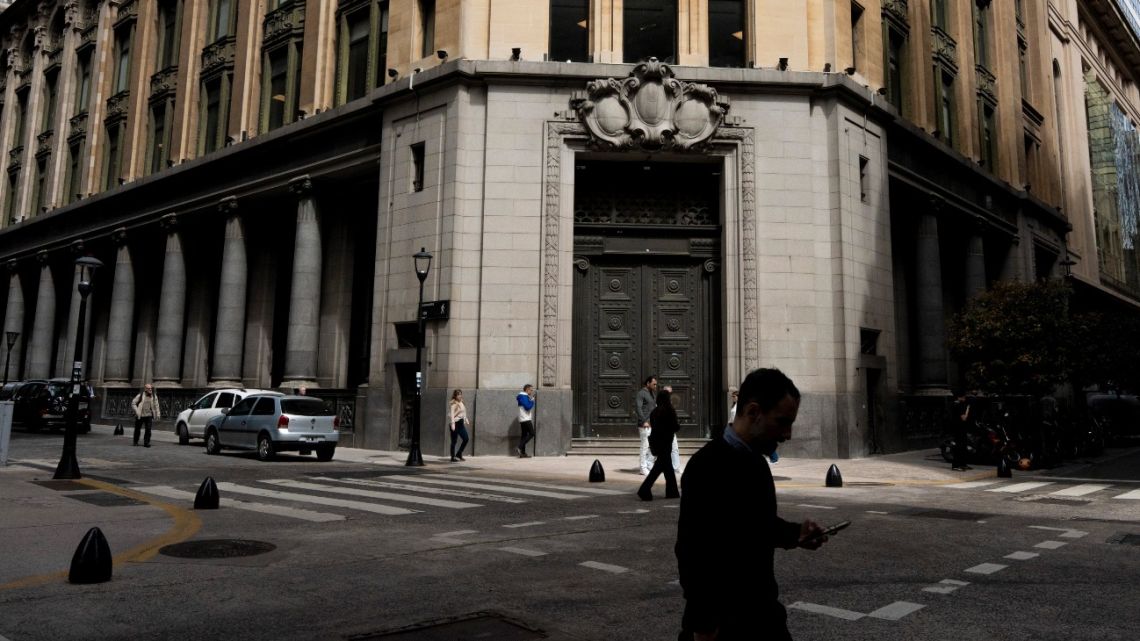
Argentina secured a US$3-billion loan from a group of international banks to help cover a foreign debt payment due in two days and replenish the country’s depleted coffers.
The Central Bank reached a one-year repurchase agreement – or repo – with the lenders at a rate of 7.4 percent, it said in a statement early Wednesday.
Six international banks took part in the deal, according to two people familiar with the matter who asked not to be identified discussing private information. Banco Santander SA, Banco Bilbao Vizcaya Argentaria SA and Deutsche Bank AG put in about US$680 million each, the people said, with US$510 million coming from Goldman Sachs Group Inc, US$340 million from JPMorgan Chase & Co. and about US$100 million from Bank of China Ltd.
Representatives for JPMorgan, Goldman, BBVA and Santander declined to comment.

A Deutsche Bank spokesperson didn’t immediately comment, while a representative for Bank of China didn’t immediately respond to a request.
President Javier Milei’s administration was looking to cobble together enough dollars to meet a US$4.3-billion payment due Friday, while opting against an immediate return to international bond markets for now. The government put up dollar-denominated local bonds due in 2035 and 2038, known as Bonares, to the banks as collateral.
A discount of 40 percent was set on the bonds, meaning Argentina had to turn over about US$5 billion worth to access US$3 billion in cash, the people said. The Economy Mnistry didn’t immediately reply to a request for comment.

Argentina’s sovereign debt rose across the curve before paring those gains. Global bonds due in 2035, some of the most liquid, climbed as much as 0.4 cent, but were trading flat around 74.5 cents on the dollar at 12.30pm in Buenos Aires. The yield fell to 9.8 percent.
On Monday, Argentina’s Treasury bought more than half the proceeds from a US$700-million privatisation of hydroelectric power plants, according to a person familiar with the matter. The Central Bank, meanwhile, made its first dollar purchase in nine months, buying US$21 million in the foreign-exchange market, according to an official statement. It bought another US$83 million on Tuesday.
“The government isn’t just looking to cover upcoming maturities, but also to bolster reserves and build a roughly US$1.5-billion bridge to get through the peak harvest months,” said Ramiro Blázquez, Latin America strategist at StoneX. “That makes sense because, until the harvest comes in, it will be difficult to buy many dollars in the spot market, especially with inflation still running hot and policymakers keen to avoid fuelling it with a weaker peso.”

Economy Minister Luis Caputo said weeks ago that banks had offered up to US$7 billion in repo funding, among other options on the table.
As part of the preparations, the Economy Ministry last week carried out a debt swap with the Central Bank. The transaction helps assemble collateral in dollar-denominated sovereign bonds that can be pledged in a repo structure, in line with previous operations involving the Central Bank.
“The 7.4 percent rate is very positive, and the one-year tenor shows the economic team is confident reserve accumulation will gain traction this year,” said Walter Stoeppelwerth, chief investment officer at Grit Capital Group. “The market is really reacting to the Central Bank’s recent dollar purchases, which signal a stronger commitment than the repo itself, already priced in.”

The repo deal – which extends beyond the immediate maturities and is short term in nature – also underscores the need for Argentina to reestablish market access this year. In mid-2025, the Milei administration signed a two-year, US$2-billion repo loan with international banks set to mature next year, on top of a similar US$1-billion, two-year deal signed earlier that year, adding to the stock of short-term obligations.
Attention will soon turn to Argentina’s potential return to international markets. Officials had signalled that resolving the January maturities was a key step toward further compressing country risk, which is already at a multi-year low, and pave the way for cheaper funding down the line.
New financing from Wall Street adds to Milei’s momentum since his party won Argentina’s midterm elections in October, pulling off a comeback after a sharp market selloff before the vote spurred a US$20-billion bailout from the Trump administration. The president’s libertarian party has emerged as the largest bloc in Congress, while leadership in the Peronist opposition ranks remains fragmented.

Milei took advantage of his newfound political strength to pass Argentina’s first annual budget of his Presidency in December, anchoring his fiscal surplus. He also passed a tax amnesty law and he’s marching forward next month with a labour reform bill that will retest his negotiating skills with powerful governors and centrist blocs he needs.
Analysts project Argentina’s economy will grow 3.4 percent this year after posting an estimated 4.4 percent growth in 2025, according to the Central Bank’s most recent survey of economists.
by Ignacio Olivera Doll & David Feliba, Bloomberg













Comments