
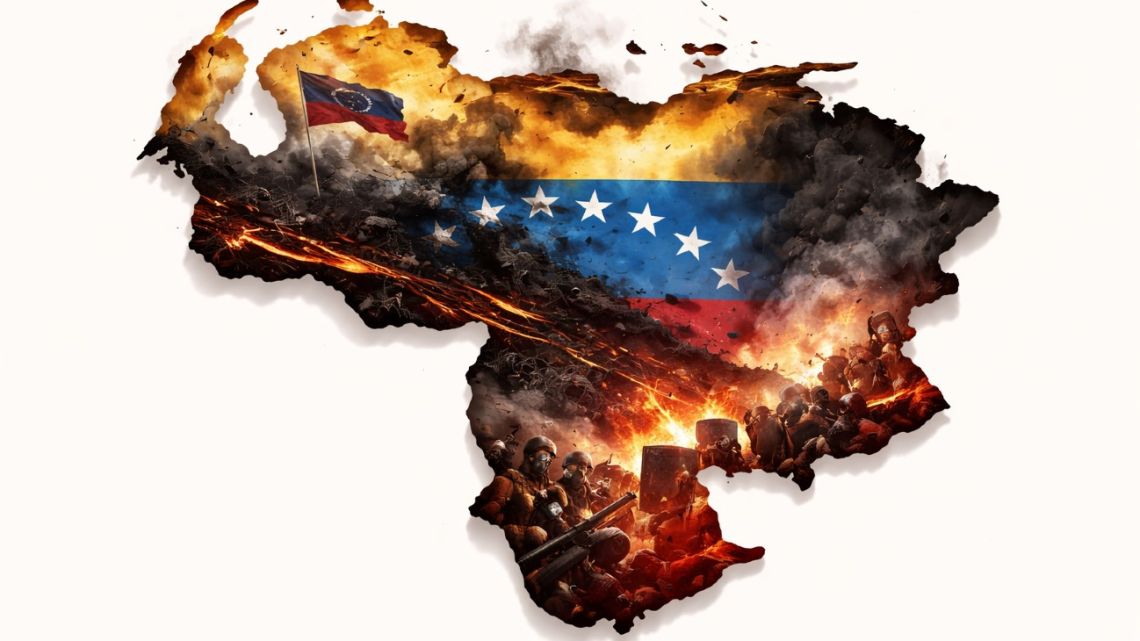
Following an electoral 2025, this new year brings the return of the ‘Beyond the Headlines’ series with its professed aim of seeking out issues which are perhaps more important than urgent and thus do not appear in the week’s main headlines or the other columns. But a bit of a false start today because it becomes impossible to ignore the jumbo (or perhaps dumbo) elephant in the room: Donald Trump’s capture of Nicolás Maduro last weekend.
When the Austrian SS paratroop colonel Otto Skorzeny snatched Benito Mussolini out of his mountain captivity in 1943, it was a spectacular stunt which did almost nothing to alter the course of World War II – whisking Maduro from a heavily guarded Caracas military base to a New York courtroom was also an almost magical feat but has yet to prove a game-changer in Venezuelan history. If Bolivarian 21st-century socialism could outlive Hugo Chávez, it could also survive Maduro.
The questions vastly outnumber the answers in these early days. Did Trump’s deal-cutting with Venezuelan Vice-President Delcy Rodríguez follow or precede Maduro’s capture? Was this bold commando raid pure White House unilateralism or was it a disguised military coup or even an exit strategy brokered by Maduro himself? Can Trump’s Nobel Peace Prize spite really banish a María Corina Machado “having neither support nor respect within her country” out of the picture altogether and with her the popular will? Does Trump really mean his crassly self-interested motive of seeking to revive a Venezuelan oil glut when world prices are barely $56 a barrel? Whither international law?
Answers to these questions are mostly premature at this stage so instead this column will offer a potted history of Venezuela leading up to this potential turning-point.

Venezuela’s birth as an independent republic in 1830 offers striking parallels to today’s situation since it followed two highly destructive decades (in the form of the wars of Independence rather than Bolivarian rule) – if almost a quarter of the population have emigrated in this century, around a quarter perished in those wars. The independence movement started there as early as 1806 with Francisco Miranda and the country had to bear the brunt of the brutal Spanish General Pablo Morillo’s initially successful reconquest following Napoleon’s defeat. Always the poor cousin within the Viceroyalty of New Granada (Colombia), Venezuela also lost what little wealth it had.
The country also has a pre-Columbian pre-history (perhaps stretching back as far as 15 millennia) and a colonial past (the only mainland discovery of Christopher Columbus in 1498, its first colony was in 1502 while Caracas was founded in 1567 with a massive introduction of African slaves in the 18th century – for a couple of decades Venezuela was under German, not Spanish Hapsburg rule) but we will start from 1831. The country began post-colonial-life in 1821 as part of Gran Colombia, a situation Venezuela was prepared to tolerate while run by its favourite son Simón Bolívar but the union fell apart soon after his death in 1830.
The first generation was dominated by war hero José Antonio Páez, the father of independence, who served three presidential terms between 1830 and 1863 with puppets in between. Venezuela in the 19th century was a backwater run by strongmen, of whom the most important were Antonio Guzmán Blanco (three terms between 1870 and 1887 in which he faced the sanguinary Federal War rebellions) and Cipriano Castro (1899-1908) – Páez, Guzmán Blanco and Castro were all generals and all members of the Liberal Party.

Nominally constitutional rule until then but then came the long dictatorship of Juan Vicente Gómez from 1908 until his death in 1935 (actually a stickler for respecting the constitution except that he constantly changed it every time it did not suit him). Gómez was something like Mexico’s Porfirio Díaz a generation later – savagely repressive but also modernising the country with roads and telegraphs.
During this period petroleum was discovered in Maracaibo in 1914 with the industry booming as from 1918. The money was used by Gómez to repay Venezuela’s massive debts by shrewdly bargaining oil concessions with foreign companies, chiefly Royal Dutch Shell and Standard Oil (the dictator’s rabid anti-unionism restricted the refineries to Aruba and Curaçao during his régime) with minimal trickle-down to a population of still only two million in 1935.
The following decade saw two more generals, Eleazar López Contreras and the more democratic Isaías Medina Angarita, who even legalised the Communist Party. Then in 1945 came the advent of democracy and the first elections with universal suffrage in Venezuelan history, won by Rómulo Betancourt’s popular Acción Democrática (AD) party. This civilian government was quickly terminated by a 1948 coup, followed by a decade of dictatorship under General Marcos Pérez Jiménez – one of a junta until 1952 and then sole president. Like Gómez, Pérez Jiménez combined ruthless oppression with ambitious infrastructural programmes leading to rapid economic growth.

Early in 1958 the country made a far more solid return to democracy lasting four decades with a general image of stability and prosperity far surpassing Latin American stereotypes – the first edition of The Economist read by this columnist in 1960 informed him that the three strongest currencies in the world after the almighty dollar were the Swiss franc, the Portuguese escudo (with ultra-monetarist Antonio Salazar) and the Venezuelan bolívar. Five AD presidential terms in that period (two of them Carlos Andrés Pérez) and three for the COPEI Christian Democrats (two of them Rafael Caldera). Co-founding OPEC in 1960, Venezuela nationalised its petroleum industry in 1976 under Pérez on the back of oil prices quadrupled by the 1973-1974 crisis, which in theory should have made the country richer than ever but somehow Venezuela found itself on the wrong side of petrodollars with massive debts and recurrent crises, of which the 1989 ‘Caracazo’ leaving hundreds dead was the most dramatic.
In 1998 Lieutenant-Colonel Hugo Chávez – who had staged an abortive coup in 1992 – came to power via the ballot-box, gaining popularity amid financial turmoil. The next year the Bolivarian Republic of Venezuela was founded with a brand-new constitution. Bolstered by three-digit oil prices in some years (much of which he spread around the subcontinent to gain regional influence), the populist Chávez was re-elected in 2006 and 2012 and finally only vanquished by cancer, although he did lose a 2007 referendum on expanding presidential powers.
Upon his death in March, 2013, Chávez was succeeded by Maduro, a bus-driver who became presidential chauffeur and subsequently National Assembly Speaker, Foreign Minister and Vice-President in October 2012. Elected in April 2013 (just 1.5 percent of the vote ahead of Henrique Capriles) and re-elected in 2018 amid a low turnout and in 2024 (spuriously by all accounts), he carried populist pricing to such extremes that the currency collapsed – nor did he share the luck of Chávez with oil prices. Some seven million citizens or more left the country in his catastrophic presidency. Charges of human rights violations are levelled by not only conservative governments but also Amnesty International and Chile’s socialist ex-president Michelle Bachelet working for the United Nations. No need to write more about Maduro with everything pouring into the media since last weekend.

The fall of a tyrant like Maduro is always good news but…






Comments