

Jean-Claude Juncker, the former European Commission president and former Luxembourg prime minister, once said: “We all know what to do, but we don’t know how to get re-elected once we’ve done it.”
This observation encapsulates Europe’s current dilemma. Most European leaders know what reforms and budget cuts are needed to boost productivity, promote innovation, streamline regulation, rein in public spending, and shore up their defenses. But after decades of welfare expansion, voters are reluctant to give up their social benefits.
The European electorate has become risk-averse, protective of living standards that no longer reflect underlying economic fundamentals. Yielding to short-term incentives, parties on both the left and the right now vie to outdo one another in making unsustainable promises, feeding a populist cycle that deepens polarisation.
In his seminal 2024 report on European competitiveness, Mario Draghi, the former president of the European Central Bank and former Italian prime minister, warned that the continent is at risk of becoming a museum: beautiful, historic and irrelevant, with tourism its only competitive industry. While most European leaders have championed Draghi’s work, they seemingly lack the political will to implement his recommendations.

France’s attempt at pension reform is illustrative. French President Emmanuel Macron sought to raise the retirement age in a country where people over 65 have higher average incomes than the working-age population, triggering months of protests and political turmoil.
Populists on the left and the right attacked the idea, arguing that the fiscal deficit can be reduced only by raising taxes on the wealthy – despite the fact that France already has one of the highest tax burdens among rich countries. The proposed pension reform eventually became so toxic that the government shelved it.
As newly appointed Finance Minister Roland Lescure explained: “It’s the price of compromise and it’s the price of political stability.”

The pressing need to strengthen Europe’s defence posture in response to an increasingly hostile geopolitical environment provides another telling example. Many European leaders, aware of voters’ priorities, are loathe to increase defence spending. Spain, for example, continues to fall far short of its NATO defense-spending obligation of two percent of GDP, despite repeated warnings from allies and the growing threat on Europe’s eastern flank.
Italy, for its part, announced that it will increase its defence outlays, only to use accounting maneuvers to disguise infrastructure projects as military spending. As the Spanish political scientist Pol Morillas points out, Europe wants a seat at the table of global powers but refuses to pay the price of admission.
These examples are symptomatic of a wider European malaise. Across the continent, politicians face electorates unwilling to accept the reality that the combination of demographic decline, sluggish productivity, and debt accumulation is unsustainable.

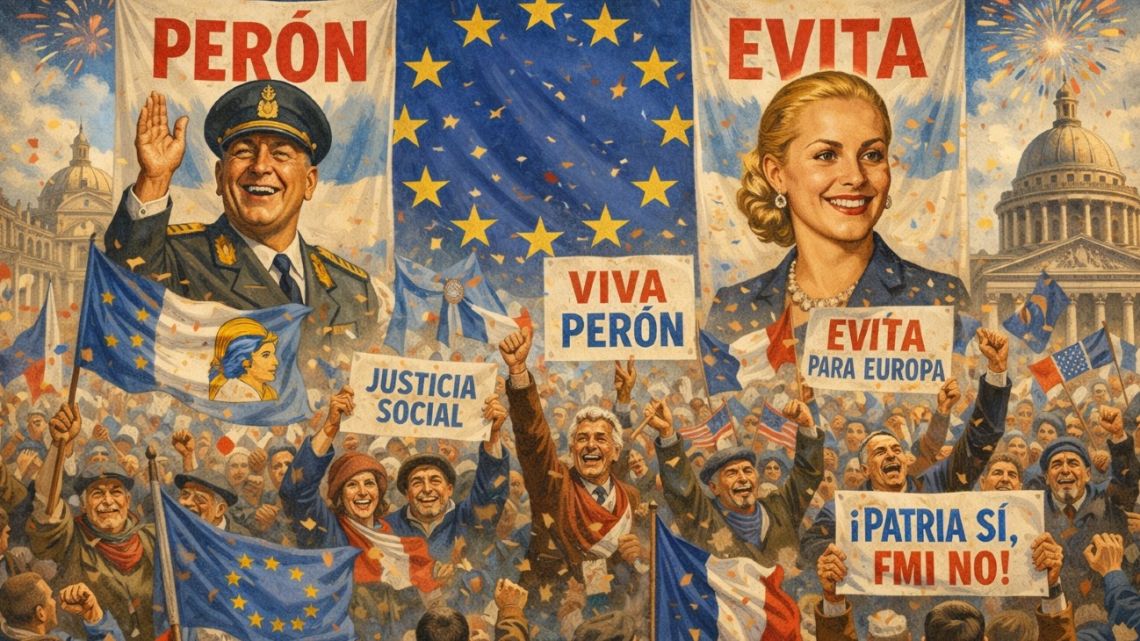
To be sure, Europe is not Argentina. But European voters increasingly resemble their Argentine counterparts, who, despite runaway inflation and repeated debt defaults, continued until recently to fall for the easy “solutions” of subsidies, clientelism, and an ever-expanding public sector offered by left-wing Peronism/Kirchnerism.
As in Europe, politicians in Argentina knew what needed to be done. Between 2015 and 2019, then-president Mauricio Macri tried to address the economy’s chronic mismanagement with a cautious and gradual reform agenda that was highly unpopular and exacerbated the electorate’s frustration. After his tenure, Kirchnerism returned, and the crisis deepened.
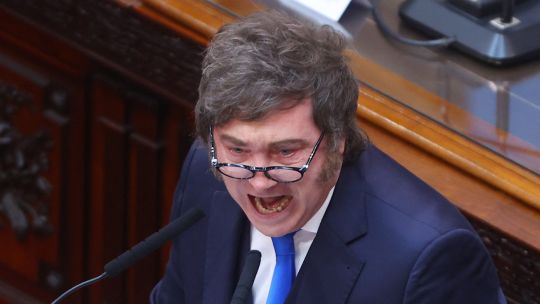
Following decades of irresponsible spending and falling living standards, voters turned in 2023 to the libertarian firebrand Javier Milei. As president, Milei has railed against “political elites,” while also implementing economic policies largely designed by Luis Caputo, his finance minister and a former JP Morgan banker who previously attempted to pursue reforms as head of Argentina’s Central Bank during the Macri administration.

Milei’s “chainsaw” cuts – the most rapid and intense reduction in public spending in modern history, with the possible exception of Greece after its 2009 debt crisis – have helped stabilise public finances and created a budget surplus for the first time in more than a decade. But these fiscal improvements have come with social costs, including a substantial increase in poverty (from just over 40 percent in the first half of 2023 to nearly 53 percent in the first half of 2024), ballooning income inequality, a rise in unemployment and deepening political polarisation.
No-one knows how Milei’s experiment will play out, but his mandate, reaffirmed in October’s midterm elections, should not be viewed as a full-throated endorsement of libertarian orthodoxy. Rather, it reflects an electorate that, having historically been averse to sensible reforms despite continuous economic and financial crises, reached a breaking point and embraced an outsider – an “anti-populist populist” whose promise of shock therapy meant implementing a conservative economic agenda at a high social cost.
Empirical research shows that democracies, on average, outperform populist regimes in terms of long-run economic growth, innovation and social welfare. But democracy also incentivises short-term electoral success over long-term responsibility. When political short-termism takes over, populism is more likely to thrive, offering simple answers to complex problems, deferring hard choices, and stoking resentment. To avoid this trap, leaders must be willing to tell voters what they do not want to hear, and voters must be willing to reward them for it.

Europe’s current trajectory suggests that neither leaders nor voters are doing their part. But reality, as always, will reassert itself. The question is whether Europe will confront it on its own terms or whether, like Argentina, it will wait until a crisis forces its hand, at which point the untouchable entitlements of today may be lost entirely.
Juncker’s cynical joke increasingly reads like prophecy. Europe’s leaders know what to do. They just need the courage – and the backing of voters – to do it.
* Cristina Ramirez is an international political analyst for Panamá en Directo and a PhD candidate in the Department of Political Economy at King’s College London. Copyright: Project Syndicate, 2025. www.project-syndicate.org
related news
by Cristina Ramirez, Project Syndicate











Comments