

The toppling of Venezuela’s Nicolás Maduro offered the clearest sign yet of Donald Trump’s intention to reassert US dominance in the Americas, but it’s Argentina that holds clues about how successful the so-called “Donroe Doctrine” may ultimately be.
Even before the stunning intervention in Caracas, Trump had regularly wielded aggression in an attempt to get his way in Latin America: He’s threatened military force against Mexico, Colombia and Panama, slapped punitive tariffs on Brazil, and put his finger on the scale of an election in Honduras.
But Argentina, home to one of his fiercest global allies, is perhaps the only place where he’s leaned on the sheer financial might of the US government to help a friend.
The question as the Venezuela dust settles and Trump’s strategy comes into clearer view is whether he’ll utilise that approach more frequently, especially given that it has shown initial signs of delivering on his aim of loosening China’s grip on a major regional economy.

Last September, with Argentina's leader Javier Milei stuck in the most perilous moment of his Presidency, Trump came to the rescue: The US Treasury unveiled a US$20-billion lifeline meant to stem a currency slide and shore up market confidence in Argentina ahead of a crucial midterm election.
It was a near-unprecedented move with clear political motivations. The Treasury hadn’t intervened in such a way in a Latin American economy since a Mexican currency crisis in 1995, an episode that risked spilling over into the US.
Argentina’s peso problems carried no such threat. But Milei had gone to dramatic lengths to prove his devotion to Trump, realigning Argentina ideologically with the US leader.

In February 2024, the Argentine flew to Washington to endorse Trump just after then-president Joe Biden’s secretary of state visited Buenos Aires. Since then, he’s made a habit of visiting Mar-a-Lago, the White House, the Conservative Political Action Conference and anywhere else he might score a minute of the US president’s time.
Trump’s decisive support was proof that Milei’s bet had paid off. In October, he won a landslide victory in the midterms, earning an opportunity to continue pursuing his “shock therapy” regime for Argentina’s beleaguered economy.
But Trump also benefited, even before Argentina last week repaid the US$2.5 billion from what it had used of the swap line. Over the last year, Milei has moved to limit China’s further entry into Argentina, a country that like many of its neighbours has seen an increasing flow of investment from the Asian behemoth in recent years.

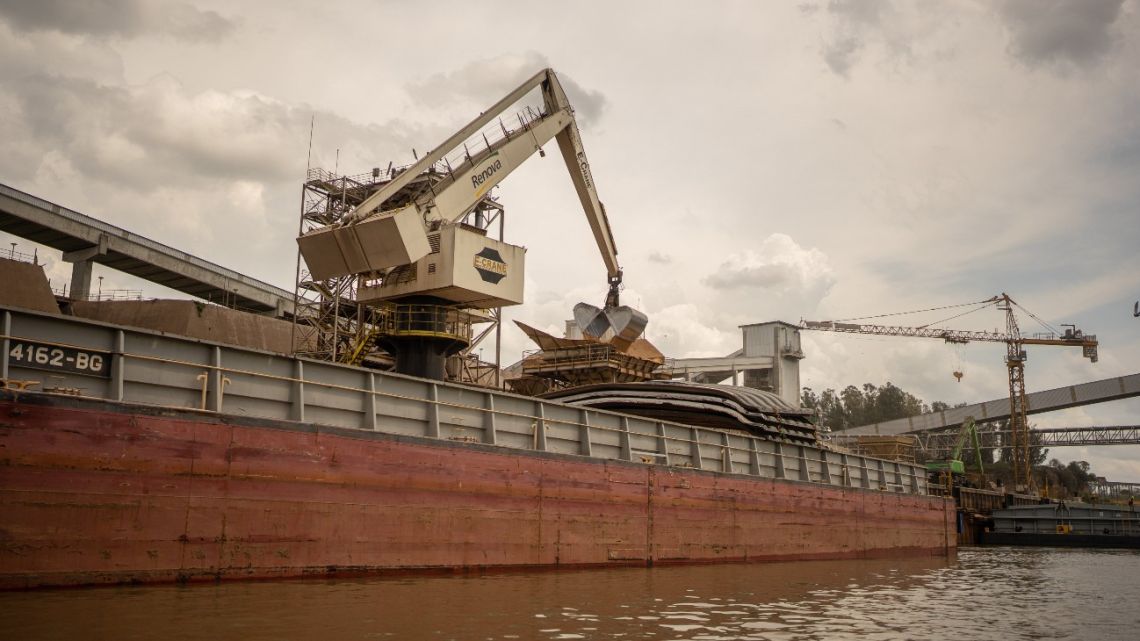
Shortly after the US delivered the aid, Milei put new obstacles in the way of construction of a Chinese telescope in the Argentine Andes. As he marched on with a new nuclear power plan, he maintained a freeze on a proposed US$8-billion plant backed by Beijing. And in December, a Chinese company was again blocked from bidding on a project to deepen a key Argentine waterway used to ship goods across the world.
Milei, however, has been careful to avoid a full break with China. The president who referred to the country’s Communist government as an “assassin” on the campaign trail has softened his rhetoric as president, and Argentina's Central Bank renewed a portion of its US$18-billion currency swap line with the People’s Bank of China last April.
An already-completed Chinese space facility that the US has claimed could be used for military surveillance is still running. Through November, Argentine exports to China had risen 57 percent in 2025 from a year prior, far faster than the 26 percent increase in shipments to the US over the same period.

A spokesperson for Milei didn't respond to a request for comment. But in a television interview last week, he drew a distinction between Argentina's ties to the US and its relationships with other nations.
“We are allies of the United States and Israel in geopolitics, and then there are commercial issues that will be treated as commercial issues,” Milei said.
That reflects a basic reality that Trump will have little choice but to acknowledge: no matter how badly he or anyone else wants to push China out of Latin America, Beijing is there to stay. Even the friendliest government can’t fully reshape geopolitical and economic relationships just because Washington wants it to.

China’s direct foreign investment projects in the Americas topped US$180 billion by the third quarter of last year, according to data from Rhodium Group, a US-based research outfit. Its economic influence has surpassed that of the US in 14 of the region’s 33 nations since the start of the century, Bloomberg Economics research shows.
And while Trump has moved beyond saber rattling to actual military action in Venezuela, few Latin American governments have been immediately swayed.
In a region desperate for investment into the infrastructure and technology needed to mine rare earth minerals, modernise industries and push economies into the future, few seem to see the US as a credible alternative to the money flowing from Beijing.

Trump’s trade policies, meanwhile, are exacerbating the problem, discouraging private US companies from investing abroad. That has left Argentina as the exception when it comes to US engagement that remains tilted toward coercion.
“Milei’s the only case where carrots are also in the US arsenal and there are rewards, not just absence of punishment,” said Benjamin Gedan, senior fellow and director of the Stimson Center Latin America programme in Washington.
That dynamic will almost certainly have to change if Trump wants to mould his revival of the 19th-century Monroe Doctrine into a policy capable of augmenting Washington’s present-day influence, even as elections in Chile and Bolivia have started a rightward regional shift that could speed up with Brazil, Colombia and Peru set to vote this year.

Otherwise, friendly leaders are likely to find themselves stuck in similar positions to Trump’s foes: trying to appease duelling superpowers, neither of which they can afford to alienate.
Milei is no exception. In last week's TV interview, the Argentine leader said that he’s planning to visit China later this year.
by Manuela Tobias, Bloomberg






Comments