

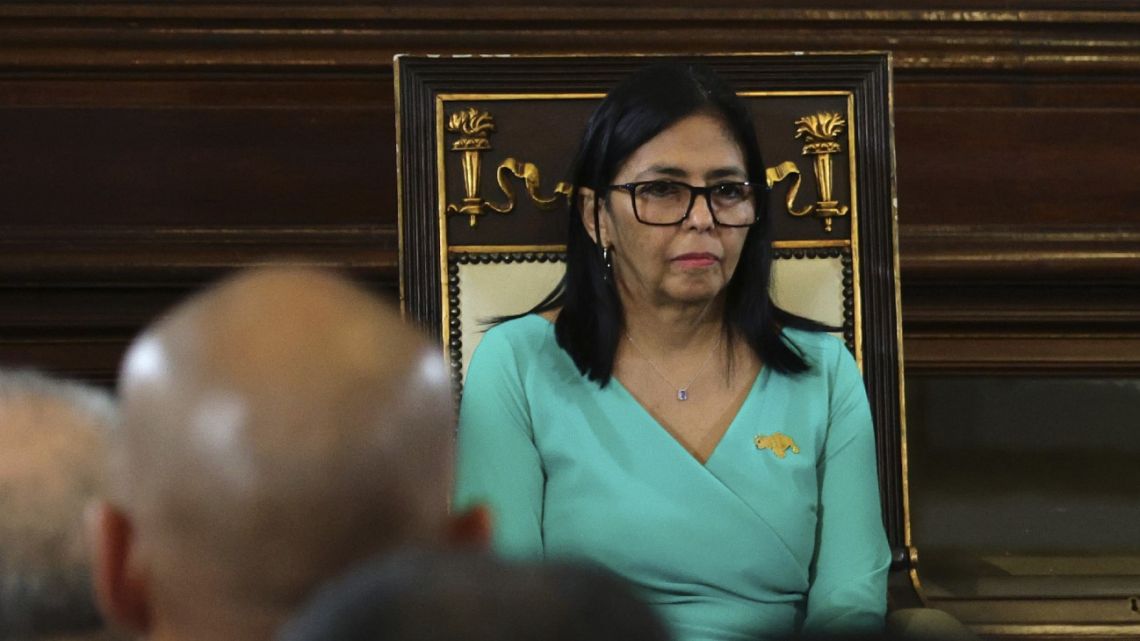
Venezuela’s government is reasserting itself after the capture of Nicolás Maduro, swearing in Delcy Rodríguez as acting president and flashing warning signs that a new wave of repression has begun.
As the government continued to churn inside the presidential palace Miraflores, Venezuela’s military counterintelligence officials have been patrolling the streets of Caracas, according to at least two witnesses. At least seven journalists and members of the press were detained on Monday morning and early afternoon, most of them at the National Assembly and its surroundings, according to the national press workers syndicate.
Heavily armed security forces and pro-government motorcycle gangs known as colectivos were seen roaming the capital, at times stopping drivers and checking their phones. While they aren’t as influential as they were at the height of Maduro’s power, the US State Department has said they have been responsible for killings during protests.
Venezuela’s Information Ministry didn’t immediately respond to a request for comment.

“The presence of colectivos on the streets is clearly intended to reinforce the government’s internal repression scheme and prevent popular mobilisations through fear,” said Andrei Serbin Pont, president of the Buenos Aires-based research group CRIES, who closely monitors Venezuela’s security forces. There are also military checkpoints, through which “the government is trying to obstruct drone reconnaissance activities that it believes the US is conducting.”
Later Monday evening a series of apparent blasts was heard near the presidential palace, rattling residents. The source and cause of the sounds were not immediately clear. They stopped shortly after, and there were no immediate reports of damage.
What’s happening on the ground in Caracas doesn’t quite match the calls for peace Rodríguez made during her swearing-in ceremony on Monday.

“For the people of Venezuela, I swear not to rest for a single minute to guarantee peace and the spiritual, economic, and social well-being of our people, and to ensure a government that provides social welfare, political stability, and security,” she said.
Institutional backing

At least for now, she has the backing of both the Chavismo strongholds in her government and US President Donald Trump, who has said she would work with Washington to “make Venezuela great again.” She also struck a conciliatory tone on Sunday, asking the US to work with her country on a cooperation agenda.
Her biggest public endorsement from within Venezuela came from Nicolás Maduro’s own son, who said he would “unconditionally support” her and echoed her call for foreign investment based on respect. He said he’d had indirect communication with his father.
“To you, Delcy, my unconditional support. Count on me and my family,” Maduro Guerra said, while tearfully describing what he called difficult hours for his family. He spoke during the installation of Venezuela’s National Assembly in Caracas on Monday.

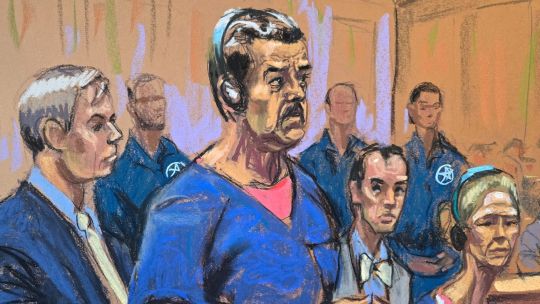
Her installation comes just days after Maduro was seized by US forces and flown to New York, a move that plunged the oil-rich country into political uncertainty and intensified scrutiny of Washington’s intentions.
Maduro Guerra, 34, has served in the National Assembly since 2021 and was sworn in for a new legislative term on Monday. Often referred to as “Nicolasito,” he is Maduro’s only son and is frequently seen alongside him at political rallies and public events. The ruling party has promoted him as part of a younger generation of leaders where he has largely focused on religious affairs.
Jorge Rodríguez, Delcy’s brother, was reinstated as head of the assembly for a sixth consecutive annual term.

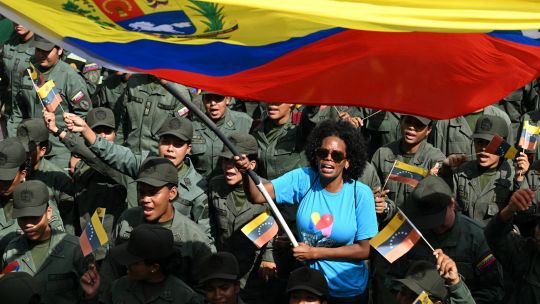
While the parliamentary session was under way, Maduro supporters took to the streets for a second consecutive day to protest his capture. The only absent lawmaker among the 285 elected last year was Maduro’s wife, Cilia Flores, who was also taken by US forces. Her empty seat and name were shown on state television.
Ruling party lawmakers appeared largely sombre, though many flashed victory signs and raised clenched fists in a show of resistance. Longtime Maduro allies, including his right-hand man Juan Escalona, received visible gestures of support from colleagues.
Socialist framework
Venezuela’s Constitution – dating to 1999 at the dawn of the socialist era spearheaded by late presidential icon Hugo Chávez – offers different scenarios depending on how Venezuelan authorities classify Maduro’s removal from office.
In a ruling issued Sunday, the country’s rubber-stamp Supreme Tribunal of Justice indicated it is treating the episode as a temporary forced absence, a designation that preserves the existing government structure while starting a constitutional clock until elections are convened.
Under that framework, Rodríguez may exercise executive authority for up to 90 days, extending the interim period into April. The Constitution allows for a single 90-day extension, which would push the deadline to July and force lawmakers to decide whether Maduro’s absence has become permanent.
If the National Assembly declares an absolute absence during the first year of Maduro’s current term, the national charter requires a new presidential election within 30 days, opening the door to a vote as early as August if lawmakers move quickly to formalise his removal.
Members of the new assembly were elected in an early vote in May 2025, amid widespread disappointment and fear among voters. Most of the opposition, led by Nobel Peace Prize laureate María Corina Machado, boycotted, arguing it was an attempt to eclipse Maduro’s July 2024 re-election, which was widely deemed to have been fraudulent. The opposition says Machado’s stand-in candidate Edmundo González Urrutia won by a landslide. On Saturday, Trump said she didn’t have the support and respect to take power.
A more doveish faction of the opposition, including former governor and two-time presidential candidate Henrique Capriles, chose to participate in the parliamentary vote and a subsequent regional election. That group secured fewer than 20 seats, far short of the numbers needed to influence legislation. Another opposition bloc widely viewed as aligned with the government won 13 seats.
Venezuela’s opposition shared images on Monday of what appeared to be small-scale protests against Delcy inside the country. The photos and videos show people in different parts of Venezuela, most of them not revealing their faces, holding signs opposing her swearing-in with messages reading “No, Delcy.” Other images show graffiti on walls that read: “We don’t like you, Delcy, you are a narco-terrorist.”
But the presence of counterintelligence officials and colectivos makes clear that the government wants to hold back any semblance of dissent or resistance, Christopher Hernandez-Roy, senior fellow and deputy director at the Americas Program at CSIS, said Monday.
“I think this is all part of a strategy to prevent any spontaneous protests for democracy,” he said. “For María Corina Machado, for Edmundo González Urrutia, for a broader change in the regime than just simply the departure of Maduro.”
– /BLOOMBERG











Comments