

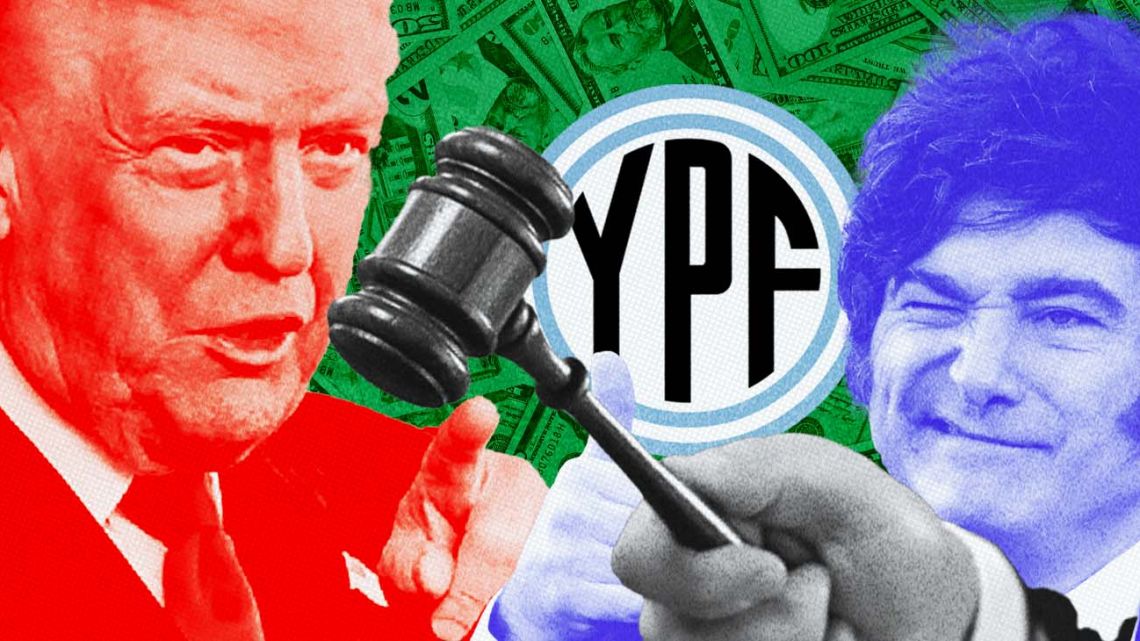
The Argentine Republic is a veteran of many battles in New York Courthouses and the YPF case is one of its most epic stand-offs. Similar to the historic and infamous ‘pari passu’ case ruled by Judge Thomas Griesa — who was particularly vicious towards the government of Cristina Fernández de Kirchner – it marked an era of confrontation and also mutual interest between Wall Street and Buenos Aires, that seems to be coming to an end. There will be more, no doubt, but it is difficult to imagine an emboldened and domestically powerful Argentine president, allied to the strategic enemies of the United States, attempting to question the superpower’s hegemony in its own courts, while expecting nothing bad to come out of it. Indeed, before Cristina it was Néstor Kirchner who mocked US President George W. Bush at the Cumbre de las Américas held in Mar del Plata in 2005, marching down the streets together with Venezuela’s Hugo Chávez and Diego Maradona, a known Bolivarian-sympathiser. A few months later, Néstor paid off the debt with the International Monetary Fund to the tune of US$9.3 billion – the starting-point of the pari passu case with the so-called vulture funds personified by billionaire Paul Singer – in an attempt to declare financial sovereignty as the commodities super cycle boom fuelled by China fed dreams of eternal hegemony. Cycles, however, come and go.
It was obvious that everyone involved in some way or another with the YPF case was going to try to take the credit for the final victory in a case that began with the 2012 nationalisation of the energy firm during Fernández de Kirchner’s second and final term. President Javier Milei was amongst the first to come out and say his government had to come in and fix the “cagadas” (or “shit shows”) that came out of Axel Kicillof’s most eye-catching move during his days as Economy Minister. Kicillof – who is now Milei’s main political adversary and the current governor of Buenos Aires Province, the nation’s most-populous region – sought his piece of the pie too, telling Milei to shut it while arguing that his point from day one (that Argentine law supersedes YPF’s bylaws) had been upheld by the United States Court of Appeals for the Second Circuit. Fernández de Kirchner, highlighting her legal background, thanked Sullivan & Cromwell, the prestigious and pricey law firm that represented the Republic, while justifying the political decision to expropriate a private company given the later importance of the massive Vaca Muerta shale basin in Argentina’s economic development. Mauricio Macri then took a jab at Kirchnerism, calling the legal battle a “nightmare” started by Cristina while trying to own the win too, claiming his Attorney-General Bernardo Saravia Frías had come up with the legal strategy. And then there was Alberto Fernández, probably the least powerful of these political figures, who took the opportunity to call Milei psychologically imbalanced. Not a single one of them appears willing to say that this legal victory is the consequence of years of litigation, throughout multiple presidencies of different political ideologies and both cause and consequence of the vicissitudes of Argentina’s political and economic volatility.
With the Second Circuit court’s ruling on the table, some experts are claiming it was evident all along that United States legal doctrine indicates that an expropriation is a sovereign act of an independent nation that cannot be called into question by a bilateral contract that, at the end of the day, is inferior in hierarchy than the law. But this was never clear nor evident, which is why Argentina was on the hook for some US$16 billion after a ruling from Loretta Preska, a previous judge from US District Court for the Southern District of New York, put immense pressure on the nation’s international credit standing. Preska is the sitting judge in what was Griesa’s courthouse, but always seemed much less combative with the Argentine Republic in general. Her rulings were scathing, though. But while the decision by the appellate court to overturn Preska’s ruling lifts a massive load off Argentina’s sovereign’s back, it also raises multiple red flags both for Argentina and the United States.
The going logic in 2012 and during the early part of the trial was that Kicillof and Fernández de Kirchner had made a mistake in the expropriation of YPF from Spanish energy firm Repsol, successfully taking control but failing to launch a mandatory tender offer to remaining shareholders – as established by YPF’s bylaws. Whether it was down to ignorance or just a feeling of impunity, given the power Kirchnerism had at the time, they decided to ignore the bylaws and instead passed a bill through Congress titled ‘On Argentina’s hydrocarbon sovereignty,’ giving them legal authority under Argentine law. Yet YPF was listed in the New York Stock Exchange, meaning that the company had agreed to be regulated by the US Securities and Exchange Commission and ultimately to be under the jurisdiction of the US Department of Justice. An important part of the trial focused on whether New York was the proper jurisdiction for the case to be heard.

Ultimately, Argentina reached a US$5-billion agreement with Repsol for the 51 percent of its shares it forcibly took during the expropriation and both parties agreed to drop any and all litigation. At the time, it was claimed that they paid too much and could have found ways of buying the stake for cheaper – Vaca Muerta was a recent discovery, Repsol had effectively been disinvesting in the company and it came at a time when Kirchnerism was beginning to run out of dollars. Yet remaining shareholders were left out and a key former ally of the Kirchner’s, the Petersen Group owned by the Eskenazi family, was the largest single shareholder. The Eskenazis had entered YPF at the behest of Néstor Kirchner who sought to construct a friendly group of titans of industry and ended up taking a 25 percent stake financed by the company’s own dividends. After the firm’s expropriation ended dividend distribution, Petersen’s controlling entities went bankrupt and the claims against the Argentine Republic were bought up by specialised litigation hedge fund Burford Law for a few dozen million dollars. Until last week, they were on the verge of a 45,000 percent return. It is disputed whether the Eskenazi’s still had a claim on the litigation, but the moral of the story is that Néstor’s own greed almost cost the country US$16 billion.
The US appellate court’s decision to side with Argentina in this case seems to weaken the perceived security of investing in a foreign company that is NYSE-listed. It suggests that any country could pass a law, expropriate assets and manage to escape US jurisdiction on the basis that it was an act of sovereignty. Furthermore, it creates a shroud of doubt for a country like Argentina that is desperately seeking foreign direct investment and uses US financial markets to increase legal security and safety. It also begs the question as to what political influence the White House can exert on the traditionally powerful and supposedly independent US Judiciary. Indeed, the US government intervened in the case formally multiple times, asking the court not to force officials from Argentina’s Economy Ministry to turn over personal messages and to be careful about potential asset seizures.
Ultimately, Argentina suffered from the international debacle caused by the Kirchnerite governments, particularly in the aftermath of the 2008 global financial crisis. To this day, the country is still under currency controls and on the macroeconomic front, it remains deeply fragile. Whether the decision was correct or not is up to legal scholars but it is very positive for Argentina, a fact the local political intelligentsia acknowledges but will never capitalise on. If they all came to agree on certain issues that went beyond the short-term political gain of “la grieta,” one could imagine the political volatility would begin to wind down. Not the case, this time.







Comments