

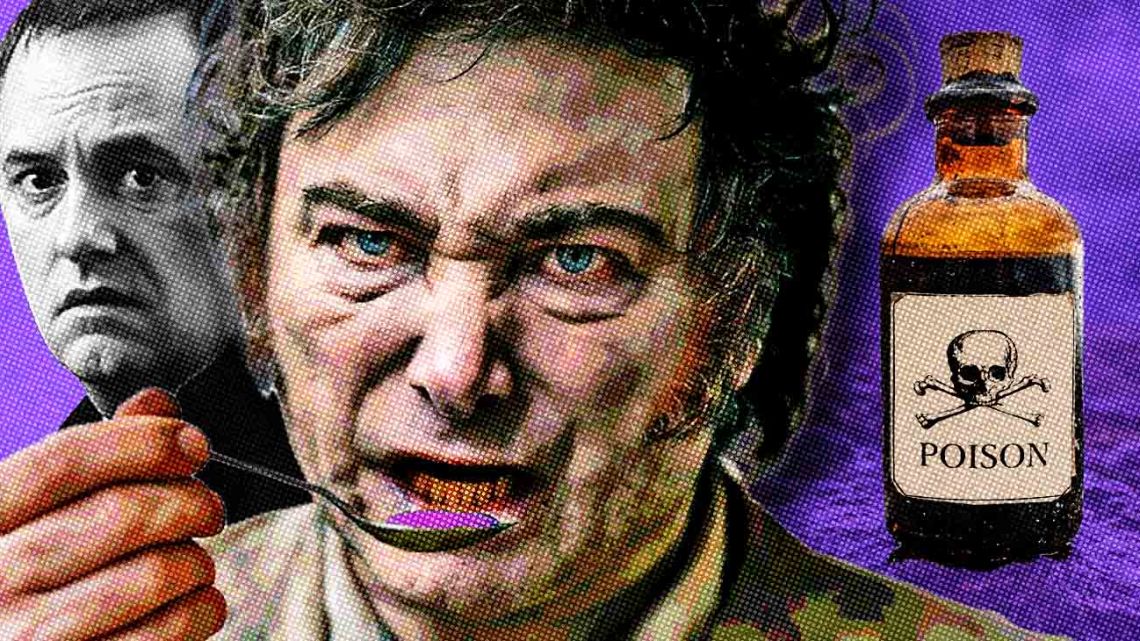
Javier Milei is a man who automatically accuses those who disagree with him of being on the take, so he should have known that if he and his associates did anything that was even a tiny bit suspicious they would get pilloried not just by their ideological foes but also by many who prefer them to whatever the opposition has to offer. This is what tends to happen to holier-than-thou politicians who feel they are morally superior to their adversaries and make a habit of boasting about it.
For over a year, President Milei and his bossy sister Karina have been the target of people who on the whole approve of the government’s economic programme but who nonetheless seem ready to believe that the ruling couple are every bit as corrupt as were Néstor Kirchner, his wife Cristina Fernández de Kirchner and their accomplices who, when in power, helped themselves to billions of dollars of public funds. Even the fiercest critics of Milei’s behaviour have yet to suggest that the money they think he put aside came to even one percent of what was salted away by some of his predecessors in office but, as far as the most vocal are concerned, it is a question of principle, so the amount politicians allegedly pilfer is irrelevant. In their view, saying someone is “slightly corrupt” is akin to saying a woman is “slightly pregnant.”
For several weeks now, Cabinet Chief Manuel Adorni – who like Milei delights in mistreating people who do not share his opinions – has been in the stocks. Bombarding him are a host of upstanding citizens, public-spirited lawyers, journalists and the like who profess themselves appalled by the fact that he took his wife with him on an official visit to New York, let an acquaintance give them a ride on a private jet to Punta del Este and has yet to explain in detail exactly how he got a loan that enabled him to buy a relatively modest flat in an inexpensive suburb. The country’s biggest newspapers have devoted entire pages to delving into Adorni’s affairs. And as was to be expected, individuals who never batted an eyelid when Cristina Fernández de Kirchner and her cronies were looting the country and still think she is the victim of a dastardly right-wing campaign of “lawfare” are gleefully making the most of the opportunity they have been given to get their own back.
Ridding Argentina of all forms of corruption so she can stand alongside such paragons of collective virtue as Denmark and Finland will be even harder than eliminating inflation. For it to happen, millions will have to forget the survival skills that enabled them to keep their heads above water in turbulent times and learn others appropriate for societies in which men and women find it natural to trust those in authority.

Here, people of all walks of life have on occasion had to pay more respect to the unwritten norms than to the ones devised by often crooked lawmakers, so it would not be at all surprising if Adorni – like most members of the sadly depleted middle class – had not done everything entirely by the book. Would that make him a monster of corruption? Perhaps it would in some European countries, where having lied about a traffic offence that was committed 20 or 30 years earlier can be enough to put an end to a distinguished career, but for now at any rate it would be unfair to punish all Argentine politicians who in the past failed to hew to such rigorous standards.
In any event, Milei had better clean up his act. He simply cannot afford to give people who on the whole approve of the main thrust of his economic programme more valid excuses to gang up on him, but this is what he has been doing ever since he reached the Presidency. In addition to insulting economists who dared criticise some of his measures by comparing them to apes, he let journalists know that he thoroughly despised them and their trade and wanted to see the traditional outlets devoured by social media.
That was a serious mistake. It virtually guaranteed that allegations of corruption in high places would quickly become a major issue and that hardly anyone would be willing to give him, or those linked to him, the benefit of any doubt. It also meant that, instead of taking the accusations levelled against him and members of his government with the seriousness they deserved and rooting out any wrongdoers, he dug in his heels and pretended there was nothing untoward going on in his vicinity.

Unlike Mr and Mrs Kirchner and their friends, Milei and the people surrounding him simply have to be honest because their own fate, and that of the country, depends on the willingness of huge numbers of people to make sacrifices in the hope that, after several years of enforced austerity, a reshaped economy will benefit them and those close to them. If too many come to the conclusion that Milei, his sister and the politicians that surround them are a gang of mafiosi like the lot they replaced, the government will be unable to achieve any of its objectives.
By now, Milei and the brighter members of his government must be aware that the widespread belief that Argentina is a singularly corrupt country even by Latin American standards continues to scare off big investors. According to Transparency International, which relies on local “perceptions” of corruption, nothing much has changed in the last two years. Until it does and Argentina acquires the reputation of being a “moderately” corrupt country like Spain or Italy, she will find it difficult to take full advantage of her much coveted natural resources in a world in which, as first the Russian invasion of Ukraine and then the attempt by the US and Israel to defang the terrorist regime in Iran reminded us, their strategic importance and therefore their value is growing fast.






Comments