

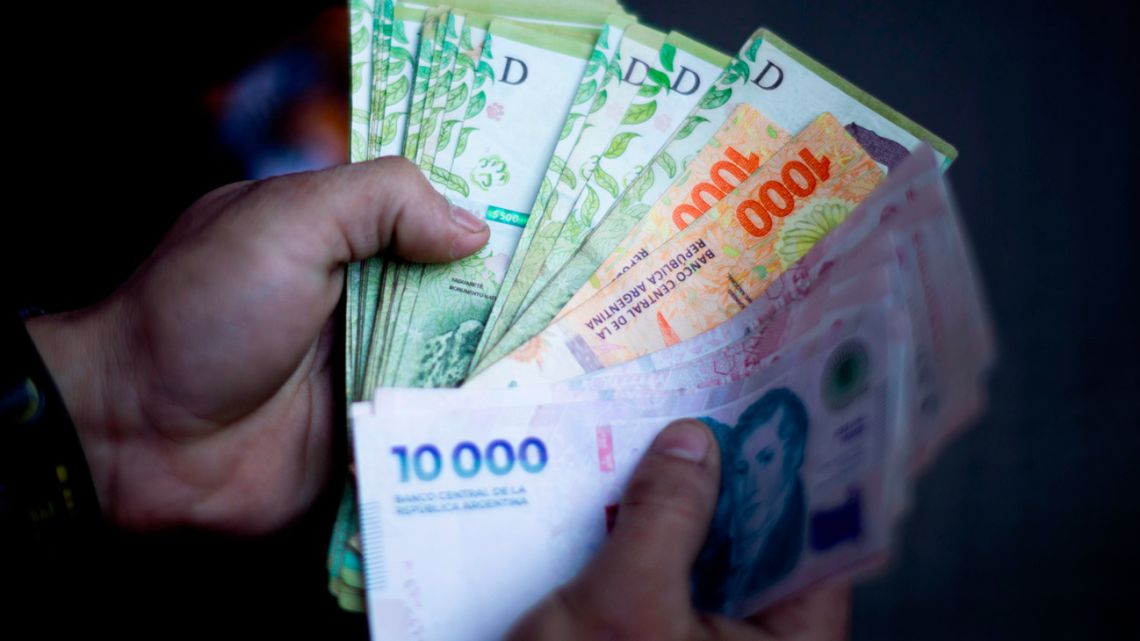
An incipient decline in the Argentine peso is gaining momentum, as investors grow more risk averse and policymakers in Buenos Aires loosen their grip on the volatile currency.
The peso is down about six percent over the last eight weeks, the biggest drop in emerging markets over that time and the currency’s largest fall since the run up to midterm elections rocked the country’s markets last October. It now stands near a five-month low, after erasing a large chunk of its 2025 gains.
Several factors are driving the slide. While the peso trades freely within a range that widens every day, the Central Bank is allowing one-day repo rates – a reference point for investors – to remain below inflation. It has also pulled back from the dollar futures market in May, an arena they’ve tapped to tame their currency. The government will publish new inflation data Thursday.
The shift in strategy comes at a time when investors are expecting weaker financial flows into emerging markets and a stronger dollar globally. Several Latin American central banks are keeping benchmark rates firm or preparing to tighten policy.

In Brazil and Peru, where interest rates are above inflation, economists expect policymakers to raise borrowing costs at least once this year. Forecasts for Brazil’s benchmark rate have moved higher, with analysts now seeing it at 13.5 percent by December. In Peru, authorities have signalled they are ready to raise rates if inflation keeps accelerating. Colombia is holding its rate at 11.25 percent. Mexico is the exception, after a small cut early last month.
But in Argentina, the Central Bank is more focused on the amount of money in circulation than interest rates, which remain around 20 percent compared to inflation expectations over the next 12 months of about 23 percent. The weakening peso is, in part, a reflection of the Central Bank’s new approach.
Over the past 60 days, it accelerated its decline against the dollar, reversing an inflation-adjusted rally that had built up during the first four months of the year, even as prices accelerated by 12.3 percent over that period.

“The market saw the Central Bank’s lower intervention in dollar futures during May as a policy decision to seek a weaker nominal exchange rate,” said Alejo Costa, a strategist at Max Capital in Buenos Aires.
The global backdrop is also playing a role: higher rates are hitting emerging markets, the Brazilian real is weaker, and prices for soybeans, wheat, oil, silver and gold are falling. But that, Costa says, does not explain everything: “The global shock explains 25 percent of the story, no more than that. The rest is idiosyncratic.”
The peso’s renewed weakness bookends Argentina’s crop harvest, when the country tends to receive its largest inflow of dollars. But the amount of greenbacks tends to dwindle in the second half of each year.

In that context, exporters also now appear less willing to sell at these levels. Daily dollar sales by agricultural exporters have missed forecasts and averaged US$142 million so far in the second quarter – 11 percent below last year’s pace, according to industry chamber CIARA-CEC.
After the peso’s real appreciation, some are seeking hedges or refusing to validate the current exchange rate, adding pressure on the currency.
The government may also be trying to avoid entering the second half of the year with a peso that is too strong and vulnerable to an abrupt sell-off as the country gets closer to the 2027 election cycle, Costa said.

After a rush of dollars into Argentina in recent months, market watchers are starting to worry about money leaving.
“We are now more concerned about financial outflows,” Álvaro Vivanco, an emerging-markets strategist at Wells Fargo, wrote in a report to clients this week. The bank closed its recommendations to sell dollars for Argentine pesos. “Argentina has been a popular trade for a segment of investors, and we anticipate some outflows after a strong carry-driven performance.”
Andrés Borenstein, an economist at BTG Pactual who pens a weekly newsletter, said Argentina is also being hit by a broader move in global markets. On the other hand, Argentina’s sovereign risk, another barometer for investors, remains around 500 basis points, near a multi-year low, Borenstein points out, indicating investors may tolerate the peso’s losses for now.

“To some extent, what happened was that the dollar strengthened globally,” Borenstein said. “The real fell, as did most emerging-market currencies. Global markets also had a bad week, and that is not good for Argentina.”
by Ignacio Olivera Doll, Bloomberg













Comments