

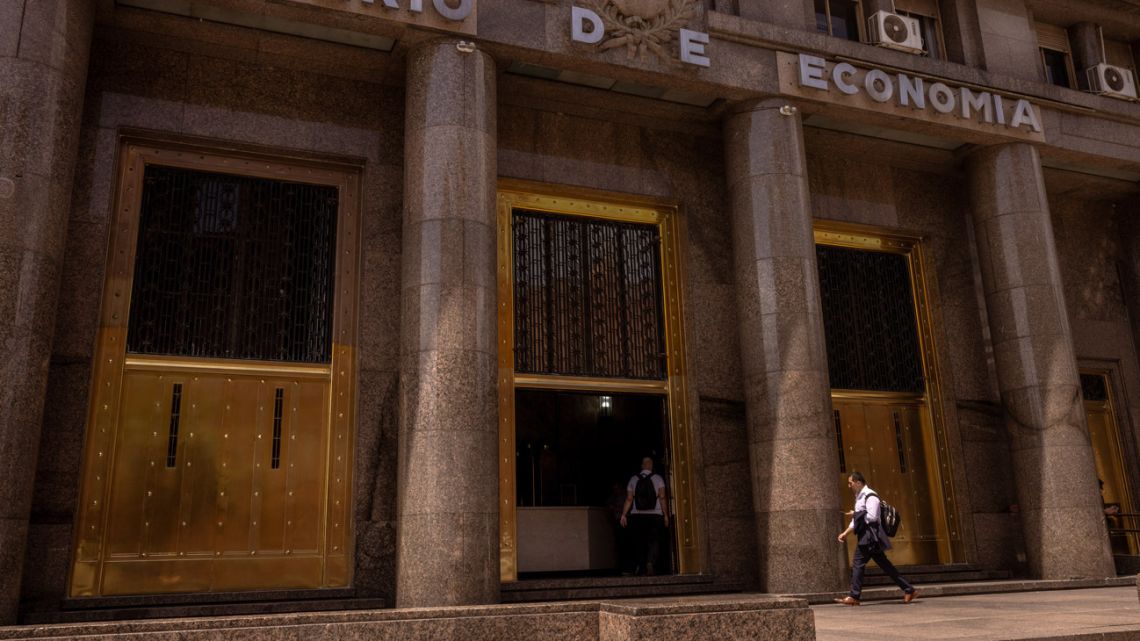
A bond sale planned for Wednesday may be a small step for Argentina’s government at home, but a major move toward a potential return to international debt markets.
Officials and analysts view the deal as a dry run for the country’s eventual resumption of overseas borrowing. The government plans to auction a so-called Bonar under local law, the Treasury’s first dollar bond in five years, and the size of foreign orders will be a key indicator for Javier Milei’s government as it moves toward issuing globally.
Few doubt the deal will draw solid demand from local buyers, as seen in recent corporate and provincial placements. The government has already taken steps to both prevent arbitrage on the sale and to stabilise the currency.
But there’s also “a lot of interest from foreign investors and this is meant to capture their demand,” said Matias Tamburini, chief executive officer of Balanz Capital Valores, a brokerage firm. Argentina could receive between US$2 billion and US$4 billion in orders, largely from real-money funds and overseas banks, he added.

Economy Minister Luis Caputo indicated Tuesday that he plans to seek at least US$1 billion in fresh debt at a yield below nine percent in Wednesday’s offering.
The bond is set to mature in November 2029 and pay a 6.5 percent annual coupon in semi-annual installments, according to the government. Caputo has said a portion of the proceeds will be used to cover upcoming maturities. Argentina faces about US$4.5 billion in bond payments in January, followed by a similar amount that’s coming due in July.
The relatively short tenor is part of the appeal for some investors. “A short duration like this bond is attractive because much of the emerging-market debt universe is 10-year paper and there’s a shortage of shorter bonds,” said Walter Stoeppelwerth, chief investment officer at Grit Capital Group.

Caputo told his team he has lined up international investors who plan to take part in the auction, according to a person with knowledge of the matter. Real-money funds and international banks will be able to take part in the sale through local institutions alongside domestic investors, the person said, requesting anonymity to discuss details that haven’t been publicly announced. The Economy Ministry declined to comment.
Late on Tuesday, the Central Bank unveiled new foreign-exchange restrictions on local players ahead of the sale. Individuals who buy dollars in the FX market to subscribe to the bonds must now hold them for 15 days before selling them for pesos. Meanwhile, banks that buy the bonds and sell them for pesos in the secondary market are barred from buying dollars to rebuild their FX position for 90 days.
Milei responded with enthusiasm to this week’s planned transaction, describing it as a “return to markets” in a post on X. Argentina issues debt locally several times a month.

“There’s a community of portfolio managers who would like to own a bond with a duration of about 3.8 years and a yield in the 11 percent to 11.5 percent area,” Stoeppelwerth said. With average duration for hard-currency EM sovereign debt hovering at around 6.5 years to 7 years, a shorter-dated Argentine bond offers investors a way to diversify interest-rate risk while locking in double-digit dollar returns, he said.
However, there’s still a long way to go before Argentina regains full access to international markets, including structural reforms and sufficient accumulation of reserves, said Juan Manuel Pazos, chief economist at local brokerage One618. “The placement represents a tactical move to mobilize domestic liquidity and compress spreads,” Pazos said, adding that the deal will likely raise US$1 billion to US$1.5 billion, less than the US$4.3 billion needed in January.
In a bid to curb peso volatility ahead of the issuance, Argentina’s Central Bank sold dollars in the official market on Wednesday and in other recent sessions, according to people with direct knowledge of the matter. Given the bank hasn’t reported any intervention in its daily financial statements, the sales are likely being made on the Treasury’s behalf, the people said. The Central Bank declined to comment.

Fluctuations in the government’s own deposits at the Central Bank, where it has less than US$100 million, also suggest intervention. “The daily moves show small but steady sales, and that’s not a positive signal,” said Amilcar Collante, an economist at Profit Consultores, which tracks Treasury dollar holdings alongside sovereign debt payments.
International demand for Wednesday’s sale will hinge on the yield on offer, which in turn depends on the price that clears at the auction. Comparable international bonds issued by the country, for example those maturing in July 2029 and that same month the next year, are currently yielding a 10 percent return. Some reports estimate that the final yield on the new bond, which will mature in November 2029, could be 11 percent or 12 percent.
Caputo said the government deliberately chose a local-law structure to circumvent the so-called Guzmán law, a 2021 statute that requires congressional approval for new hard-currency bonds under foreign jurisdiction and forces the government to improve at least two of three financial terms – maturity, coupon or principal – in any foreign-law exchange. Issuing under domestic law gives officials more room to remain outside that framework.

Argentine markets have rallied sharply since Milei’s party exceeded expectations in October’s midterm elections. Sovereign yields have fallen to around 10 percent, roughly six percentage points over comparable US Treasuries, which is close to the levels that Caputo has highlighted as attractive for a new issue.
The minister said last week the government is “very confident” that Argentina’s country risk will continue to fall and that “we are the closest we’ve ever been to having access to markets.” Banks have already presented offers totalling US$6 billion to US$7 billion, as the government decides how much to borrow, Caputo said during an event in Buenos Aires.
“Strong demand from abroad would send a powerful signal that Argentina is back on the radar of global credit investors,” Tamburini said.
related news


by Ignacio Olivera Doll, Bloomberg












Comments