

Lawmakers in Mendoza Province on Tuesday approved a controversial mining project despite fierce opposition from thousands of local residents who fear its environmental impact on access to water.
Following a vote in the provincial lower house, Mendoza senators endorsed a package of copper and gold mining proposals that have the support of President Javier Milei’s national government.
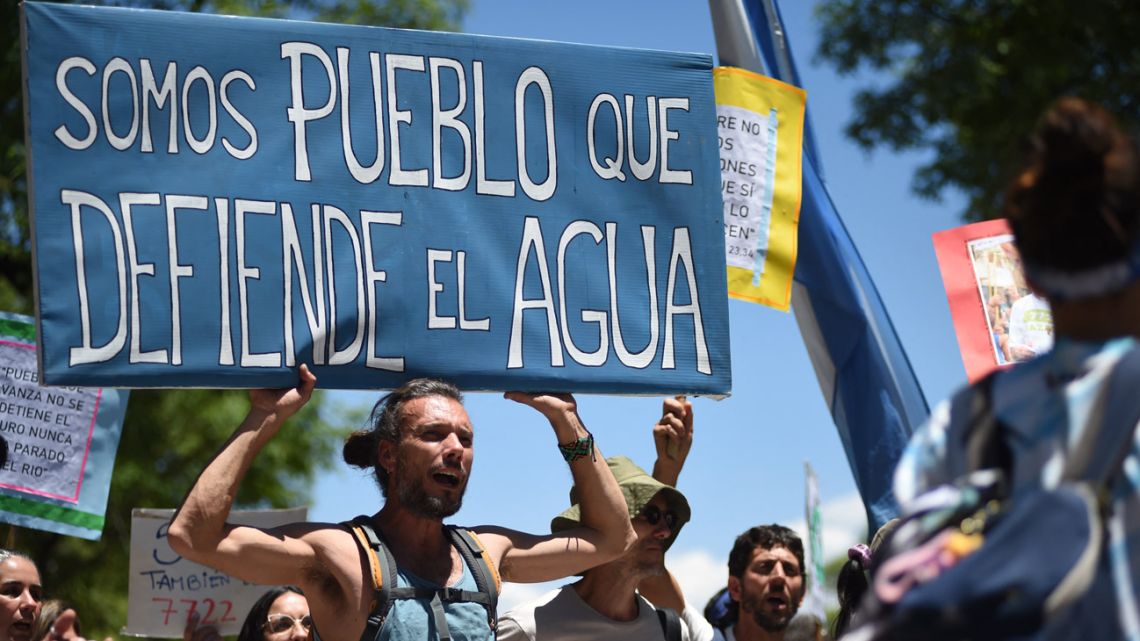
Ahead of Tuesday’s legislative debate, protesters have rallied in the provincial capital to pressure lawmakers to reject the proposals. Highlighting concerns over mining projects and their impact on the local area, many held up signs reading: “El agua de Mendoza no se negocia” (“Mendoza’s water is not up for negotiation”).
Local authorities deployed a large security operation involving more than 500 police officers and fencing blocking off access to the legislature.

Named “San Jorge,” the Uspallata project – in Argentina’s west, near the Chilean border, – involves an investment of more than US$500 million.
The bill authorises the development of the mining concession and clears the way for an open-pit copper mine and gold operation across the defined parcels of the project area.
It is backed by provincial Governor Alfredo Cornejo, a leader from the Unión Cívica Radical (UCR). An environmental impact statement of the project was approved by a wide majority in both chambers.

“San Jorge is the gateway for Mendoza to engage in mining and position itself globally as a province with mining potential,” ruling-party senator Natacha Eisenchlas said in closing the debate.
After the vote, the project’s CEO, Fabián Gregorio, said in a statement that approval “allows us to take another step” and that “a phase of technical feasibility work now begins.”
Resistance
The project has faced resistance from local residents. In recent weeks there have been demonstrations in towns such as Uspallata, San Carlos, Lavalle and the provincial capital of Mendoza.
A group of around 2,000 protesters – made up of assemblies from different towns in the region, social organisations and members of political parties – set off in a caravan early Monday, marching from Uspallata, the epicentre of the main mining project, to the local legislature.
The two-day “Asamblea por el Agua de Uspallata” covered over 100 kilometres, passing through Potrerillos, Cacheuta, Blanco Encalada and Luján de Cuyo before reaching the capital on Tuesday.
All along the route stopping points every seven or eight kilometres had been organised for water, food and rest zones, permitting more people to join the march on bicycles or in vehicles.
Parallel caravans from Lavalle, Valle de Uco and Eastern Mendoza joined the rally as it approved the capital.
The rallies were the largest mobilisations by the Mendoza environmental movement since the mass demonstrations of 2019 against Law 7722.
Critics say the Proyecto San Jorge bill – recently rebranded PSJ Cobre Mendocino (Mendoza Copper) – represents a grave risk to the availability of water in the region.
“Most scientific reports are negative or worrying,” said Carlos Russo, a member of the Pure Water Assembly of Las Heras – the jurisdiction to which Uspallata belongs.
“It is an area of pristine waters, of springs, and downstream, there are one-and-a-half million of us living there,” he added.
Opposition Peronist Senator Félix González (Partido Justicialista) argued that the project’s environmental impact statement is inaccurate. He predicted that legal action was “almost certain.”
Milei-backed bill
On Monday, President Milei waded into the row, describing the push as “an enormous opportunity for Mendoza.” He said that it would bring in “an investment of US$500 million to mine 40,000 tons of concentrated copper annually.”
"To nobody’s surprise, Kirchnerism is not joining in, following their line of the last 25 years of always being against the private sector, investment, progress and employment,” said the head of state.
The President also declared his support for the province, describing it as “highly competitive.”
“Mendoza has positioned its emblematic wines in the most demanding markets of the world. With the same competitive level, it is now seeking to position itself as a mining producer.”
He also pointed out that the “new” Argentina will grow via “the three main vectors of the economy: agriculture, energy and mining.”
Milei has repeatedly stated his desire to turn Argentina into a major copper-exporting power, following the example of neighbouring Chile, the world’s leading producer with reserves greater than Argentina’s.
The national government plans to send a bill to Congress in the coming days that would reform Argentina's Glacier Protection Law. The initiative aims to give provinces more freedom to move forward with mining projects.
According to the Cámara de Empresas Mineras, Argentina could triple its copper exports – about US$4.6 billion in 2024 – by 2032.
– TIMES/AFP/PERFIL












Comments