

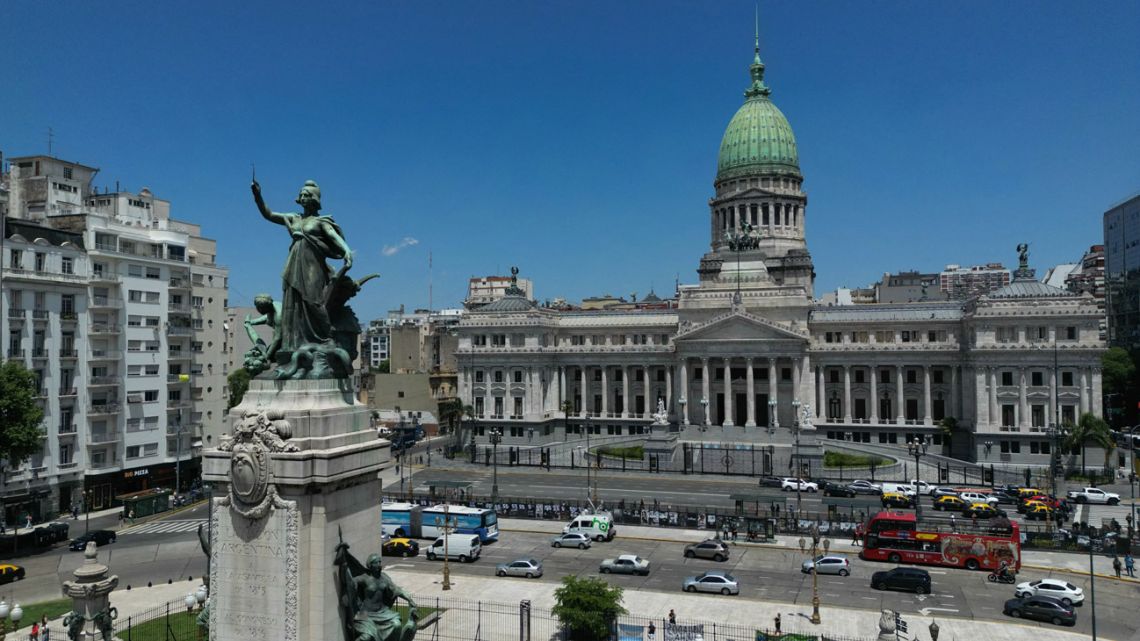
President Javier Milei entered the second half of his term on Wednesday with greater representation in Congress after his party’s victory in October’s midterm elections, although he will still need to negotiate to get his controversial reforms approved.
The new make-up of Congress, with the ruling party nearly tripling its seats, coincides with Milei’s call for special sessions running through to the end of the year. Among other priorities, the government has targeted approval of its 2026 Budget bill and will push ahead with labour, criminal and tax reforms.
The victory of Milei’s La Libertad Avanza party in the October midterms, facilitated by a multi-billion-dollar lifeline from his ally and US counterpart Donald Trump, has strengthened the President's hand, though he still lacks a majority in Congress.
To deliver his promised reforms, Milei will likely need to rein in his fiery temperament, refrain from insulting opponents and cultivate a more conciliatory profile to foster alliances with provincial governors, who are hungry for funds after two years of “chainsaw” cuts and austerity.

On the fiscal front, the government is promoting a “presumption of innocence” tax bill, which raises the thresholds that define tax evasion and shortens the statute of limitations, along with another bill that would ban budget deficits. It also intends to toughen Argentina’s Penal Code.
According to officials, Milei’s labour reform bill will seek to make hiring rules more flexible, redefine compensation calculations and overhaul the existing system of collective bargaining agreements.
The proposals have met resistance from leading trade union federations and groups.

Milei’s government also plans to amend Argentina’s Glacier Protection Law – the government argues that the protected areas “are not well defined” and proposes that each province determine the area to be preserved, in order to encourage mining.
Environmental organisations and local communities have already signalled resistance to any easing of the current protections.
Strength and fragility
“The path for moving forward with some of the reforms is fairly clear because opposition governors are willing to reach an agreement,” said Sergio Morresi, who holds a doctorate in Political Science from the University of São Paulo and teaches at Argentina’s National University of the Littoral. “There is a mutual willingness to negotiate.”
The crisis facing the Peronist opposition, which is still searching for someone to blame for its electoral defeat, has eased Milei’s path.
“Until internal disputes within Peronism are resolved, it’s unlikely the opposition will be able to regroup,” Morresi warned.
The expert said that Milei’s political strength is fragile, as it depends on the economy remaining relatively stable – and that stability, in turn, depends on signals of support from the United States.
Political analyst Rosendo Fraga, meanwhile, said that “the negotiating spirit shown by the governors may change if their demands aren’t met,” particularly when it comes to budget allocations.
In the Senate, agreements would allow the government to reach a simple majority. It is a “fragile” majority, Fraga argued.
New Interior Minister Diego Santilli, an experienced political operator, “has managed to open dialogue, but not yet secure agreements”, the analyst noted.
But in the lower house, the situation is more complex for the government. Out of 257 seats, La Libertad Avanza holds 95 and needs 34 more to reach the quorum required to open debate, meaning it will have to build alliances.
“The government may manage a working majority in the lower house, but it is unlikely to secure a permanent caucus. Politics is fluid,” Fraga said.
All of this unfolds against the backdrop of an exhausted economy, with tens of thousands of jobs lost, a battered industrial sector, rising job insecurity and inflation that, while having eased earlier, has now clocked in above two percent per month for three consecutive months.
With more than US$10 billion in debt payments coming due in 2026, the outlook remains challenging.













Comments