

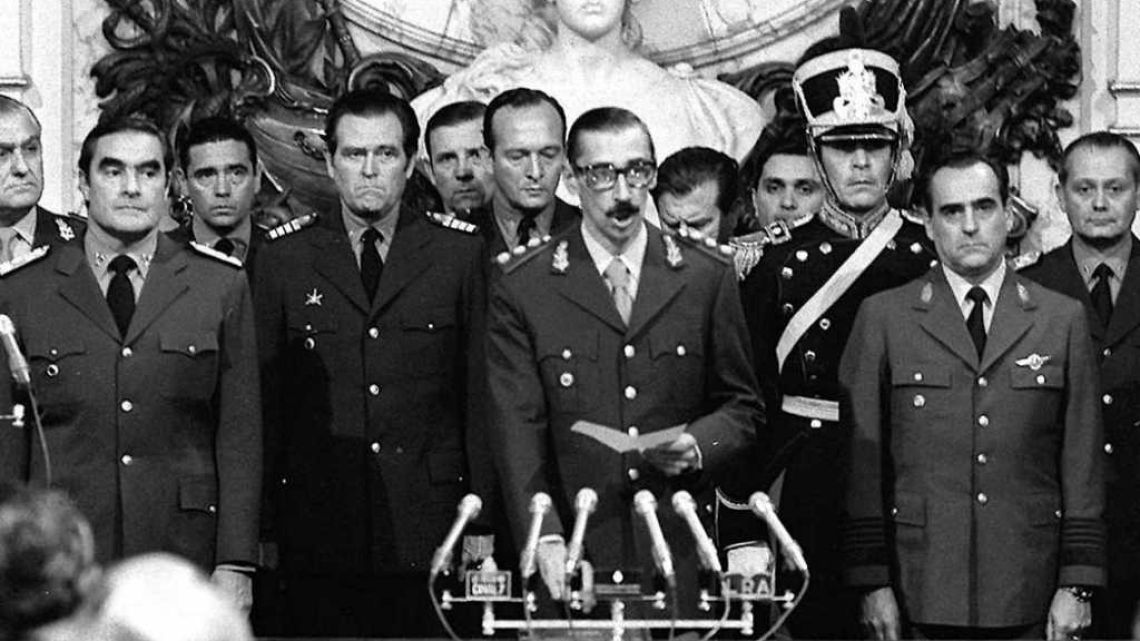
Fifty years after the March 24, 1976 coup that ushered in Argentina’s last military dictatorship, more than two-thirds of the population rejects the regime and supports continuing trials for crimes against humanity, according to a new nationwide study.
Research conducted by the Pulsar observatory at the University of Buenos Aires and the Centre for Legal and Social Studies (CELS) rights group found that 71 percent of Argentines hold a negative view of the brutal military junta that ruled between 1976 and 1983.
Of those surveyed, 45 percent described the regime as “very bad” and 26 percent as “bad,” while only around seven percent expressed a positive opinion.
The Pulsar survey also shows strong public backing for ongoing judicial processes against those responsible for human rights violations under the dictatorship. Some 70 percent of respondents said the state should continue prosecuting military officers for crimes against humanity, with 26 percent against.

The findings suggest that the state policies of memory, truth and justice pursued in Argentina since the return to democracy continue to shape public attitudes towards the dark period.
The dictatorship remains widely associated with state repression. When respondents were asked what first comes to mind when thinking about the junta’s years in power, the most common answers were the disappeared, repression, violence and torture.
The Pulsar-UBA-CELS survey also found that 63 percent of citizens believe there were little or no reasons that justified the military overthrow of the constitutional government of president María Estela Martínez de Perón. Twenty-seven percent saw cause, whether sufficient or not.

Interpretations of the period, however, are not completely uniform. While 61 percent describe the regime primarily as a dictatorship that implemented a systematic plan of disappearances and human rights violations, 32 percent view it instead as a campaign against terrorism in which “excesses” were committed.
Researchers say the gap reflects an ongoing debate over how the period is remembered, though underline that the overall judgement of the regime remains overwhelmingly negative.
Collective memory
The study also points to a generational shift in how knowledge of the dictatorship is transmitted.
Seven in 10 respondents say they know “a lot” or “something” about what happened between that dark era but direct personal experience of the repression has become less common – only around 30 percent of those surveyed said they have a friend, relative or acquaintance who was detained, persecuted or forcibly disappeared during the dictatorship.
Instead, education has become the main source of information about the period. Forty-four percent of respondents cited school or university as their primary source, followed by conversations with family members or friends.
Researchers describe this process as a transformation in the way collective memory is passed down as the generation that lived through the dictatorship gradually disappears.
The survey found that support for democratic rule remains strong. Seventy-eight percent of respondents said democracy is preferable to any other form of government while only 10 percent believed that an authoritarian system might be preferable under certain circumstances.
In a sign of democratic health, 83 percent said they believe a new military coup in Argentina is unlikely.
Additional polling underlines public support for democracy. In a recent survey by the Zuban Córdoba consultancy firm, published in the lead up to the anniversary, 63 percent of respondents ranked the democratic system as their preferred form of government, with 12 percent choosing an authoritarian system and 13.54 percent recording no preference.
The findings come as the country prepares to mark the 50th anniversary of the coup that installed the military junta initially led by Jorge Rafael Videla, Emilio Massera and Orlando Agosti.
Human rights groups estimate that some 30,000 people were forcibly disappeared during the military regime during the era of state terrorism.
Anniversary rallies
Human rights organisations, cultural groups and neighbourhood associations have organised a series of events throughout March to commemorate the anniversary and reflect on the legacy of the dictatorship.
At the Espacio Memoria y Derechos Humanos complex at the ex-ESMA Navy Mechanics School, once one of the regime’s most notorious clandestine detention centres, activities include exhibitions, educational workshops and a community “embroidery vigil” that will create a large banner to be taken to the March 24 mobilisation.
Other initiatives include neighbourhood marches, book fairs and campaigns led by the Abuelas de Plaza de Mayo rights group encouraging schools, trade unions and social organisations to create and decorate the white headscarves that symbolise the group’s decades-long search for children stolen during the dictatorship.
The events will culminate on March 24, the anniversary of the coup, with a mass demonstration expected to march to Plaza de Mayo.
According to the Pulsar survey, around 23 percent said they had joined the annual demonstration,
This year’s anniversary comes amid renewed debate over how the period is interpreted in Argentina.
Since taking office in December 2023, President Javier Milei’s government has challenged the widely accepted narrative surrounding the dictatorship and criticised state policies focused on memory, truth and justice that have been established over the past two decades.
Rights groups have also expressed concern about changes affecting programmes linked to historical memory and the legal teams representing the state in ongoing trials related to dictatorship-era crimes.
The March 24 mobilisation will serve as a reminder of the dictatorship’s crimes and a reaffirmation of public support for democracy.










Comments