

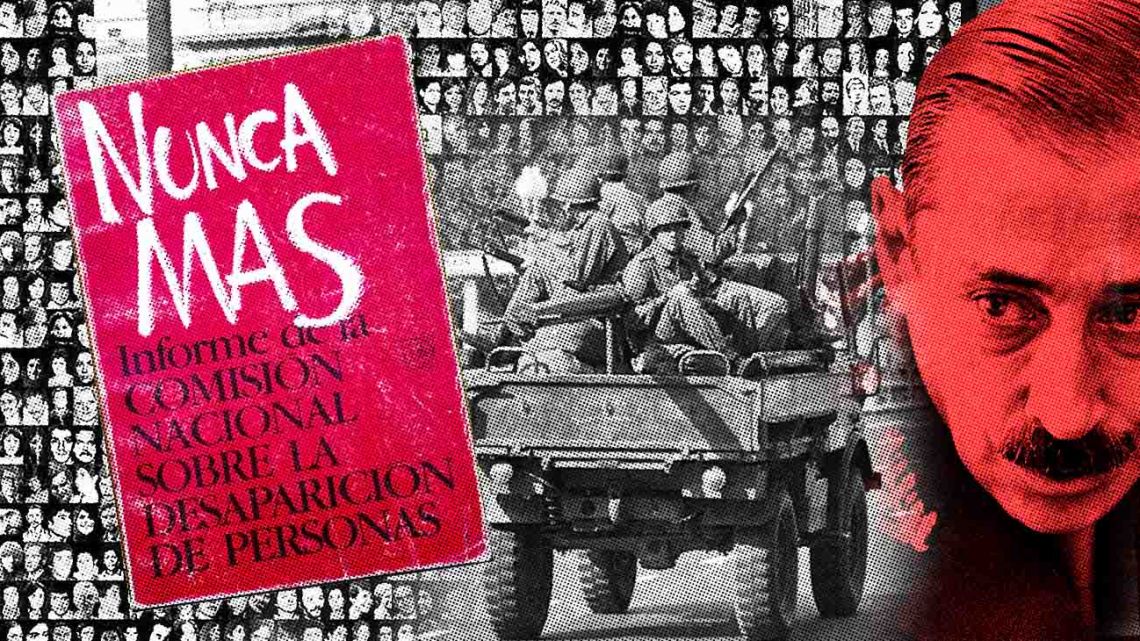
At the time, some called what happened on March 24, 1976 “the clockwork coup,” because everything about it had been so predictable. For months, Argentines had taken it for granted that, sooner rather than later, the armed forces would brush aside Isabelita’s shambling government and replace it with a stern but, on the whole, fairly level-headed regime led by that soft-spoken moderate general Jorge Rafael Videla.
Few found the prospect alarming or even regrettable. In this part of the world, it was then normal that, after a period of populist chaos, the men in uniform would have no choice but to step in and restore a semblance of order and do their best to modernise a notoriously underperforming economy. On this occasion, they were also expected to rid the country of the terrorist bands that, since the late 1960s, had made a habit of murdering politicians and trade unionists, kidnapping businessmen for ransom and mounting assaults on police stations and army barracks.
Just how many people either supported the regime that took over the country or – if they had any democratic scruples, were willing to give it the benefit of the doubt – is impossible to say, but it may well have had the backing of a majority. However, unfortunately for them, the junta members had no interest in giving their rule a patina of legitimacy by calling a referendum; the military chiefs were against elections or anything associated with them on principle and frowned on opinion polls. This meant that, unlike their Chilean counterparts, after their downfall they were unable to remind their critics that, for several years at least, much of the population had been on their side.
In any event, it was soon evident that Videla’s junta would not be like the bossy and slightly conservative but on the whole fairly mild administrations of Juan Carlos Onganía or Alejandro Agustín Lanusse, presidents (de facto, as it became de rigueur to point out) who seemed to worry more about men wearing beards and girls wearing miniskirts than about problems raised by violent extremists. Unlike such predecessors, Videla and company had to face the challenges thrown down by organisations of terrorists convinced they had history on their side, the main ones being the Montoneros, which after starting life on the far right of the ideological spectrum had migrated towards the Third World Left that was then in fashion, and the Marxist “People’s Revolutionary Army,” or ERP.

Dealing with them was clearly necessary, but the way the regime chose to go about it could hardly have been worse. Instead of working within the law, as it could have done, it allowed the terrorists to make the rules by applying methods that would surely have merited the wholehearted approval of Mao Zedong, Fidel Castro and the Iranian theocrats but which, even in difficult circumstances, are repudiated by most civilised Westerners.
Military strategists were strongly influenced by what the French had done in their doomed attempt to make Algeria an integral part of their own country, even though most of the population had very little in common with them. They were also influenced by the example given by Juan Domingo Perón who, shortly before his demise, had in effect institutionalised State terrorism by sponsoring, along with his guru José López Rega, the Triple-A, whose fascistic members immediately showed themselves to be every bit as bloodthirsty as their avowedly leftist foes.
In any event, while the terrorist groups proved attractive to disgruntled urban intellectuals, they never enjoyed much support among the population at large, so treating them as if they did made little sense. Nonetheless, for military officers wanting to believe they were fighting an immensely important war on behalf of the nation, the temptation to exaggerate their importance soon became irresistible. It was a mistake which would have appalling consequences, not just for their enemies but also for many of their own comrades who would spend decades behind bars for obeying orders.

Two months after the coup, in an article titled ‘Civilisation and Savagery,’ I wrote: “One special danger presented by terrorism of any political colour is its effect on the security forces themselves. Men fighting a treacherous, slippery, hydra-headed foe, which has no scruple as to method, are often tempted to fight back in a similar manner.” Needless to say, such cautious comments and other, rather more vehement ones that followed in articles with titles like ‘Beware of the Butchers’ in August of that year, had no effect on official thinking. Though many military men were becoming aware that if democracy were restored, as they insisted it would be after they had purged the system of its many ills, the top brass and many lower-ranking officers and NCOs would have to face an Argentine version of the Nuremberg Trials. However, within a few months the die had already been irrevocably cast.
But it was not the systematic abuse of basic human rights that did for the “Process.” Several years had to go by before it became a major issue. It lost support because of its failure to improve the country’s economic performance. This was not surprising; many senior officers shared with their civilian contemporaries the excessively optimistic beliefs of the Peronist and Radical leaders who had made Argentina a byword for short-sighted economic folly and had no time for anything smacking of austerity. Their inability to defeat inflation led to public unrest and then – in a desperate attempt to distract attention from their woes – they started a war in the South Atlantic, which they lost.
After that, they knew the game was up. While retreating from power, they crossed their fingers and hoped that the Peronist candidate, Italo Argentino Luder, who had promised to forget all that unpleasantness about human rights, would beat the Radical Raúl Alfonsín in the upcoming elections.

Alfonsín won and to his great credit put the military chiefs responsible for what had happened on trial, but the main beneficiaries of the public’s belated interest in human rights, which until then had been a niche concern not only here but in most Western countries, were not the Radicals but the Peronists. While the Process lasted, Néstor Kirchner and his wife Cristina Fernández de Kirchner were among its friends. After it was buried, they changed into life-long human-rights warriors, as, indeed, did many surviving terrorists who claimed they had taken up arms in defence of the bourgeois democracy that until then they had thoroughly despised and, thanks to Mr and Mrs Kirchner, were rewarded at public expense for their alleged contribution to its restoration.



Comments