

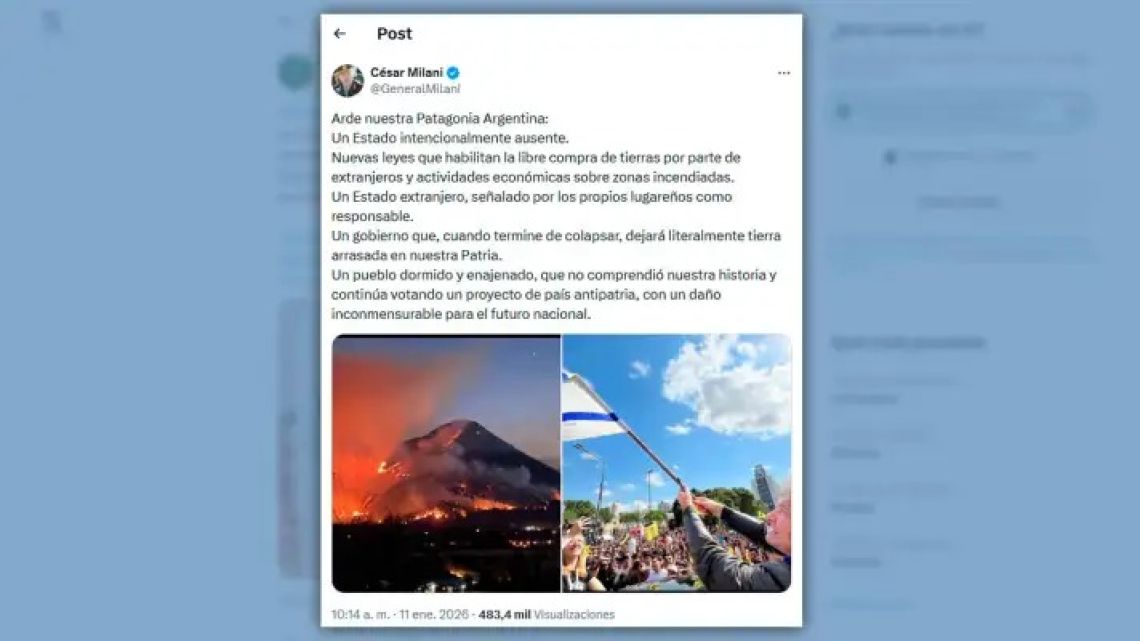
Viral messages on social media attributing raging forest fires in Patagonia to alleged Israeli plans to populate the region, reviving centuries-old conspiracy theories.
The claims prompted accusations of anti-Semitism from Jewish organisations in Argentina this week.
"I want the Jews out of my country" and "the Israelis are burning Patagonia" are some of the messages circulating in Spanish and, with adaptations, in at least five other languages on social networks.
Authorities in Argentina have confirmed the fires were started deliberately, but have not identified those responsible.

To date, more than 15,000 hectares of land have been consumed by the flames.
"As for the perpetrators, we still don't know," said Carlos Díaz Mayer, a Chubut Province prosecutor,on Tuesday.
However, messages attributing the fires to foreign interests – especially Israeli ones – are multiplying rapidly on social media. Many of the posts link them to an ongoing debate about potential changes to laws regulating rural land ownership by foreigners and non-residents and the later use of areas affected by fire.

For example, there is a photo circulating of a grenade that users claim is of Israeli origin and was used to start the fire. This is false – authorities in Chubut confirmed the explosive was discovered in December but said it was produced by the national firm Fabricaciones Militares.
On Monday, the Argentine Zionist Organisation issued a statement denying that the fires were started by Israelis and denouncing the claims "as part of some kind of conspiracy.”
It also highlighted the seriousness of the "reappearance of the so-called 'Plan Andinia,' an anti-Semitic libel with no historical or political basis.”

The conspiracy theory that Israel wants to take over Patagonia and establish a Jewish state there has been circulating since the 1960s. It gained momentum in the 1970s.
The theory has its roots in the late 19th-century anti-Semitic pamphlet "The Protocols of the Elders of Zion," which accuses Jews of conspiring to dominate the world, said historian Ernesto Bohoslavsky of Argentina's CONICET scientific research institute.
These types of narratives, "that seem to explain complex processes very simply," are appealing, especially on social media, the expert said.

"The story is always being updated. In 2001-2002, for example, there was a version that Argentina was going to sell part of Patagonia to pay off its foreign debt," he added.
Mauro Berenstein, the president of the DAIA (Delegación de Asociaciones Israelitas Argentina) Jewish community group said in a post on X this week that pointing fingers without evidence "reinforces an anti-Jewish narrative and hatred."
– TIMES/AFP













Comments