

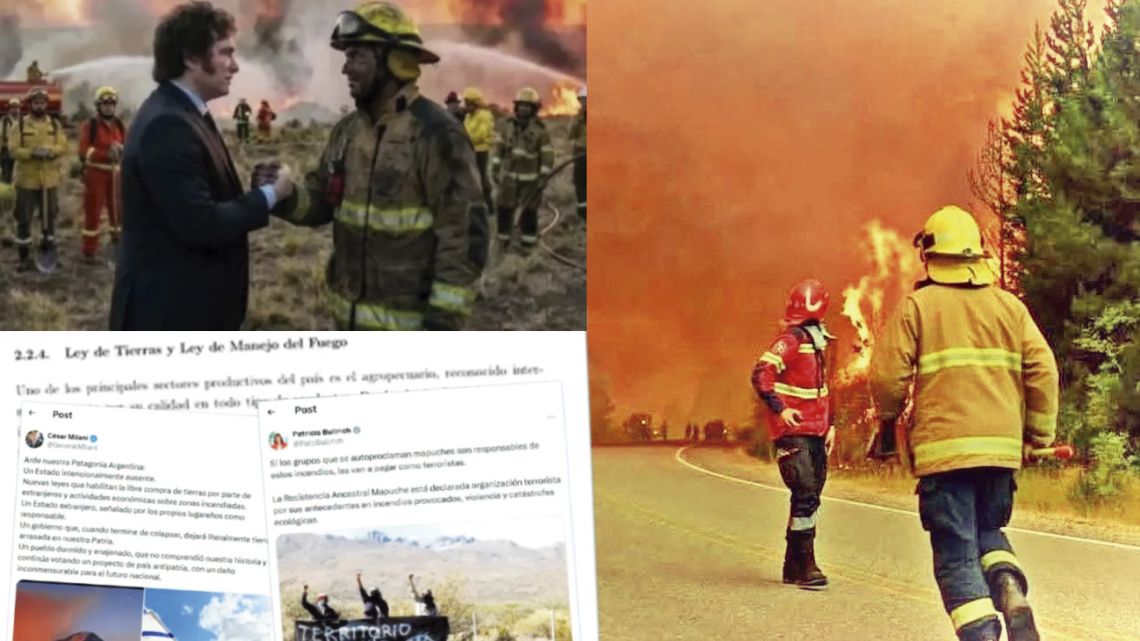
An Israeli-Jewish plot, accusations against the indigenous Mapuche community and allegations against real-estate business interests are just some of the theories circulating about the origin of the devastating fires burning in Patagonia. These stories are being replicated on social media, without any kind of verification, but they are also being pushed by political leaders and public figures who are seizing the opportunity to push their own agendas.
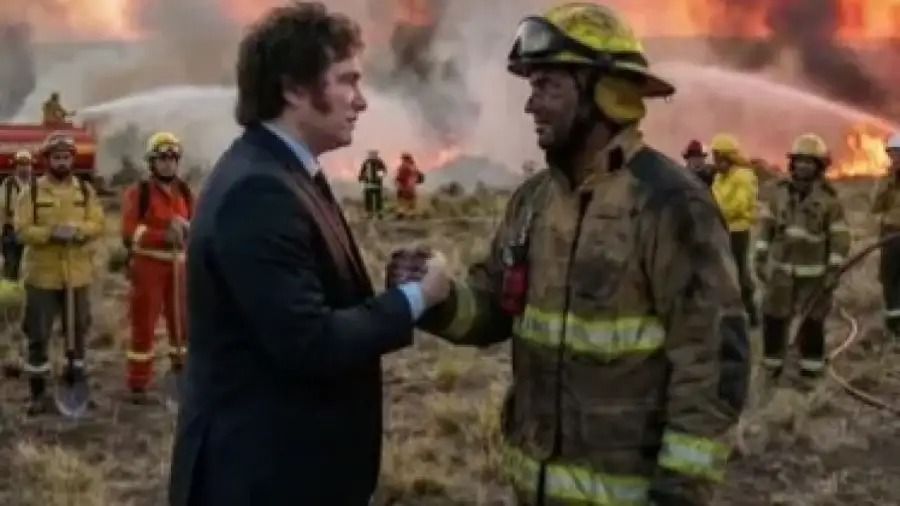
Even President Javier Milei has gotten in on the act, going so far as to publish an image generated with artificial intelligence in which he is seen holding the hand of a forest firefighter – despite not even setting foot in Argentina’s south in recent weeks.
It’s as if there is a tailor-made explanation for every individual and their own biases. Fake news about the fires raging in Chubut Province and nearby regions spreads in different formats: memes, images that mimic newspaper headlines, tweets written in a supposedly revelatory tone, carrying eye-grabbing emojis. It is a phenomenon typical of our times, but it takes on a different dimension when it becomes the language of officials or media stars.
The Chequeado fact-checking organisation, which is dedicated to verifying information, is tracking the most widely circulated digital narratives. It rejects the hypotheses blaming Israelis and Mapuches. The site’s journalists interviewed the chief prosecutor of Lago Puelo, Carlos Díaz Mayer, who said that “they are an invention.” As he later confirmed at a press conference alongside Chubut’s Chief of Police Andrés García, the main line of investigation is that the fire was deliberately started in the context of a land dispute between groups who live in the area.
Investigation and claims
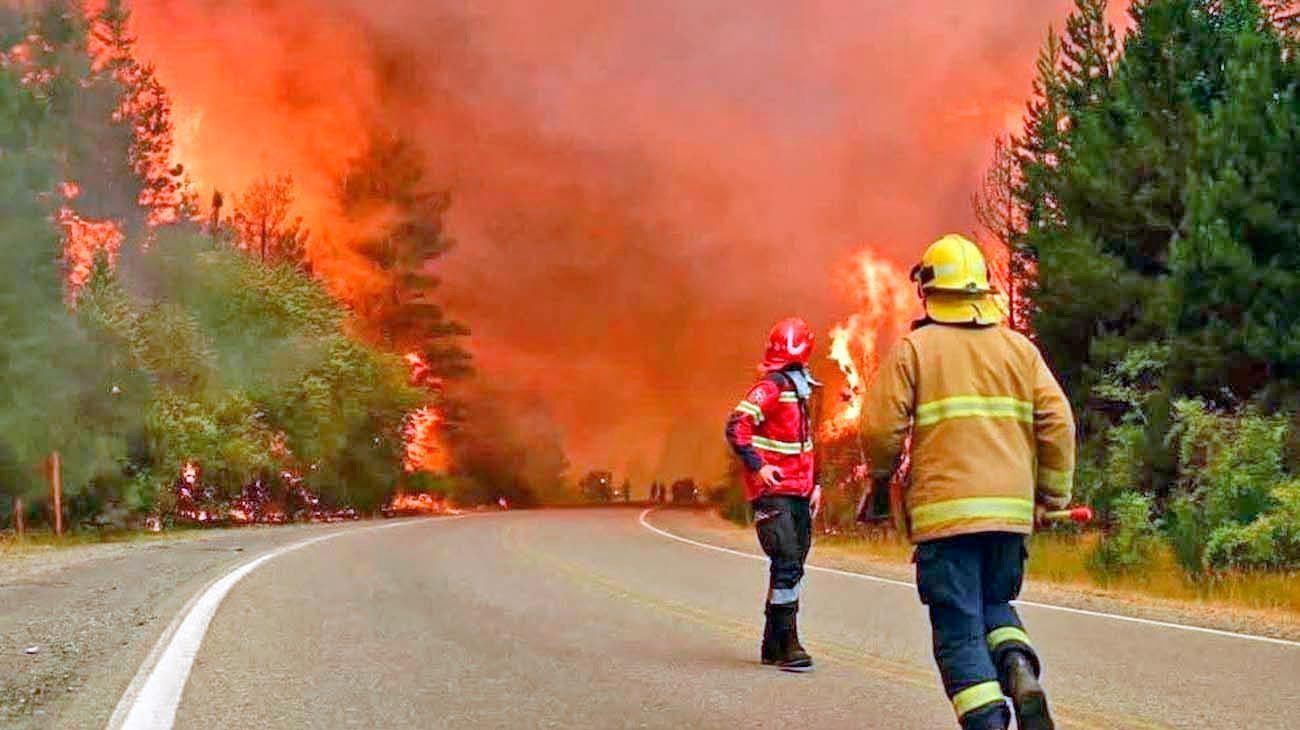
So far, Argentina's Judiciary is working on the hypothesis that the fire began as a result of a deliberate human act. The fires affecting the picturesque towns of El Hoyo and Epuyén started on January 5. Initial forensic examinations detected the presence of accelerants in the soil.
Across the province, a thesis linking the fires to real-estate speculation took hold rapidly – and not by chance. In Chubut alone, between 2019 and 2024, some 148,000 hectares were lost to fires. Many in the region say the objective is to destroy land, so that it can later be sold on cheaply to interests in production and manufacturing.
This hypothesis was one of the most widely circulated. The provincial government has pushed back. Chubut Province Governor Ignacio ‘Nacho’ Torres has lashed out at journalists who have raised the theory in the media. “As long as I am governor, not a single hectare of native forest will be sold in my province, whether burned or not, because our Constitution prohibits it under Article 105. And in the case of Los Alerces National Park, which is a World Heritage Site, it is technically impossible,” he declared.
According to the governor, “there are many conspiracy theories that are deliberately spread to frighten, confuse or politicise.” Torres has called for “responsible reporting” and alleged, without providing further details, that after a most recent fire in Lago Puelo, lands were illegally occupied by outsiders. “Buses were coming from other provinces, many from Buenos Aires Province, and they are still settled here,” he said.
The speculation has put renewed scrutiny on Argentina’s ‘Ley de Manejo del Fuego,' or Fire Management Law. In 2020, at the initiative of Peronist lawmaker Máximo Kirchner, the law was amended to prohibit agricultural activities, subdivision and the sale of land that has been burned for a period of between 30 and 60 years.
In recent days – especially on social media – claims have been circulating that Milei’s government repealed this legislation (it has not) and intends to amend the ‘Ley de Tierras,’ or Land Law to ease rules on purchases. This claim was often combined on social media with a previous publication by the Observatorio de Tierras (Land Observatory), made up of researchers from CONICET national scientific research council and the University of Buenos Aires, which revealed that 13 million hectares of land in Argentina are in foreign hands (around five percent of national territory). The study warned that in 36 districts, foreign ownership exceeds the permitted 15 percent. In the lakeside town of San Martín de los Andes, 54 percent of land is no longer Argentine-owned.
It is false that Milei has repealed the Fire Management Law and the Land Law, but the government does intend to modify them. A document published by the Consejo de Mayo (May Council) in December 2025 is clear on that: its members recommended liberalising land purchases by private foreign individuals (state entities would still require authorisation) and eliminating the ban on exploiting land after it has been burned.
Bullrich versus the Mapuches
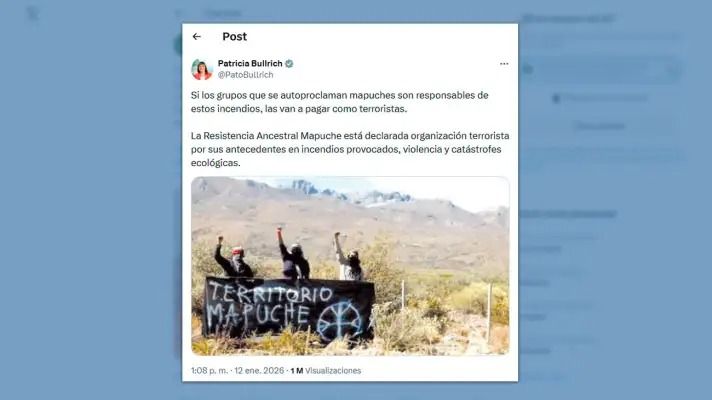
Another popular hypothesis pinned the blame for the fires on the indigenous Mapuche community. This theory even had a promoter: former national security minister and La Libertad Avanza Senator Patricia Bullrich. She wrote on social media: “If the groups that proclaim themselves Mapuche are responsible for these fires, they will pay for it as terrorists. The Resistencia Ancestral Mapuche [Mapuche Ancestral Resistance, or RAM] has been declared a terrorist organisation due to its history of arson, violence and ecological catastrophes.”
The former minister accompanied her message with a photo she had previously posted last February, when she announced that RAM had been added to Argentina’s public register of terrorism and terrorists. It was an image highly conducive to virality: people with their faces covered, fists raised, carrying an aura of violence.
On X, Bullrich’s attempt to link the fires to the Mapuches earned her all kinds of criticism. Some questioned her use of the conditional tense and the lack of alignment between her statement and the judicial investigation. Others mocked the comparison, comparing RAM to the ‘Cártel de los Soles’ (Cartel of the Suns), the alleged group in Venezuela that was used as a pretext by the US government to snatch Nicolás Maduro after it had been declared a terrorist organisation. When Maduro finally appeared in US court, the cartel claim had been dropped.
Bullrich did not respond to any of these messages. But it is known that since the disappearance and death of Mapuche activist Santiago Maldonado in 2017, she has taken any chance possible to criticise the indigenous community and portray it as an internal enemy of the state.
The 'Israeli angle’
“I acknowledge that my comment contributes to the irresponsible circulation of hate speech, which is always the prelude to higher levels of violence, especially when it comes from a public figure,” said Marcela Feudale on Radio 10 this week. She made the remark after previously stating that the fires in the south had been started by two Israelis.
Feudale took responsibility for her mistake and apologised. However, the journalist and radio host was not the originator of this hypothesis, which has been endlessly replicated online, especially on Elon Musk’s X. This fake narrative combines anti-Semitism with antimileísmo and fear of foreign land purchases. Argentina’s judiciary and prosecutors do not consider this a plausible lead in their investigation.
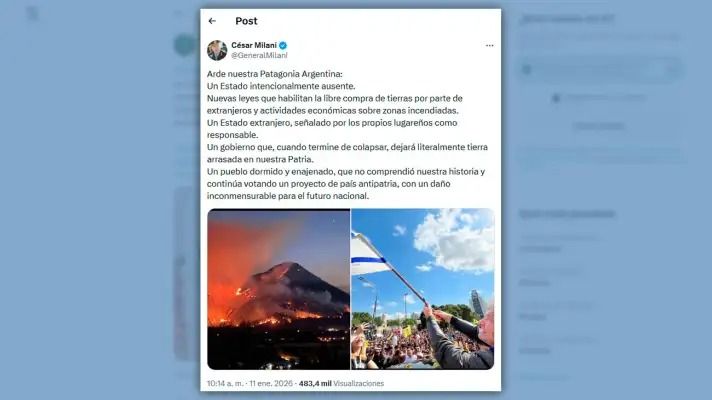
Among the political figures who embraced this hypothesis is former Army chief César Milani. – he shared two photos on his social media: one of burnet-out forests and another of Milei waving an Israeli flag. The military chief spoke of “a foreign state, identified by local residents as responsible” for the fires.
In response to the circulation of this theory, the Llamamiento Judío Argentino (Argentine Jewish Appeal) published a statement warning of the existence of “minority sectors” that “seek to sow discord and division within our country, resorting to old Judeophobic libels such as the apocryphal ‘Plan Andinia,’ originally conceived in Tsarist Russia to persecute Jews who joined anarchist and socialist revolutionary movements”.
The organisation speaks of “local propagandists” who “import conflicts alien to our social history in order to divert attention from the true political and economic culprits of this scourge, among whom undoubtedly are Qatari investors, originally admitted under Mauricio Macri, who have already acquired 110,000 hectares along Route 40, between Bariloche and El Bolsón.”
The “Plan Andinia” refers to an old conspiracy theory that resurfaces time and again alleging a supposed plan to create a Jewish state in Patagonia. It has been used on multiple occasions by Argentina’s right to attack the Jewish community, but now – in the context of Milei’s close proximity to Judaism, Jewish leaders and Argentina’s alignment with Israel – it has been flipped to be presented as an anti-Milei argument. The Llamamiento Judío Argentino turns this reasoning on its head, arguing that it serves to conceal others who are amassing land in the south.
One data point shows just how deeply this theory took hold: according to Google Trends, on January 11, coinciding with a peak of online discussion about the theory, searches for the term “Plan Andinia” spiked. Chubut, Río Negro, Neuquén, Santa Cruz and Buenos Aires City were the geographical areas where these searches were concentrated.
Milei’s AI photo
With less sophistication, Milei promoted his own fake news. On his social media accounts, he shared an image generated with the help of artificial intelligence showing him shaking hands with a firefighter. The image bore the caption: “Thank you to everyone who worked. Nothing is more heroic than risking your life to save others.”
The President did not travel to the south.
While the political class latches onto any hypothesis that suits its interests or image, in Argentina’s south the fire has devastated 15,000 hectares and counting.
related news




Image Gallery





Comments