

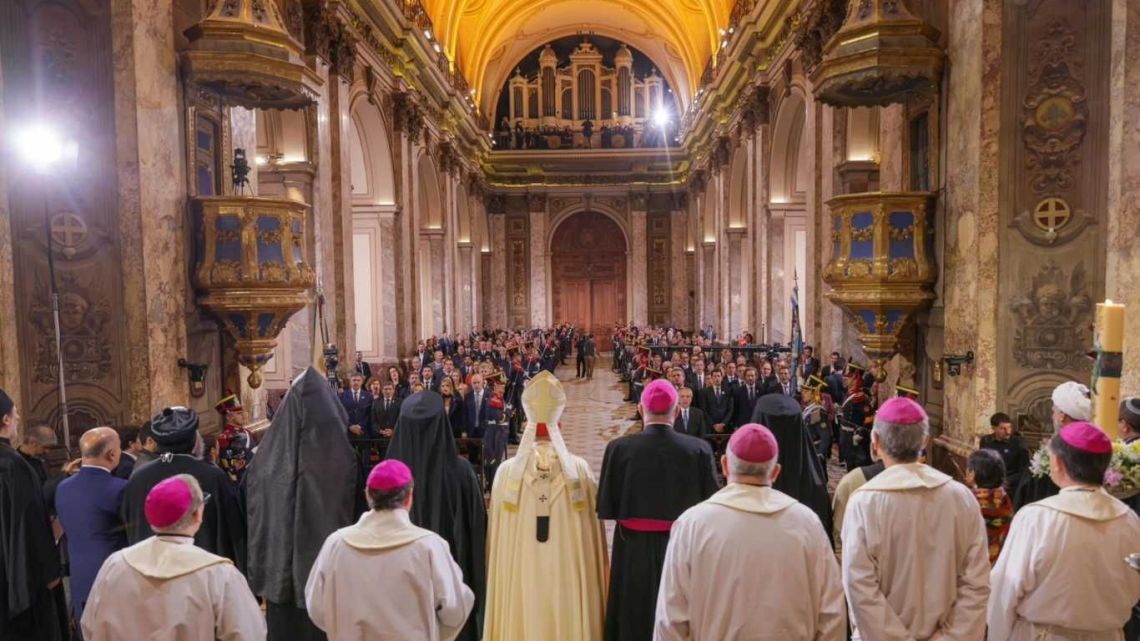
The Argentine Episcopal Conference (CEA) marked the 50th anniversary of the last coup d’état that interrupted democracy, stating that “today, as citizens, we once again say ‘never again’ to a dictatorship and ‘ever more’ to a just democracy”, while calling for a “complete and illuminating memory” of those years.
“As Pope Francis reminds us in the encyclical Fratelli Tutti, we know that ‘it is easy nowadays to fall into the temptation of turning the page, saying that it all happened long ago and that we must look ahead. No, for God’s sake! One cannot move forward without memory; one does not grow without a complete and illuminating memory,” the CEA stated.
The bishops urged that, in order to uphold and defend democracy, the state must “safeguard the dignity of individuals and the equality of all citizens” and give equal priority to “the extremes of life: the elderly and children.”
“We are living in a time with a growing tendency towards authoritarianism; a time in which populisms of differing kinds exploit citizens’ anxieties, yet do not provide the remedy for a good life. A time in which an ideology of the survival of the strongest over the weakest is becoming dominant, when the strength of democracy should be expressed in care for the most vulnerable,” the CEA emphasised.

“With its advantages and its challenges, democracy will always have as its axiom the safeguarding of life. Any affront or violence against human dignity is, in essence, an aggression that destroys the system itself,” the Synod stated in a document from CEA’s Permanent Commission, chaired by Monsignor Marcelo Colombo.
The text stresses that “democracy unequivocally prohibits the elimination of one’s opponent; it does not permit bloodshed and replaces physical confrontation with civic debate.”
“It is therefore essential to have an intelligent and effective presence of the State that safeguards the dignity of individuals, the equality of all citizens, and guarantees their full participation in community life,” it adds.

During the military dictatorship’s reign of terror, the role of the Catholic Church was complex and, at times, deeply contested. While some members of the clergy and religious communities courageously denounced human rights abuses and accompanied victims of repression, other sectors of the Church hierarchy maintained a more ambiguous relationship with the military regime.
The Church’s role remains the subject of ongoing reflection and debate, but since the return to democracy, religious leaders have acknowledged a troubled past and called for self-criticism and a commitment to truth and reconciliation.
For the Synod, March 24, 1976, marked “the beginning of that dark night in our history: the tragedy of state terrorism that lasted for seven long years until December 10, 1983, when we finally regained democracy.”

“We recognise the gravity of what occurred during those violent years and understand that memory demands self-criticism, both from society and from the Church within it, so as to help rediscover and rebuild a sense of fraternity among Argentines.”
– TIMES/NA/PERFIL












Comments