

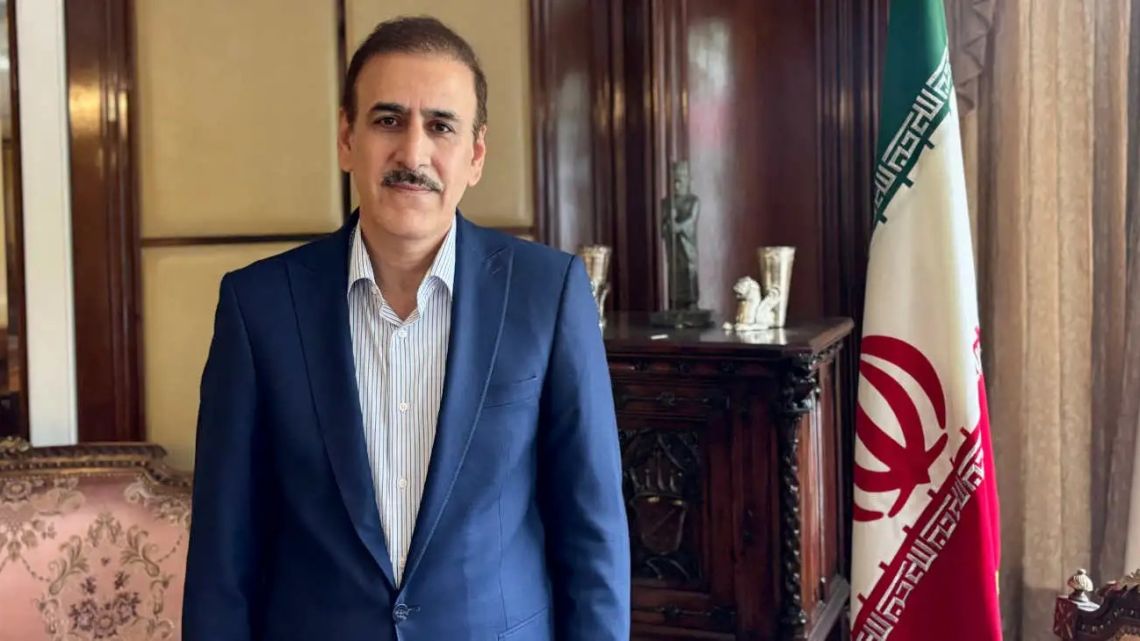
“The world is no longer the same” since February 28, when the United States and Israel launched coordinated surprise airstrikes on Iran, admits Tehran’s top diplomat in Buenos Aires.
In an exclusive interview with Perfil, Mohsen Soltani Tehrani, Iranian chargé d'affaires in Buenos Aires, highlights what he describes as the “historic” nature of the Islamic Republic’s counter-offensive against Israel and the US, possessor of “the most powerful and feared army” in the world. “It is more than resistance to a brutal aggression. It is a hugely important military achievement,” argues Soltani.
The Iranian diplomat – currently the highest-ranking official in Argentina, a result of a bilateral relationship reduced to a minimum – accuses the US and Israel of launching “brutal aggression” in violation of international law. Two weeks on – with the Islamic Republic's government still standing, strong Iranian retaliation and the closure of the Strait of Hormuz – the diplomat reveals Tehran will not negotiate a ceasefire without conditions.
The conversation also addressed the impact of the conflict on Argentina and its ties with Iran. Soltani downplayed statements by President Javier Milei – who recently described Iran as an “enemy” and himself as “the most Zionist president in the world” – and once reiterated Tehran’s denial of responsibility for the 1994 bombing of the AMIA Jewish community centre, Argentina’s worst-ever terrorist attack.
How do you interpret the current situation?
It is a brutal [act of] aggression that violated all international norms, the United Nations’ Charter, and it occurred in the middle of negotiations with the United States over Iran’s nuclear programme. It is the second time something like this has happened and that shows they had no intention of negotiating or reaching an agreement.
In Geneva, there had even been discussions of limiting Iran’s military capacity or the development of ballistic missiles, just days – even hours – before the dawn attack on Saturday, February 28. Did the attack surprise you?
It did not surprise us because, according to information from Iranian authorities, it was clear they were going to attack. Personally, I thought so because while negotiations were progressing over the previous three weeks, the United States was increasing its military presence in the region with warships, aircraft carriers and bombers.
In any case, what is important to understand is that with this terrorist attack they believed something similar to what happened in Venezuela would occur. They thought they could strike Iran, martyr the leader and threaten other levels of the military and government authorities. That same day Trump said we should surrender or we would meet the same fate, and that everything would end very quickly. That was a miscalculation.
According to Tehran, what is the objective for the United States and Israel?
Each has its own strategy and programme, but with Donald Trump they have now reached a common point. If you look at the global geopolitical landscape, the United States is advancing a strategy to take control of oil, gas, minerals and rare earths in order to contain China and other powers, so as not to fall from first place in the world to second or third. They tried something similar with Venezuela and concluded they could do the same with Iran.
On the other hand, Israel has its own regional interests: disintegrating a large country in the region that has always opposed its military expansion. After that attack I heard someone say: “Do you know why Israel does not publish a fixed map of its territory? Because it never wants to set limits and always wants to expand.” This has been said publicly – in fact, the US ambassador to Israel recently said that Israel has the right to expand much further than the territory it already holds.
Since the Zionist regime was established in our Middle Eastern region by occupying Palestinian territories, that process of territorial expansion has continued. We are talking about the occupation of Palestine and the war crimes committed since the creation of Israel.
They have now killed 70,000 Palestinians – men, children and women – and have completely destroyed the Gaza Strip.
Regarding relations between Iran and Israel, at what point do you think the conflict is geopolitical, ideological or religious?
You have to look at it from Israel’s side, because they act under the Zionist ideology, which becomes a plan of government. They speak of reaching “from the Nile to the Euphrates.” That ideology has become something strategic for them, a state policy. As Muslims we oppose their expansionist policy, their acts of terrorism and genocide, but we have never attacked Israel or other countries. We did not start this war of aggression.
In the first days they said they wanted to overthrow Iran’s regime, but that did not work. So they changed the argument and said the attack was “preventive.” First they talked about regime change and then they began saying Iran was a threat.
But what threat? Eight or nine months ago the United States attacked Iranian facilities and said everything had been destroyed and the nuclear programme set back for years; now they again claim there is a nuclear threat. Every day they change the explanation because they cannot justify the attack.
As part of their justification, the United States and Israel argue that Iran finances or coordinates organisations or militias, including Hezbollah. How do you respond to this?
Hezbollah is not a military group transferred from somewhere else to the border with Israel; it comes from a Shiite community that has lived in Lebanon for a long time. When the Islamic Revolution triumphed in Iran, that community was under attack from Israel, which at the time attacked Beirut and sought to expand to take all of Lebanon. In that context Hezbollah emerged as a resistance movement of that community, which Iran later supported.
It is not that Hezbollah wants to expand or take territory. But because they managed to contain Israel, in the West accusations began that they were terrorists or operated like a mafia. Yet no evidence has ever been presented. Iran also supports groups in Iraq and the Houthis in Yemen, which are movements close to Shiism.
From our perspective those peoples have the right to establish their government and their way of life. But when they are not aligned with imperialism they are labelled terrorists.
They are often described as Iranian “proxies.”
Yes, but the word “proxy” suggests Iran has sent mercenaries to fight on its behalf, and that is not correct. These are peoples who live in those regions. Other powers want to take their territory or their resources and when they fail, they call them proxies or terrorists.
In the West, criticism of the State of Israel is often interpreted as anti-Semitism, but you speak about imperialism and Zionism. What is the difference?
Exactly. Zionism is different from Judaism. If you look at history, Christians, Jews and Muslims lived together in Palestine for centuries. The problem began with the United Kingdom, the [1917] Balfour Declaration and the Zionist movement, which led to the militarisation of the territory and the occupation of Palestinian lands.
We have no problem with Jews – Jewish and Christian communities live in Iran, for example, in cities such as Isfahan or Tehran. There are also Sunni Muslims in several provinces and they have representation in parliament. What we criticise is not the Jewish people or religions, but the Zionist ideology.
What changed in Iran after the assassination of Ayatollah Ali Khamenei?
Regarding the selection of the successor to the martyred leader, it is important to remember that Trump said Iran could not choose its leader without his consent. In reality, the system works differently: The leader is chosen through a council of religious figures elected by the population in each province, and that council appoints the supreme leader. Even though Trump said we could not do it without his approval, we did it anyway, which shows the system continues functioning even in such a difficult situation for the country.
Before moving on to relations with Argentina, is there anything else you would like to add?
The United States fired two missiles at a school in Minab, a remote place in southern Iran with no strategic value, where 165 girls and 14 adults, including teachers and administrative staff, were killed. That attack carried a very cruel message for the Iranian people: if they can kill girls with a state-of-the-art missile, they can kill anyone.
At first they said it was not them; Trump said perhaps Iran had done it. But later images from security cameras appeared showing the type of missile: a Tomahawk. When the Iranians showed those videos, [the US] replied that many people possess those missiles and perhaps Iran had obtained one as well. But only a few countries have those missiles and they are not transferred to others. Even in the United States there was criticism.
A similar situation occurred in 1988 during the Iran-Iraq war, when the United States shot down an Iranian passenger plane flying from Dubai to southern Iran. One hundred and eighty people died on board. At the time they said they had mistaken it for a military aircraft.
But it was not a mistake; it carried a hidden message, a threat. Just as that passenger plane was destroyed in the 1980s, what happened to the school was not a coincidence either.
President Javier Milei recently again said Iran “is an enemy of Argentina” and described himself as “the most Zionist president in the world”. What do you think of those statements?
From the [Iranian] Embassy, we do not want to take a particular position on President Milei’s statements. His support has no relevance in the course of this war. The last time you were here, the President had said Iran was an enemy of Argentina. Afterwards he changed that version and said Argentina is an enemy of Iran.
In any case, previously he had meant the Iranian government, not the Iranian people. The Argentines we know do not think like Milei. But if he presents himself as the most Zionist president in the world, then he could indeed be considered an enemy of Iran, because Zionism seeks to destroy or disintegrate Iran and is killing innocent people.
But in that case it would be him, not the Argentine people.
What practical implications could those statements have during the war?
They have no implications. Milei’s position regarding Iran has not changed anything. Relations are already at a very low level and his stance does not alter the situation.
I believe he wants to capitalise on what he imagines will be a US victory and show he is on that side. But in practice Argentina does not have the military or economic capacity to influence our region, so his position has no effect on this war.
In Argentina, the Middle East conflict is often linked to the AMIA Jewish community centre and Israeli Embassy bombings [in 1994 and 1992]. When the President speaks of Iran as an enemy, that debate resurfaces. How do you respond to that interpretation? What is Iran’s position regarding the AMIA accusations?
Iran has always denied any responsibility and there is no conviction or evidence proving that Iran participated in that attack. However, the same accusation is repeated again and again.
It is the same position Iran has had for years. We reject the accusations, but we have tried to cooperate to resolve the issue. A Memorandum of Understanding was even signed in 2013, but later the Argentine government changed and the agreement was rejected, accused of being a cover-up. All these accusations are based on reports from Mossad and the CIA that have no legal validity.
We had already expressed our willingness to sit down and resolve the issue if there was a willingness to do so. But we can see that such a willingness does not exist. Since then, the situation has remained unchanged. Argentina is calling on Iran to hand over its citizens, and Iran is refusing. Now we have the trial in absentia, which is something new.
Could you comment on the protests and repression before the war?
They are two different issues. The demonstrations in January began in the bazaar for economic reasons. The bazaar is a traditional commercial centre in Iran and still operates in cities such as Tehran, Tabriz or Isfahan, with great economic weight.
The protests began in that context due to strong volatility in the dollar. Part of that volatility resulted from US pressure on the financial system to prevent Iran from accessing foreign currency from exports. Companies that buy Iranian oil can be punished by the United States and lose access to the international financial system. That situation created inflation and economic difficulties, which triggered protests among bazaar merchants.
Taking advantage of that context, some groups provoked unrest for several days and there were clashes with casualties. According to some estimates nearly 3,000 people died, including members of the security forces and civilians. Authorities say that among those disturbances there were groups linked to foreign actors and that some attacked civilians or police officers to worsen the situation.
For that reason, Iran viewed those disturbances as a continuation of the war that began in June 2025.
On uranium enrichment, how do you respond to the accusations regarding the purpose of Iran’s nuclear programme?
Iran maintains that it has the right to continue its nuclear programme for peaceful purposes, which includes uranium enrichment as part of that cycle. It considers that right to be established under the Treaty on the Non-Proliferation of Nuclear Weapons (NPT), of which Iran is a member.
Israel, by contrast, is not part of that treaty and possesses nuclear weapons. Although some facilities have been damaged, the country retains the expertise and know-how to continue, and it intends to preserve that technology.
Would you like to make a final comment?
We have now had 15 days of war. Despite the attacks by the United States and Israel, Iran has shown that it can not only respond but also strike the most powerful and feared army.
The Iranian people have not divided; on the contrary, they have united. That is also changing perceptions around the world. Many people, even politicians and diplomats, are surprised by Iran’s ability to resist.
The world before February 28 and after that date is different. The military power of the United States and Israel is no longer perceived in the same way. From our perspective, Iran is managing to resist and emerge strengthened from this war of aggression.








Comments