


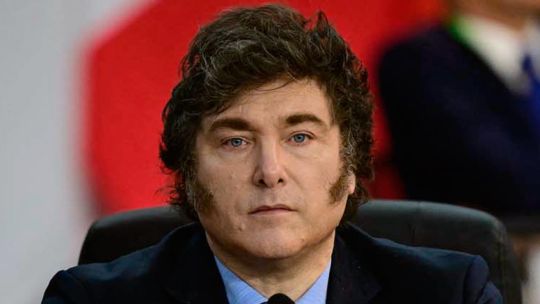
Ahead of his consequential speech inaugurating the 2026 legislative year, President Javier Milei is in a conundrum. For the first time since he took office, the self-proclaimed “anarcho-capitalist” libertarian is on a winning streak in Congress that confirms his nascent political coalition is adapting to the ways of government. Yet at the same time, his high polling figures have been trending downward at a gradual but consistent pace, only interrupted in the heat of last year’s national midterms when Milei was forced to lead the campaign by appealing to his most ferocious and passionate self. What should his focus be, then? Trying to expand his base by moving to the centre, potentially continuing to haemorrhage support as he becomes “more normal,” or edge toward the extremes that are part of his genuine self and brought him this far? Milei is treading on dangerous ground as the novelty of his political blitzkrieg fades, becoming the “least bad” option among a decrepit political field, particularly as the economy fails to restart for a vast majority of the population, which in part explains his declining popularity, albeit still making him one of the most popular if not the most politicians in the country.
The figures are clear – at least according to AtlasIntel’s latest Latam Pulse survey. Its most recent edition shows that 55.3 percent of those polled indicated they disapproved of President Milei, compared to 41.5 percent who sympathise and another 3.3 percent who are unsure. That disapproval figure has been rising consistently since last April, when it hit a low of 44.1 percent, directly correlating with inflation as measured by the INDEC national statistics bureau which has been on the rise on a monthly basis for the past nine months. There was a temporary reprieve for the President in the November poll, directly after the surprising and solid electoral victory in national midterms. Society remains deeply polarised, with 53.1 percent considering the Milei administration bad, compared to 46.9 percent who consider it regular and/or good. Only 20 percent of the population considers its economic situation good, while 30 percent expect it to improve in the coming six months. While corruption remains the major problem identified by those polled, economic issues including unemployment and inflation have been on the rise as a major preoccupation.
While it would be unwise to directly associate these figures causally with the economic situation, it undoubtedly has an impact. Milei’s popular mandate was to lower inflation, which he did very successfully, getting it down below the two percent monthly rate. But since that benchmark, he has failed to contain price hikes, which are gradually sliding up, with inflation reaching 2.9 percent in January. An improved macroeconomic situation must eventually translate into better opportunities for a majority of the people, but under the economic plan put in motion by Milei and Economy Minister Luis ‘Toto’ Caputo, growth has been concentrated in so-called “extractivist” sectors, including the financial sector which hasn’t really been creating productive investment despite its growth, leading to a deep recession in consumption. Not only have salaries lagged behind inflation, but formal jobs in the private sector have been falling at a substantial rate, hand in hand with the number of small and medium sized companies that have been shutting down. According to public policy think tank Fundar’s monthly company monitor, 22,000 companies have shut down since November 2023, when Milei beat pan-Peronist candidate Sergio Massa in the presidential run-off election. Some 200,000 private-sector jobs have been shed in the same time period, according to official figures published in the SIPA employment report. The backdrop is that the economy is expanding, closing 2025 with a 4.4 percent increase according to INDEC’s monthly activity index (EMAE).
The apparent paradox of a growing economy that is shedding jobs with falling real salaries has created a sort of credit bomb for families. One of the debates of the week centered on the growing number of overdue loans to families and individuals, hitting 9.3 percent according to the Central Bank. The situation is even more extreme in the non-financial sector, with digital wallets, supermarket credit cards and other such means of credit seeing non-performing loans hit 24.6 percent. As families are unable to make ends meet, they rely on cheap and easy credit which quickly snowballs into high and rising interest payments. Servicing debt becomes a growing burden on already weakened salaries, threatening to further derail any potential economic recovery.

In this context, despite it, Milei retains his position as the strongest political alternative in the country. “In the land of the blind, the one-eyed man is king,” says the proverb. Recent congressional votes show the President’s La Libertad Avanza coalition on the offensive, in part thanks to its absorption of Mauricio Macri’s PRO and its broader alliance with UCR Radicals, provincial governors, and centrist Peronists. The aforementioned poll shows Macri with a meagre 23 percent approval rate (compared to 64 percent negative opinions). Across the aisle, Peronism is facing a deep crisis as Cristina Fernández de Kirchner’s star fades (38 percent approval, 58 disapprove) and Buenos Aires Province Governor Axel Kicillof tries to take her place (interestingly, the third-best positioned in the AtlasIntel poll and with consistent growth mirroring Milei’s decline).
Macri has been trying to raise his profile of late and he recently split with former first lady Juliana Awada. The proverbial ladies’ man, he’s been recently connected with models and actresses, while at the same time leveraging his role as president of the FIFA Foundation to project global influence. Yet it appears insufficient – he also doesn’t seem to have the ambition or energy to dispute the presidency with Milei and instead is focused on trying to find an alternative candidate. Fernández de Kirchner is being held under house arrest and set to face multiple cases of corruption, while son Máximo looks tired and recently capitulated to Kicillof. The governor remains an unpopular figure with a large portion of the electorate given his high profile and combative term as economy minister under Fernández de Kirchner, but he will surely be looking to compete in 2027. Massa, the other leg of the pan-Peronist power structure, remains in hibernation. The President can’t be too sure that a competitive candidate won’t emerge at some point, he himself was a total outsider who only months before the election seemed to have no chance – until he did.
In part, he’s been trying to keep political momentum by picking fights with other types of adversaries. Claudio ‘Chiqui’ (“Tiny”) Tapia, president of the AFA football association, has been a favoured target. Extremely popular after the 2022 World Cup win, Tapia acted with impunity and in plain sight, garnering power and money in obscene ways. From one day to the next, he became public enemy number one and the Judiciary went all in, together with major media outlets like Clarín and La Nación. He’s become a useful distraction for the Milei administration, particularly as corruption accusations hit close, not least involving the presidential chief-of-staff, Sister Karina, and Javier himself. The industrial business elite has been another good sparring partner. The UIA industrial sector group has repeatedly asked the government for certain protections in the face of the opening up of the Argentine economy that has led to an influx of imports, particularly cheaper priced products from China. Paolo Rocca, head of industrial giant Technit, complained after his company lost out to a major energy sector contract against an Indian rival it accused of dumping. He was nicknamed “Mr. Garbage” by Milei on social media. Javier Madanes Quintanilla, owner of aluminum giant Aluar and the recently shuttered tyre factory Fate, was dubbed “Rubbery” in the president’s post.

All of these are attempts by Milei at maintaining political momentum while trying to shore up his popularity. He remains, by far, the political star of the moment, a concept he will try to consolidate in tomorrow’s speech by enumerating his victories while attacking his opponents. Taking a page from US President Donald Trump’s State of the Union address, Milei will probably preach to the choir and present himself as a genius who engineered an economic miracle and deserves the Nobel Prize. He’s got time until the election, but society won’t tolerate eternal contraction, much less so from a supposed expert in
“growth with and without money.”







Comments