

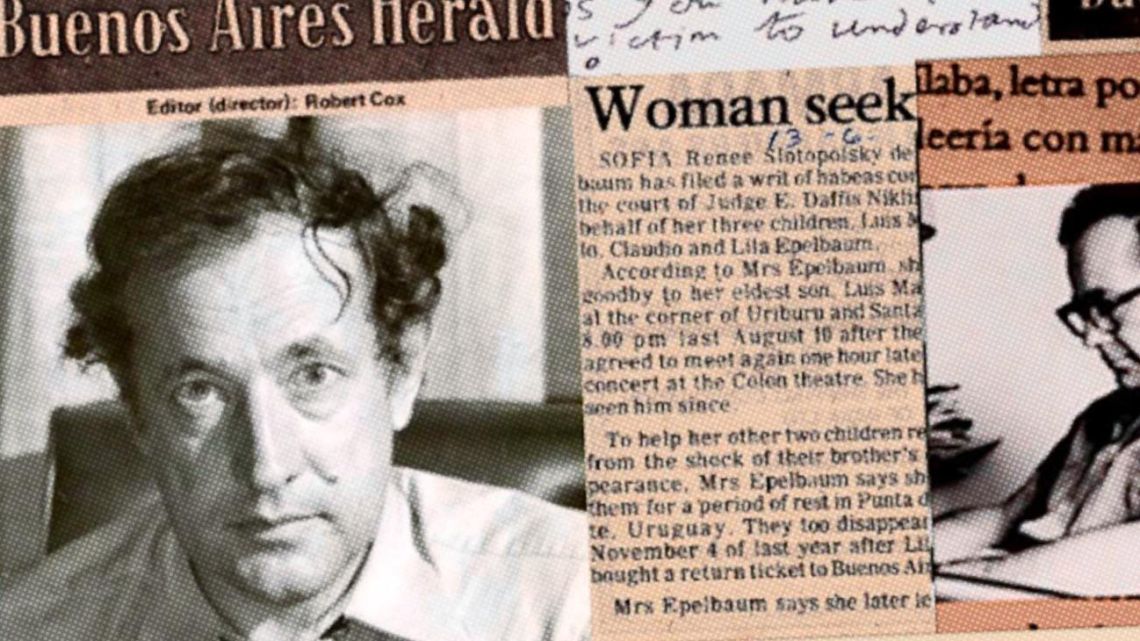
Last May 30 and June 7 mark the 50th anniversary of two crucial journalistic pieces which denounced the workings of state terrorism in Argentina – barely two months after the March 24, 1976 coup.
On May 30, 1976, the Buenos Aires Herald ran a front-page piece penned by the editor, Robert J. Cox, in which the reappearance of “missing children” linked to the kidnapping and murder of their parents is recounted in full.
In it, Cox boldly pointed out that these murders – and, by extension, the disappearance of the children – “bore all the hallmarks of right-wing death squads.”
The bodies of the parents had been found days earlier, in a car, along with those of two Uruguayan politicians. The piece, as well as the editorial of the same day, suggests the involvement of the security forces.

The editorial asks why the death squads “were able to operate with impunity,” and “why the families” of the victims “received no help from the police.” Both pieces emphasise the fact that the now-infamous Ford Falcons without number plates were used by the kidnappers.
Days later, on June 7, Cox co-signed a Newsweek story on Argentina’s still-active death squads, pointing out that “the [Jorge] Videla regime is unwilling – or unable – to control them.”
Contrary to some versions then, the indictment of Argentina’s military regime, spearheaded by Robert Cox and a handful of colleagues, began shortly after the coup. Granted, this small group of journalists had to alternate “pats on the back” with critical pieces like the aforementioned, lest the regime imprison, murder, or disappear them – a fate nevertheless suffered by many dissenting voices.

Although the big Argentine media outlets kept silent at the time , the claim that there was no information about the crimes of the military regime is far from accurate, as these pieces show. Many more followed in the subsequent months and years. (To see more of these articles, visit https://works.hcommons.org/records/dq94p-96z09.)
This fact raises the uneasy and still not fully answered question of why civil society took so long to acknowledge and oppose the crimes of the regime – and the regime itself.
The answer is complex and multi-faceted, and it should begin with a clear, full account of the facts.

Remembering these early publications contributes to this difficult but necessary task – necessary not only to help understand the recent past but also to have a sharper view of present-day events worldwide.
* Gustavo Llarull (PhD, Cornell University) organised and digitised the Robert J. Cox Archive. To learn more about the Archive, visit https://works.hcommons.org/records/qsg5a-03h44.











Comments