

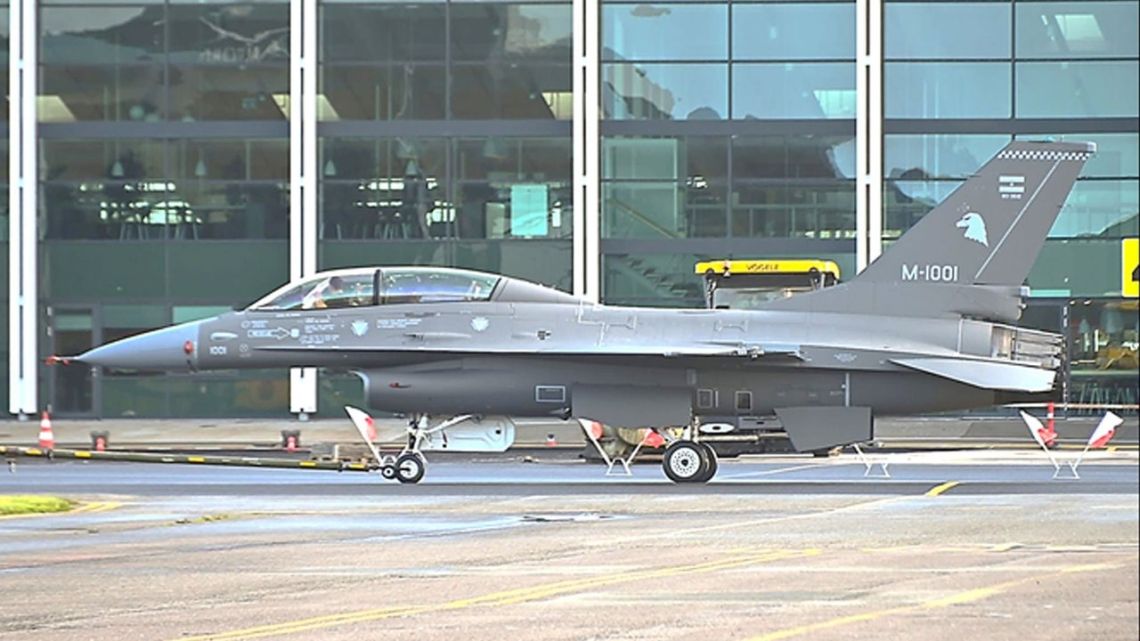
President Javier Milei and former defence minister Luis Petri have hailed the arrival of Argentina's first six F-16 jets purchased from Denmark, describing them as "guardian angels" that will strengthen the country's Armed Forces.
The US-built aircraft are among the 24 used supersonic fighters bought last year from Copenhagen for roughly US$300 million – an exchange Milei's government described at the time as Argentina's most important military acquisition in 50 years.
Petri, who resigned his post this week to take up his seat as a senator for Mendoza Province, defended the purchase in an interview, dismissing critics as supposed “sommeliers of fighter jets.”
The former defence minister, who oversaw the deal, described the purchase of F-16s as “the most important one by the Armed Forces in the last 40 years” and claimed the Air Force would take “a technological leap of at least 30 years” as a result.

“We achieved effective, not decorative, deterrence, and we regained the control of our airspace.”
Argentina had not had any supersonic planes “since 2015,” he complained.
“I don’t really care about criticism from [opposition] Kirchnerism, because they demonised and defunded the Armed Forces.”

“They say they were about to buy Chinese JF-17 planes, but didn’t, which they should have, because there have been no relevant purchases for 40 years” for the military sector.
“This government has made the decision to back its Armed Forces, and one way of doing that is by equipping them.”
On Chinese JF-17s, he specified that “only 145 have been made worldwide,” whereas of the F-16 model bought from Denmark, “over 4,500 have been made, and 3,600 of them are currently flying.”
He explained that some 800 F-16s “are used today by the United States, the main military power in the world” and highlighted that “over 26 countries use it, it’s not up for discussion, they have been modernised, and we have planes for 25 more years.”
Milei thrilled
Speaking at a ceremony last Saturday, Milei hailed the arrival of the planes.
"After a long wait, I finally have behind me the first six F-16 fighter jets," Milei said on the tarmac of a military base in Río Cuarto, Córdoba Province, some 600 kilometres (373 miles) west of Buenos Aires.
Following a ceremony, Milei boarded one of the F-16 Fighting Falcons – which had flown low over the capital before landing in Río Cuarto – and was seen smiling in the cockpit next to his sister Karina Milei, who serves as his presidential chief-of-staff, and Defence Minister Luis Petri.
"Hundreds of thousands of Argentines were able to look up and see their guardian angels in the sky for the first time," the President said in a post on social media.
"The F-16s are the new guardians of Argentine airspace," he said.
When the sale was announced in April 2024, Argentina's Defence Ministry said the modernised Danish F-16s would form "the backbone of Argentina's air defence system."
They replace Argentina's French Mirage jets, the last of which were retired in 2017 after four decades of service.
The US administration of President Donald Trump, a Milei ally, approved the transfer of F-16s.
Worth it?
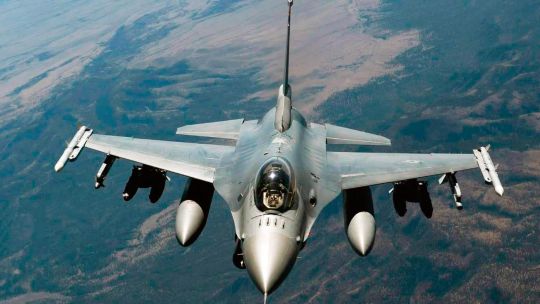
The F-16 Fighting Falcon is still, as of 2025, one of the most widely used fighter jets on the planet. Its combination of performance, operating cost and the fact that it can be easily updated explains its popularity with air forces across the world.
Designed in the ‘70s by General Dynamics, and later produced by Lockheed Martin, the F-16 was conceived as a lightweight, versatile and economical fighter jet.
With thousands of hours of combat and actual missions accumulated, the platform evolved throughout multiple blockings and settings. In 2025 older versions aimed at training, such as Block 15 and 20, live side by side with such intermediate models as Block 30 and 40, which added improvements in avionics and mission capabilities.
The current incarnation is the F-16V, known as “Viper,” incorporating an AESA radar, a new mission computer and greater tactical connectivity. This update helps extend the model’s operating life and places it as a competitive alternative to more modern fighters, especially for countries with intermediate budgets.
Other users
The F-16 is a unique case in military aviation: it is in service in the Americas, Europe, the Middle East, Asia and Oceania.
In the Americas, the United States is its main user, followed by Chile and Venezuela, while Guatemala and Argentina have started recent incorporation processes. In Europe, it is present in Belgium, the Netherlands, Denmark, Norway, Greece, Portugal, Poland, Romania and Bulgaria, in addition to other countries which still maintain fleets in transition.
In the Middle East, it is still key in the air forces of Israel, Egypt, Jordan, Bahrain, the United Arab Emirates and Oman. In Asia and Oceania, South Korea, Taiwan, Singapore, Indonesia, Pakistan and Thailand continue to use it actively, while Australia makes use of it for training.
The wide range of operators makes the F-16 a standardised platform and provides a global ecosystem of spare parts, maintenance and training which makes it easier to sustain even in countries with medium-sized military structures.
Unlike fifth-generation fighter jets, the F-16 offers a balance that is difficult to match between operating cost and performance. Its maintenance is more affordable, its logistics has been widely proved and the availability of second-hand units significantly reduces start-up costs. The inter-operability with Western standards and the possibility to modernise avionics keep it relevant.
This helps many countries sustain a “believable aerial capability” without the investment required by an F-35 or a Rafale.
Plan for Argentina’s Air Force
Between 2024 and 2025, the Argentine Air Force received the first F-16s from Europe, in a process which included spare part packages, technical assistance and training. The purchased aircraft are from different eras, which is why the operating availability will depend on the standardisation of parts and infrastructure development.
For the fleet to work in full in the long run, Argentina must sustain logistical support contracts, train pilots and mechanics, refit hangars and maintenance lines, and ensure a stable financing to cover the entire life cycle of the system. Otherwise, the tactical value of the plane will be limited by the availability of components and maintenance cost.
The arrival of the F-16 in Argentina reconfigures strategic perceptions in South America. So far, Chile and Venezuela were the only countries in the region operating the model. Its addition by Argentina opens the door to new alliances, bilateral exercises and political definitions on the role of defence in a regional context market by budgetary restrictions but with a growing need for modernisation.
This also translates into strengthened diplomatic ties, since the transfer of military planes entails technical agreements, joint training and a greater cooperation with supplier countries.
Even though the F-16 remains functional and adaptable, it faces inevitable competition: fifth-generation fighters. Such systems as the F-35 have capabilities that are invisible to the radar, merged sensors and built-in data networks which or double or treble the F-16’s features in high-demand scenarios. Furthermore, the progress of electronic warfare and the starring role played by drones and long-range missiles force it to rethink its role.
Despite all that, the F-16 maintains a clear space: it is reliable, adaptable and, most of all, fundable. That is why it will continue to fly at least for the next two decades.
– TIMES/PERFIL/NA








Comments