

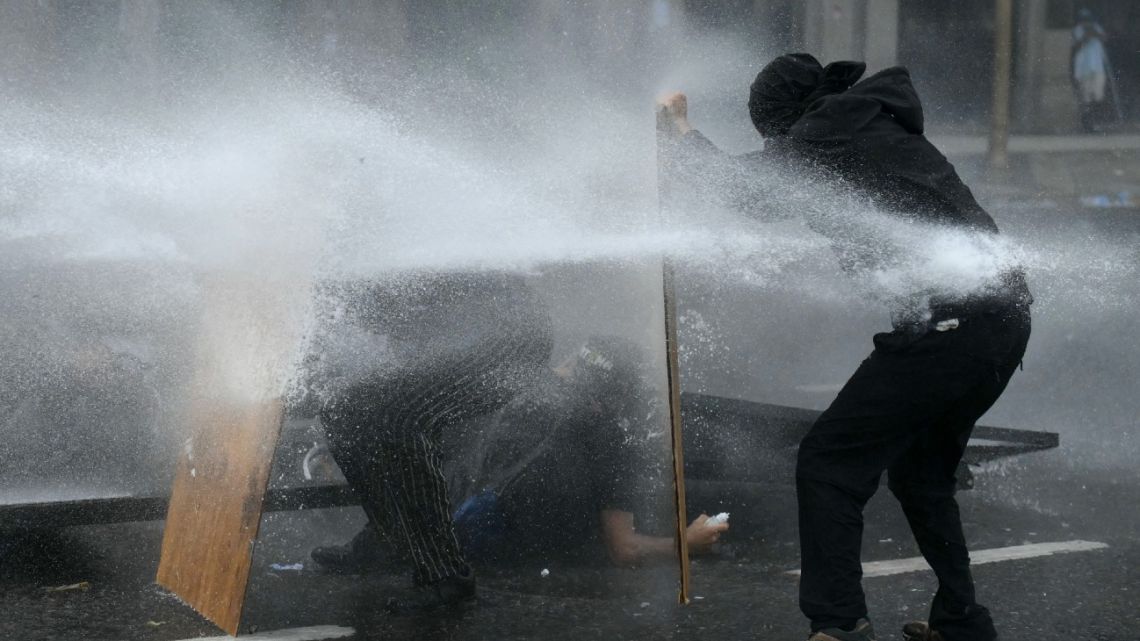
Under the stated aim of “safeguarding the integrity of journalists,” Argentina’s Security Ministry announced that members of the press must remain within an “exclusive zone” during Thursday’s union-led mobilisation against President Javier Milei’s labour reform push.
In a statement shared on social media, the portfolio headed by Alejandra Monteoliva warned that reporting from potential flashpoints could entail “self-endangerment” – a euphemism critics said places responsibility on journalists for any aggression or violence that might occur during security operations.
The Buenos Aires Press Union (SIPREBA) and the Foreign Correspondents’ Association of the Argentine Republic (ACERA) rejected the announcement, warning that the measures place limits on the exercise of freedom of expression. The question, they argue, is straightforward: how can journalists report on what happens at a demonstration if they are not permitted to actually be at the scene?
Last Wednesday, February 11, when the Senate debated the government-backed labour modernisation bill, security forces broke up a rally that had been called.

Authorities justified the police action, citing the presence of violent groups of demonstrators who threw Molotov cocktails and stones at the security forces. There were injuries from rubber bullets and tear gas, as well as arrests. Although Plaza de los Dos Congresos had been cleared by 5pm, the security operation continued until after 8pm.
With the possibility of further mobilisations this week, Monteoliva included in the latest statement a warning interpreted by some as a threat: “In the event of violence, our forces will act.”
The Security Ministry’s statement was issued ahead of a key debate on the labour reform bill due to take place in the lower house Chamber of Deputies. It applies to demonstrations on February 18, 19 and 20. Officials say the aim was to “reduce risk situations.” However, preventing the presence of the press would also mean the absence of cameras and witnesses in the event of a repressive crackdown by security forces.

Press associations warned of a previous incident in which a photo-journalist received serious injuries while covering a rally last year.
“When the March 12 [2005] repression that injured Pablo Grillo took place, it was possible to establish that the material responsibility lay with gendarme Héctor Guerrero thanks to television cameras, photojournalists and demonstrators who recorded what happened on their mobile phones,” Agustín Lecchi, SIPREBA secretary-general, told Perfil.
“We were able to reconstruct events alongside colleagues from the Mapa de la Policía project, and Guerrero was placed in the dock despite Patricia Bullrich attempting to blame Grillo himself,” confirmed Lecchi.

The union has issued a statement responding to the new measures announced by Monteoliva. “The ministry is setting conditions for press workers that are incompatible with human rights conventions, such as requiring news vehicles to park in a designated area or avoiding positioning themselves between demonstrators and security forces under the threat that doing so constitutes ‘self-endangerment,’” SIPREBA warned. “The government is shifting the State’s obligation to protect protest onto those of us who work to document and report on it.”
ACERA expressed a similar view. The organisation representing foreign correspondents in Argentina warned that the Security Ministry’s announcement not only obstructs the right to seek and disseminate information, “but also undermines society’s right to receive accurate and timely information.”
It further stressed that in contexts of high social conflict, “it is the State’s duty to guarantee the highest level of protection for journalists and media workers.” This principle is enshrined in international standards, including those set out by the Office of the Special Rapporteur for Freedom of Expression of the Inter-American Commission on Human Rights (IACHR) and the UN Special Rapporteur on the promotion and protection of the right to freedom of opinion and expression.

According to ACERA, the new provisions “create an intimidating effect on journalistic work.”




Comments