

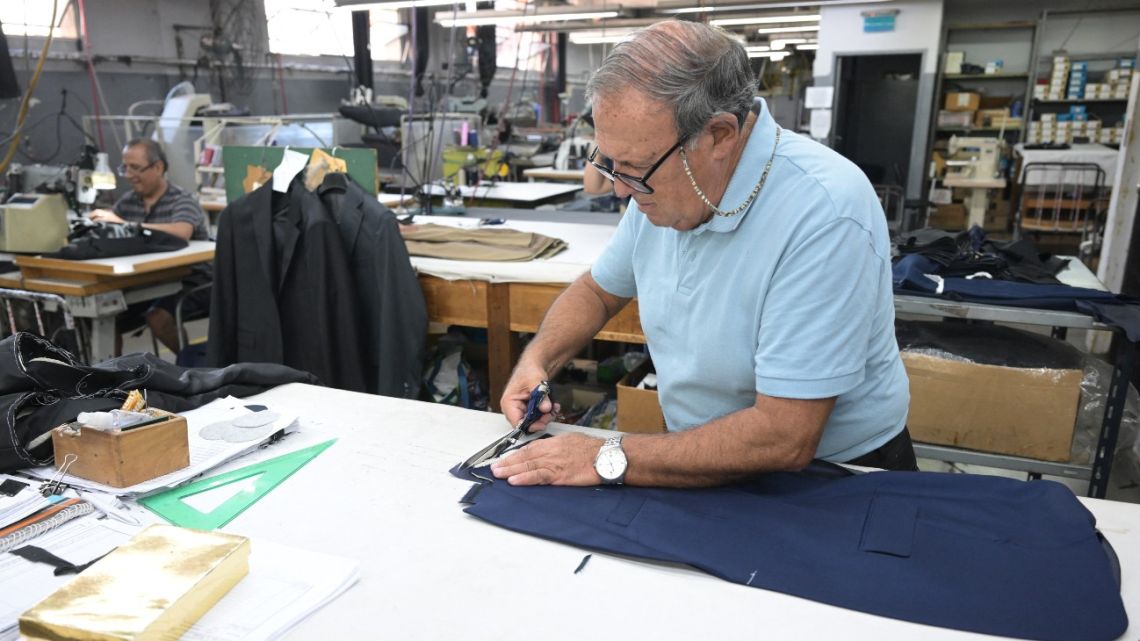
At a clothing factory in Buenos Aires, dozens of workers watch anxiously as imported garments gain ground while sewing machines stand idle – a snapshot of the crisis facing Argentina’s textile industry amid President Javier Milei’s trade liberalisation policies.
At Confecciones Seman SA, a suit and shirt manufacturer, more than 100 employees work to the steady rhythm of sewing machines. Until two years ago, the factory produced more than 3,000 suits a month. It now makes roughly half that amount.
Since 2023, Argentina’s textile sector has shed more than 18,000 jobs and is operating at one-third of its installed capacity, according to February data from the Analytica consultancy firm and the Federación de Industrias Textiles Argentinas (Argentine Textile Industries Federation, FITA) industry group.
“All this drains your motivation,” says Alejandro Pernas, the owner of Confecciones Seman and a 40-year veteran of the industry.

Milei’s government argues that the surge in cheap imports – including the arrival of Chinese platforms such as Shein and Temu – has driven down prices to the benefit of consumers in a country where clothing has historically been expensive.
“I have never bought clothes in Argentina in my life because it was a rip-off,” Economy Minister Luis Caputo said this month.
Industrialists warn that, faced with competition from cheap imports, they will have to deepen staffing cuts in a sector that employs more than 500,000 people across its entire value chain.

Since taking office in December 2023, Milei has pursued a sharp fiscal adjustment and relaxed import controls in a bid to curb inflation and lower prices – a programme that has nonetheless led to a steep drop in consumption.
Pernas has since begun importing some finished products himself. He hopes to preserve factory jobs but says that under conditions of “indiscriminate opening” and depressed consumption he will not be able to do so for long.
“If the market allowed both scenarios to coexist – local production and imports – that would be fantastic,” he says. “But today Argentina’s market is not buoyant.”
Controversy
Some 1,000 kilometres west of Confecciones Seman, in western Mendoza Province, a shop sells imported second-hand clothing from Asia, the United States and Europe by weight: 15,000 pesos (US$10) per kilo.
“Clothes are very expensive. I was looking in the city centre and it was madness,” says Jimena, 34, as she browses the racks.
Clothing imports rose 97.3 percent last year and, since 2023, prices have fallen 30.6 percent, according to a report by Analytica.
A 2024 report by the Fundar think tank found that clothing in Argentina is 35 percent more expensive than in the rest of the region, although the trend is reversed for lower-end garments and prices vary widely.
According to Fundar, the process of rising costs began more than two decades ago, with “growing import barriers” among the leading causes.
Caputo said the textile sector had historically been protected by the state and, as a result, Argentines “have been paying two, three, four, 10 times what textiles and footwear cost in the world.” This model only benefitted industry kingpins, he said.
The minister’s remarks and those of other officials drew criticism from the industry. In a statement, FITA said the problem lay in “fraudulent competition,” arguing that domestic production faces “a heavy tax burden, high costs, logistical shortcomings and lack of financing.”
Daniel Romani, a 70-year-old industrial engineer and workshop manager at Confecciones Seman, says staff are “very distressed and very nervous” about the future.
“It’s logical, because they see output fall from 200 garments to 150, to 120, and now we are making 100 jackets a day. So a skilled worker who has spent many years here feels worried. Where is he going to find work?” says Romani.
The government’s position is that industries unable to compete must reinvent themselves. Pernas, however, has reservations.
“My company can reinvent itself – tomorrow it could become an importer. But what is the woman who has been sewing sleeves in my factory for 30 years supposed to reinvent herself as?” he asks.













Comments