

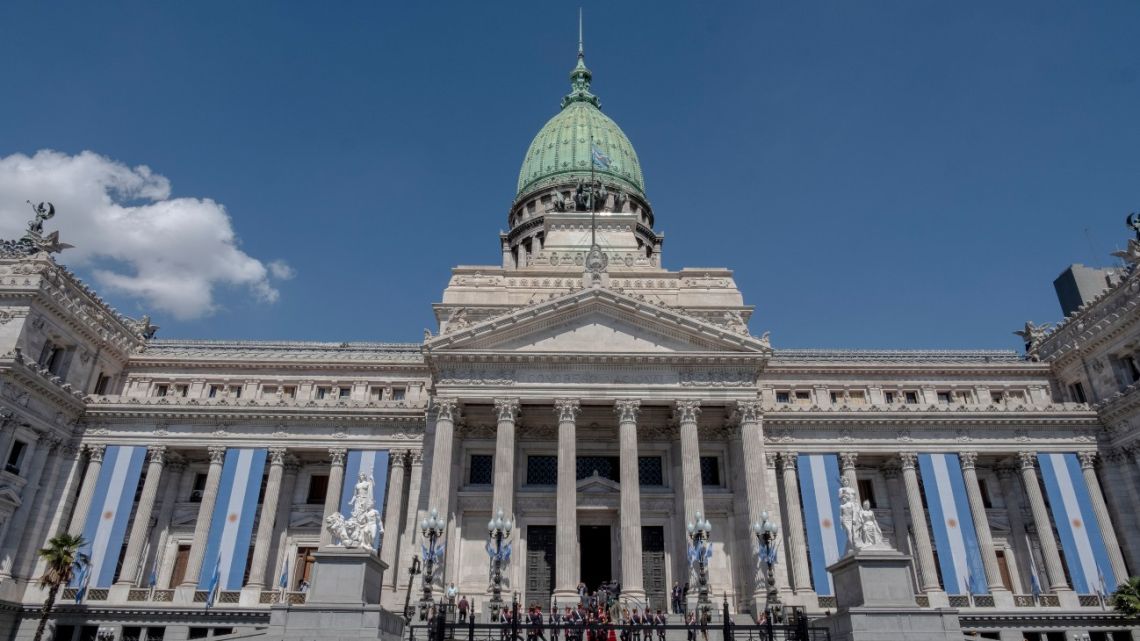
President Javier Milei’s government opened extraordinary sessions of Congress commenced in Argentina this week, marking the start of the parliamentary year.
Decree 24/2026, issued by Milei, establishes that they run until Friday, February 27, while as from March the period of ordinary sessions begins.
The ruling party’s agenda, laid out by the government, provides for the discussions of bills of Labour Modernisation, the amendment of the National Glaciers Law with regard to the preservation of glacier and their surroundings, the free-trade agreement between Mercosur and the European Union and the appointment of former national deputy Fernando Iglesias as ambassador to the European Union.
Last week, the government broadened the agenda via Decree 53/2026, incorporating the discussion of the Juvenile Penal Code seeking to amend Law 22,278 by lowering the age of criminal responsibility from 16 to 13 or 14 years.

The timetable provided for activity formally to begin last Tuesday. The government hopes that debate on Milei’s controversial labour reform package will begin in the Senate on February 11 or 12. The other bills still have no specific dates for debate since they will require committees to be formed.
Senate support for labour reform?

Milei’s government opens proceedings with negotiations underway with a view to passing the Law of Labour Modernisation, which obtained majority approval in the Budget and the Labour and Social Welfare Committees of the Senate last December 18.
Since they did not obtain the necessary votes to debate the bill on the House floor then, debate was postponed until February.
Ruling party Senator Patricia Bullrich (La Libertad Avanza-Buenos Aires City), who is steering the bill as the chair of the Labour and Social Welfare Committee, has assured that a vote will be taken on the bill before February 13.

The government can count on the support in principle of 44 senators from their own and allied caucuses, but pending changes in the text and responses to provincial demands. They will need at least 37 votes to reach quorum and open up debate.
The agreements with governors are conditioned on funds and compensation. From the Casa Rosada, the message is: “No support, no money.” Provincial governors such as Zdero (Chaco), Alfredo Cornejo (Mendoza), Marcelo Orrego (San Juan), Rogelio Frigerio (Entre Ríos), Alberto Weretilneck (Río Negro) and Gustavo Sáenz (Salta) back the reform in general, but Peronists are resisting an article that would their received revenues from income tax.
Interior Minister Diego Santilli, whose focus has been negotiating support from the governors since he took office, has scheduled meetings in the near future with Governors Sáenz, Raúl Jalil (Catamarca) and Osvaldo Jaldo (Tucumán) to review the fiscal chapter of the bill.

Bullrich is seeking consensus by negotiating changes in the text of the labour reform. In order to consolidate the construction of political alliances, she this week scheduled meetings with the heads of moderate caucuses at the offices of the Unión Cívica Radical (UCR).
Fragmented opposition

For now, the opposition remains fragmented with infighting preventing coordination against the bills pushed by the government.
The Convicción Federal Senate group has voted divided in previous debates, like the 2026 Budget. Three of its five senators – Carolina Moisés ((Jujuy), Guillermo Andrada (Catamarca) and Sandra Mendoza (Tucumán) – accompanied the government in that vote, triggering fierce internal clashes and suspicions from the sector closest to ex-president Cristina Fernández de Kirchner.
In the debate over amending the Juvenile Criminal Code, in which the government seeks to lower the age of criminal responsibility from 16 to 13 or 14 years, there is backing from other caucuses.

Santa Fe Province Governor Maximiliano Pullaro is in favour, affirming: “Adult crimes should be tried with adult punishments” since “it is neither possible nor realistic to maintain that a person of 14 does not comprehend the gravity of their actions when they commit a homicide.”
The opposition as a whole has not managed to consolidate positions in common with some sectors demanding profound changes in the texts of the different bills and others evaluating specific agreements in return for provincial compensation.
The government with margin to negotiate and avoid a solid coordination against its initiatives in this period of extraordinary sessions.
– TIMES/NA/PERFIL











Comments