

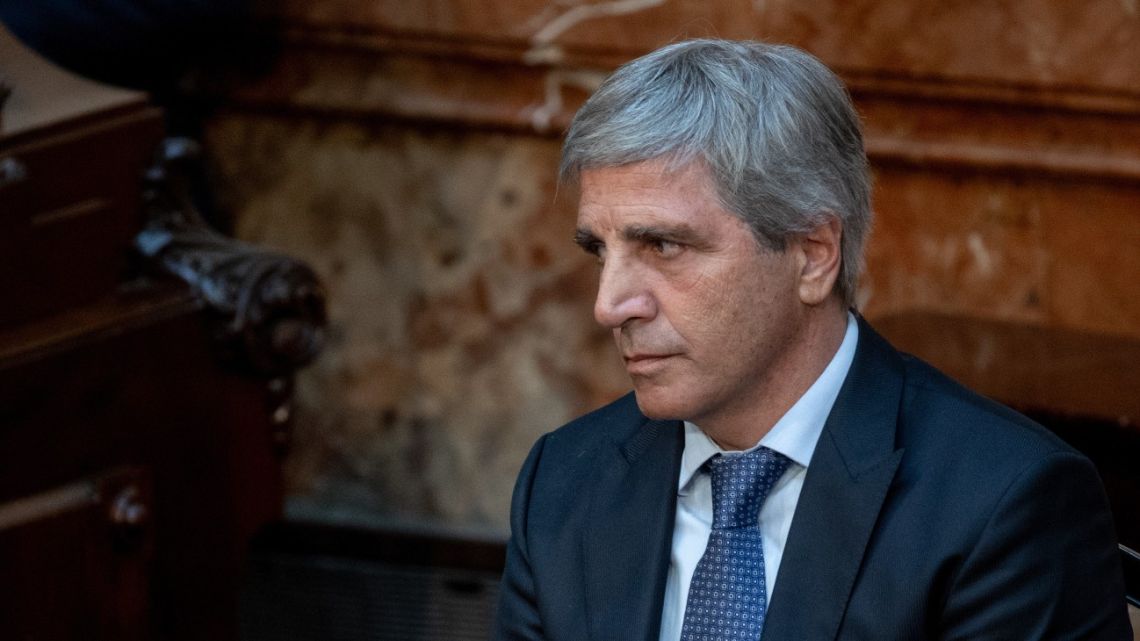
Argentina doesn’t plan to sell bonds in global debt markets while the government can access alternative funding sources at lower interest rates, Economy Minister Luis Caputo said Monday.
Caputo said in an interview with Radio Mitre that the government is observing a “crowding in” process, whereby investors are channelling money from maturing federal government debt to provincial governments and companies.
“Our intention is to continue with that practice, especially as long as we can secure alternative sources of financing to pay international investors,” he said. “We have no intention of going to the international market.”
Caputo gave no further details on timing the Ministry is focusing on, or what rates the nation is paying for funding.

Investors, who have fuelled a rally in emerging-market debt as they hunt for yield, have been waiting for Argentina to come back to global credit markets for the first time since the country restructured its debt in 2020.
The country’s bonds have been some of the best performers in the developing world for the past two years, gaining fresh steam in late 2025 following President Javier Milei’s victory in midterm elections.
The gains pushed a measure of sovereign bond spreads over comparable US Treasuries to the lowest level in nearly eight years, placing the country firmly within the range typically associated with market access. Corporates and provinces rushed to issue.

Ecuador’s successful bond sale last month again raised expectations that Argentina might issue fresh debt.
Repo, SDR

But instead of testing market demand, the government used a repurchase agreement with banks to meet about US$4.3 billion in January debt payments. It also secured financing from an unnamed multilateral institution to repay US$2.5 billion to the US Treasury from a currency swap agreement last month.
Caputo said Monday that Argentina hadn’t tapped its US$20-billion currency swap line agreement with the US to make an interest payment to the International Monetary Fund. Instead, he said the government bought US$808 million in special drawing rights, the IMF’s asset, from the US Treasury last week in a one-time transaction that doesn’t amount to a loan.
Current rates, even if low by recent years’ standards, remain above what the government considers acceptable for a country running a surplus, Caputo said.

“Today Argentina should have a much lower country risk,” he told Mitre, without specifying further. The comments are in line with Milei’s, who said in Davos country risk of around 550 basis points didn’t reflect Argentina’s economic fundamentals.
While the government has refrained from tapping global debt markets, it issued a US$1-billion local-law dollar bond in December. That sale, which was priced to yield 9.26 percent, was seen as a dry run of the sovereign’s return to overseas borrowing. Repo financing lines from banks now total about US$6 billion, with three separate deals struck over the past year.
While the country still faces sizeable debt payments over the remainder of Milei’s term – including another US$4.2 billion due in July – there’s “no urgency” for Argentina to come to markets now, according to Ramiro Blázquez, a Latin America strategist at StoneX.

The US Treasury swap line provides “a lender of last resort” and gives the government room to wait, he said.
“An operation similar to Ecuador’s would make sense, but issuing now would only be aimed at building reserves,” Blázquez said. “Argentina still trades about 60 basis points wider than Ecuador, and authorities likely want that gap to disappear before issuing.”
by Ken Parks & David Feliba, Bloomberg









Comments