

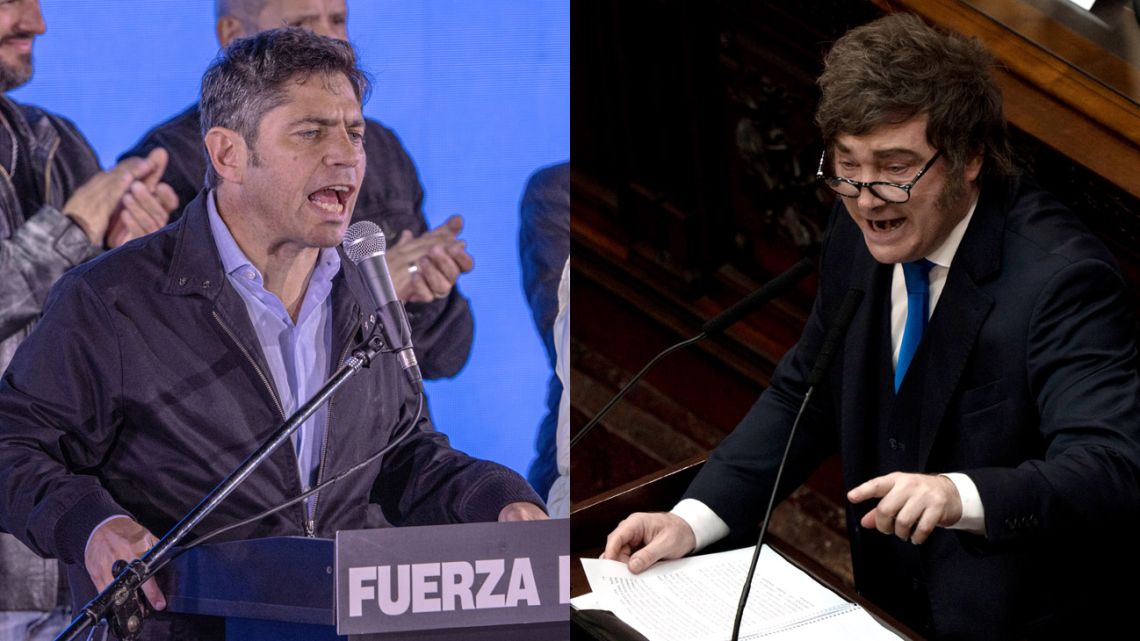
Corruption was once Javier Milei’s strongest card against the Peronist movement that dominated Argentine politics for decades. Now it’s just one of several vulnerabilities that are damaging the libertarian president’s brand and giving wings to the opposition’s comeback plans.
With Milei’s popularity at its lowest level in more than two years, talk of the 2027 election has taken over investor trips and political circles in Argentina. The question being asked is whether it might be the moment for a third way between Milei’s signature shock therapy and the kind of free-spending Peronism epitomised by its leader, Cristina Fernández de Kirchner.
“Milei is no longer a shoo-in to be re-elected,” said Steven Levitsky, a professor of Latin American Studies at Harvard University. “Right now, Peronism is positioned as the most viable alternative.”
But Peronism itself is struggling to decide what kind of alternative it wants to be. Conversations with party officials and analysts show that an internal tussle is building over whether it should promise to reverse Milei’s slash-it-all doctrine or accept its main pillars – fiscal discipline, a smaller state and debt repayment – with a distinctly Peronist twist.

Getting it right would reinvigorate a political force that has continually reinvented itself over the past eight decades and amount to another throw of the dice for Argentines desperate to restore some economic certainty after years of stagnation, rampant inflation and debt crises on repeat.
Defeating Milei, an ideological lodestar of the MAGA right, would in addition impede US President Donald Trump’s attempts to impose Washington’s dominance of the western hemisphere and provide an alternative narrative to Latin America’s shift to the right.
The prime contender to lead the fight is Buenos Aires Province Governor Axel Kicillof, given his two terms governing the country’s most populous province.

He also scares markets most. Kicillof was two-time president Fernández de Kirchner’s loyal acolyte at the helm of the Economy Ministry when Argentina defaulted on its sovereign debt in 2014 and became synonymous with precisely the kind of interventionist economic policies Milei was elected to dismantle.
“If a strongly binary scenario starts taking shape, where it’s Milei or Kicillof, that’s bad news for bonds, because the problem is that the market assigns a very high probability of default to Kirchnerism,” said Ivan Stambulsky, Latin America economist at Barclays.
A growing bloc of Argentines says it is dissatisfied with both Milei and Kicillof, creating an opening for politicians trying to chart a middle course. Nearly 30 percent of Argentines say they would vote for neither Milei nor Kicillof or remain undecided, up from about 11 percent in 2025, according to a May survey by TresPuntoZero.

Politicians from the ideological extremes dominate in polls. As a result of the political fragmentation, politicians, governors and business leaders from all corners are exploring whether there is room for a third path: preserving Milei’s fiscal orthodoxy and commitment to repaying Argentina’s vast debts – US$264 billion by some measures – while using a more active state to support investment, infrastructure and employment.
Markets, though, remain sceptical that a moderate alternative will emerge. Sovereign local-law dollar notes due in October 2028 – 12 months after the election – now yield 7.68 percent, a whopping 354 basis points more than similar bonds due in October 2027, a gauge of the expected rough ride ahead.
“In Argentina, the electoral fault line is zero money printing or infinite money printing,” said Emmanuel Álvarez Agis, founder of the PxQ economic consulting firm and former deputy economy minister under Kicillof from 2013 to 2015. For investors, he said, “ignoring that is suicidal.”

That debate might have remained largely theoretical had Milei maintained the political dominance he displayed after his midterm landslide in October. Instead, a series of unforced errors is breathing new life into the opposition.
‘Cristina lost’
Milei’s flagship promise – conquering inflation – remains only partially fulfilled. Despite forecasting monthly price growth would fall below one percent by midyear, it has hovered closer to three percent. Jobs-rich sectors remain weak, unemployment has climbed, and real wages have yet to recover meaningfully.

Meanwhile, graft allegations are swirling around the president’s orbit. Investigations involving senior officials – prompting the June resignation of Cabinet Chief Manuel Adorni – coupled with renewed scrutiny of Milei’s role in a meme-coin scandal have together helped push corruption above inflation as voters’ top concern.
Joaquín de la Torre, a veteran political strategist who accurately forecast the midterm results, said Milei’s biggest mistake was interpreting the election as a sweeping endorsement of his government rather than a rejection of the opposition.
“They didn’t win, Cristina lost,” he said. “You still owe something to the electorate.”

For Peronists, the question is no longer merely how to oppose Milei, but who will take up the torch and define the movement after Fernández de Kirchner was sentenced to house arrest and barred from holding office last June.
No-one has moved more aggressively to fill the vacuum than Kicillof. He has spent the past two years positioning himself as Peronism’s future leader – or, as he put it in 2023, someone ready to “sing new songs.” The effort has fuelled a bitter feud with Fernández de Kirchner loyalists, who still see her as their guiding light, and have booed him at rallies, accusing him of turning on the political force that made him.
Kicillof’s challenge is that he must inherit Kirchnerism without becoming trapped by it. To seize control of Peronism, he needs its loyal base. Yet to win the Presidency, he must persuade voters he represents something different from the model they rejected so clearly when they elected Milei in late 2023. What he has made clear is that he has no interest in emulating Milei.

“Milei must be defeated,” he told supporters on May 25. “We must not imitate him in anything.”
Fernández de Kirchner’s influence has meantime become increasingly negative, according to political analyst Ana Iparraguirre. While she still wields enough power to shape a Peronist primary and block rivals, the aura that made her the movement’s undisputed queen was weakened by the disastrous presidency of Alberto Fernández, whom she helped elevate in 2019.
“She can still destroy a candidate,” Iparraguirre said. “But I don’t think she has the ability to build one the way she built Alberto at the time.”

Kicillof is not the only Peronist trying to redefine the movement. A separate group of party leaders openly critical of the former Peronist government gathered on May 1 to outline a platform for 2027 built around macroeconomic order, debt sustainability and domestic production.
Behind much of the effort is Sergio Massa, the former economy minister who led Argentina to triple-digit inflation. Massa sees himself as an architect of a new Peronism and remains in regular contact with governors, lawmakers and mayors, according to people familiar with his movements. He hasn’t yet weighed in on whether he would run, though, nor has he openly linked himself to the May 1 group.
The opposition landscape could become even more crowded if former pro-market president Mauricio Macri enters the race. But his negative ratings are such that a run looks unlikely.
“Milei’s view is that as long as the opposition remains fragmented, 30 percent support is enough to make him dominant. In a run-off, he can beat Kirchnerism,” Iparraguirre said. “But if all those smaller forces come together behind a broader, unified project, the challenge for Milei becomes much greater. That’s the real battle.”
Milei is pushing a bill to eliminate primaries, a move that would boost his reelection chances and benefit fringe groups. But history suggests writing off Peronism would be premature.
“If the third way pulls off second place in the election, it could win the runoff,” said de la Torre. “But for that, you still need a candidate.”
For all the talk of reinvention, Peronism remains tethered to the figure it must move beyond. Ahead of the June 17 anniversary of Fernández de Kirchner’s imprisonment, loyalists projected a pink glow onto her downtown Buenos Aires residence to evoke the Casa Rosada, the presidential palace. Hundreds gathered outside waiting for her backlit silhouette to emerge and wave.










Comments