

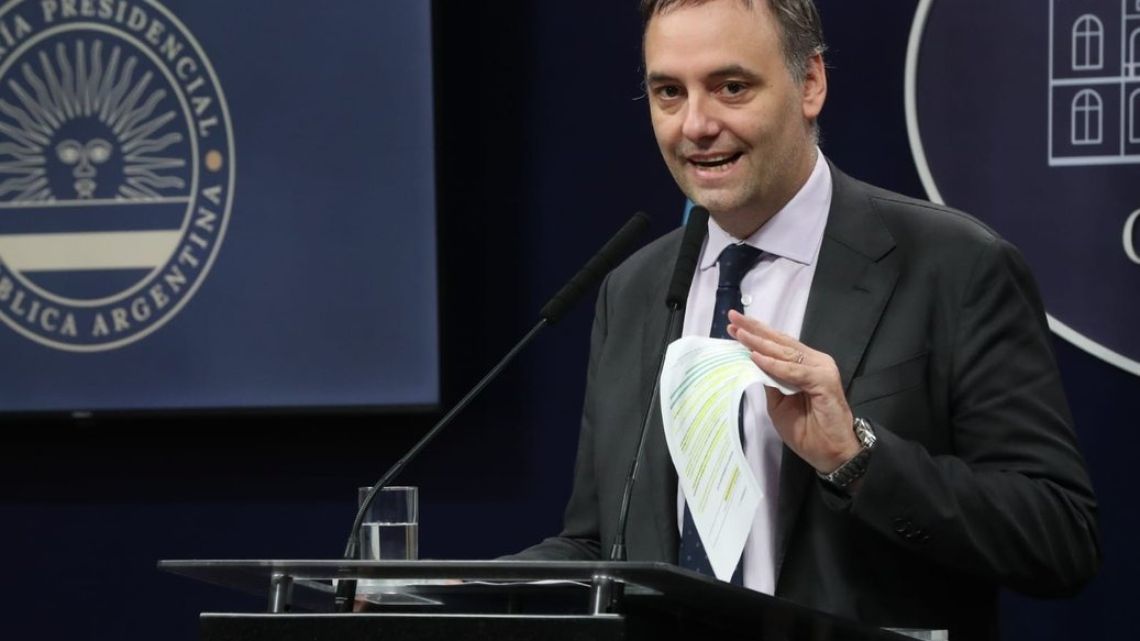
Cabinet Chief Manuel Adorni denied on Monday that Argentina’s government had censored accredited journalists at the Casa Rosada, after restricting access to the presidential palace for more than a week and reopening it under tighter controls.
Adorni said new measures on restriction of movement, introduced following a review by the Casa Militar and the Communication & Media Secretariat, were aimed at enforcing existing regulations rather than limiting press freedom.
“After a week of assessment, the Casa Militar House, together with the Communication & Media Secretariat, adopted a new protocol. This is about enforcing existing regulations. It is not censoring freedom of expression, it is not threatening journalism, it is not building a helix to silence dissenting voices,” he said at a press conference.
He added that the administration of Argentina’s President Javier Milei was “fully in favour of press freedom” and claimed it had done “more than any other” government to promote it.

However, Adorni argued, the authorities would not allow actions carried out under the banner of press freedom that could “put national security at risk.”
“Under no other government have you had so much freedom to say whatever you want, whenever you want and wherever you want,” Adorni declared defiantly.
The restrictions follow a 10-day period during which accredited journalists were barred from parts of the Casa Rosada. Access has since been restored, but with new limitations on movement within the building.

From Monday, reporters must enter via a different door, presenting identification and press credentials. Previously, entry was through another access point using biometric controls.
Several areas that were previously accessible have been closed off, including the internal Patio de Palmeras and a first-floor balcony overlooking the Salón de los Bustos, where officials’ arrivals and departures are typically observed. Internal corridor windows facing that sector have also been frosted.
Journalists’ movements are now largely confined to the press room, toilets, cafeterias and the Patio de Malvinas. Corridors in the west wing, where key presidential offices – including those used by top presidential advisor Santiago Caputo and Presidential Chief-of-Staff Karina Milei, are located, are now off-limits.

The changes come after an investigation was opened following a television report by the TN news channel that showed footage of common areas inside the palace, apparently recorded using smart glasses. A senior military official filed a criminal complaint against the journalists involved, the channel’s production team and broadcaster.
The Communication & Media Secretariat subsequently revoked the journalist’s accreditation, later extending the measure to the entire Casa Rosada press corps.
Access and the press room was reopened after 10 days, although journalists say the new restrictions – imposed for an indefinite period – were not specified when accreditations were renewed.

During a press conference, Adorni generally declined to comment on a separate judicial case in which he is under investigation for alleged illicit enrichment, involving foreign travel and undeclared property purchases.
Asked directly about the judicial probe, which is being handled in Federal Judge Ariel Lijo’s court, Adorni declined to respond.
– TIMES/NA/PERFIL











Comments