

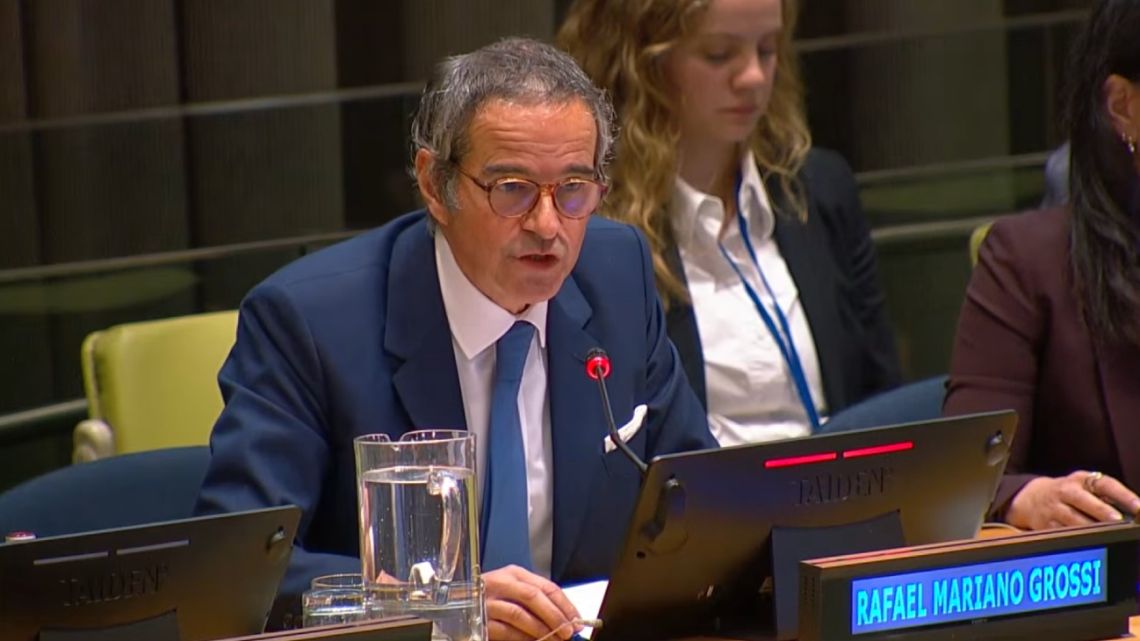
Argentine diplomat Rafael Grossi has moved into second place in the race to become the next United Nations secretary-general for the first time since the selection process began, according to reports.
Grossi, who heads the International Atomic Energy Agency (IAEA), received six votes to “encourage” his candidacy, seven to “discourage” it and two marked “no opinion” in Wednesday’s latest edition of a closed-door Security Council poll.
In the informal voting, the council’s 15 members anonymously assign each candidate one of three ratings – “encourage,” “discourage” or “no opinion” – offering an indication of support without constituting a formal vote.
Grossi was nominated by Argentina and was the first of the candidates to publicly declare his intention to seek the UN’s top job.

His move into second place came at the expense of Carolyn Rodrigues-Birkett, Guyana’s former foreign minister.
Grossi’s latest numbers do not necessarily indicate a decisive shift in his favour. In the previous poll on September 29, he received eight “encourage” votes and seven “discourage”, with no members expressing “no opinion.”
The veteran diplomat’s performance has fluctuated somewhat throughout the informal polling process, leaving his overall position in the race uncertain as the contest progresses.

Costa Rican nominee Rebeca Grynspan retains the lead after securing nine “encourage” votes in Wednesday’s poll. But the former Costa Rican vice-president and senior UN official saw her support weaken from the previous round, when she received 10 “encourage” votes.
Opposition to Grynspan also increased, with six members now marking her “discourage,” compared with three on September 29. The number of “no opinion” responses fell from two to zero.
Seven candidates – four women and three men – are competing to succeed UN Secretary-General António Guterres, whose second five-year term ends on December 31, 2026.

The selection process remains highly uncertain. A candidate must secure at least nine votes from the 15-member Security Council, while also avoiding a veto from any of its five permanent members – China, France, Russia, the United Kingdom and the United States.
Even a strong performance in the informal polls does not guarantee the nomination, with the major powers retaining the ability to block a candidate.
Once a candidate clears the Security Council, their nomination is sent to the UN General Assembly for confirmation.

It is customary for the UN’s top post to rotate between regions. Under that informal principle, the next secretary-general should come from Latin America, putting candidates from the region at the centre of the contest.
There is also a strong push for a female candidate.
– TIMES/AFP/NA








Comments