

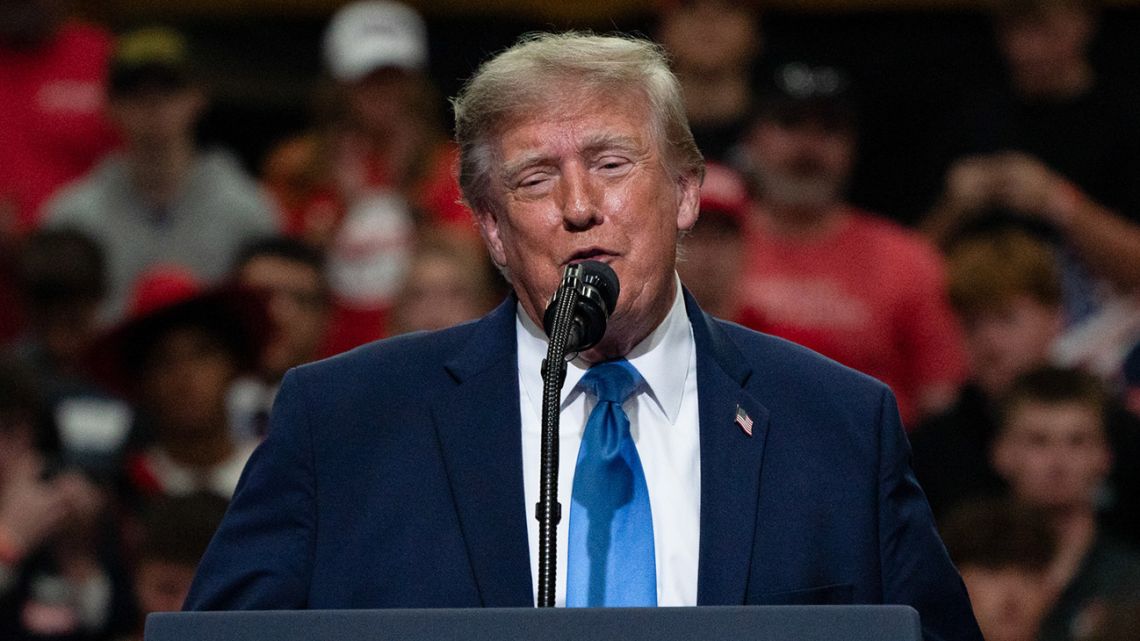
Donald Trump has slashed US aid to Latin America even as country after country has elected governments aligned with him.
Despite Washington’s renewed focus on the region, military aid to eight of its major economies slumped to just US$56 million last year, the lowest since at least 2001, according to data compiled by Bloomberg Economics.
Trump ally Flávio Bolsonaro finished first in Sunday’s Brazilian presidential election and is the favourite to win the Oct. 25 runoff against incumbent Luiz Inácio Lula da Silva. A Bolsonaro victory would leave Mexico as the only major regional economy not led by a government aligned with Trump.
Yet rather than bankroll friendly governments, Trump is pressing them to boost defence budgets, buy US weapons and join US-led operations against drug-cartels.

Since 2023, Trump allies have won elections across Latin America, including in Argentina, Chile, Peru and Colombia. Venezuela’s socialist government realigned with Washington after US forces captured President Nicolás Maduro in January.
Colombia, the largest recipient of US military aid in the region since the early 2000s, has been promised new help since right-wing lawyer Abelardo de la Espriella took power in August. But even the US$52 million in additional military financing the US State Department plans to divide among Colombia, Ecuador, Peru and Panama is a fraction of what Colombia alone received at the height of Plan Colombia, the Clinton-era counter-narcotics and counterinsurgency programme that funnelled billions of dollars in security assistance to Bogotá.
The contrast with previous US campaigns is stark. At Plan Colombia’s peak, Washington was spending hundreds of millions of dollars a year in Colombia alone on military, police and counternarcotics programmes.

“Foreign military financing is out. Foreign military sales are in,” said Henry Ziemer, a fellow at the Center for Strategic and International Studies in Washington. “Military exports are one way we can revitalise the US industrial base, but there’s not a lot of appetite to give those away. The US wants people to pay for it.”
While Trump has shunned financial support, he has committed resources in another way by deploying troops in some situations. Fourteen Latin American countries signed onto Trump’s Shield of the Americas, an anti-crime alliance he launched in March. Several countries have agreed to conduct joint strikes with the US, Defense Secretary Pete Hegseth said in August. US troops have recently joined a police raid in Ecuador and trained in Panama for jungle operations.
Separately, US forces have killed more than 220 people in strikes on vessels the military says were carrying drugs.

Trump’s approach to Latin America has been dubbed the “Donroe Doctrine,” a play on the Monroe Doctrine, the 19th-century policy asserting US dominance in the Western Hemisphere.
“The actual assistance flows have not moved in tandem with rhetoric, at least so far, amid a broader pullback in US foreign assistance,” said Bloomberg Economics’ Jimena Zuniga.
The Pentagon and the State Department did not respond to requests for comment.

Prior administrations also focused on economic initiatives in the region, which at its peak in 2012 brought support of all kinds to eight of its major economies – including for military – to over US$2 billion, adjusted for inflation. Last year, it was down to close to half of that: US$1.1 billion.
Ideological considerations aren’t the main factor determining which countries got US support, Bloomberg Economics wrote. Mexico, which has a left-leaning government, has long been a key collaborator, even though President Claudia Sheinbaum has repeatedly rejected any foreign military operations in her country.
Trump’s government has played favourites in other ways, pledging financial support to Argentina’s Javier Milei before critical elections and punishing Brazil with tariffs after its courts refused to drop charges against former president Jair Bolsonaro for an attempted coup.

“The US has other tools to support allies and pressure perceived foes, as the financial lifeline to Argentina and steep tariffs on Brazil illustrate, respectively,” wrote Bloomberg Economics’ Zuniga and Courtney McBride. “Still, the evolution of assistance flows so far may point to limits on the US strategy.”
by Maya Averbuch, Bloomberg









Comments