

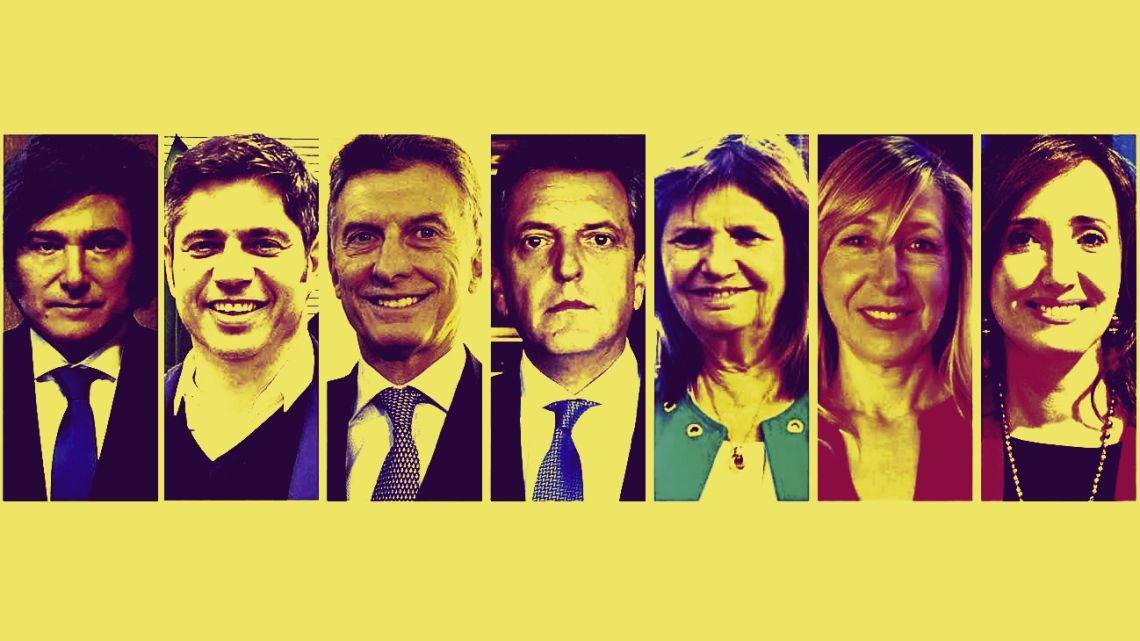
With lightning speed, President Javier Milei has gone from being seen as a likely first-round re-election winner just a few weeks ago to a candidate who can no longer be considered to have even a guaranteed place into a run-off.
Extreme forecasts are the product of the bipolar nature of the relationship between presidents and their societies that characterises us. The most reasonable approach is to consider three broad scenarios, from which alternative combinations then emerge.
Scenario one: The Milei government’s economic plan manages to reach the elections with some tangible improvement in the lives of the majority of voters and, at the same time, the Peronist candidate fails to distance himself sufficiently from the negative image generated by ex-president Cristina Fernández de Kirchner as the embodiment of Kirchnerism, allowing Milei to be re-elected in a run-off.
Scenario two: The government’s economic plan reaches the elections without bringing tangible improvements to the lives of the majority of voters and current social discontent persists, but without an economic collapse. This creates an opportunity for a candidate who maintains the current economic course, with some adjustments, offering as an improvement a president without Milei’s personal shortcomings. Such a candidate could emerge either from the coalition formed by Cambiemos/Juntos por el Cambio or from a similar centrist alliance with a strong presence in the provinces.

Scenario three: The government’s economic plan worsens voters’ quality of life and growing social discontent leads the majority of voters to prefer not simply a moderate leader of the same economic model, but a different economic model altogether. The electorate moves from the anti-Kirchnerism of 2023 to anti-Mileism in 2027, and a Peronist candidate would win the run-off.
These three scenarios could be strengthened and combined depending on: one, whether or not there are PASO primaries; two, whether Peronism and anti-Peronism go into the election united or divided; and three, whether all the provincial governments and the Buenos Aires City government that are not constitutionally required to hold separate elections bring their local elections forward.
If the national PASO primaries are retained, the electoral calendar would move forward by two months, with October becoming August; if local elections were also brought forward, then the provinces that also hold local PASO primaries and the calendar would be brought forward by another two months on top of that.

At the same time, if Peronism were to remain united, as this week’s meeting appears to indicate – bringing together Axel Kicillof, Sergio Massa and Máximo Kirchner, along with other governors and congressional leaders – it would make it more difficult for Mauricio Macri’s PRO party to lead the construction of a ‘Juntos por el Cambio 2.0’ coalition, because the sociological axiom that external threats cause groups to close ranks would come into play. A polarised scenario against a Peronist movement capable of aspiring to 40 percent of the vote would immediately push the centre-right sectors to join forces with La Libertad Avanza.
Nor should the significance of forces at the extremes be underestimated, such as Vice-President Victoria Villarruel’s nationalism and Myriam Bregman’s anti-capitalism, which together could reach double-digit support. Both are being courted to join the polarisation – in Bregman’s case, the invitation has already been made officially by Peronist Senate leader José Mayans, who, after attending last Wednesday’s Peronist meeting, publicly offered the leader of the Partido de los Trabajadores Socialistas the chance to join and compete in an internal primary.
Finally, there is the ‘outsider’ candidate factor. The most credible option, Jorge Brito, would have much to lose, given that he chairs one of the country’s main banks and energy companies, as well as property and agricultural development businesses. Then there is the recently mentioned media mogul, Infobae founder Daniel Hadad, and the figure who began last year with considerable momentum but is now rarely seen: evangelical preacher Dante Gebel.

It is worth remembering that around this same point in the electoral cycle, in August of the year before the vote, media celebrities are often discussed as potential candidates, many of whom ultimately never stood. In August 2018, the outsider candidate was Marcelo Tinelli, who at one point even recorded voting-intention figures of up to 17 percent. Further back, when Néstor Kirchner was elected with just 22 percent of the vote, the celebrity of the moment was Nito Artaza, who years later became a senator for Corrientes Province.
Returning to the three scenarios, what will change is the argument underpinning the vote. If the government’s economy recovers, the argument will be to support Milei and reject Kirchnerism. If the government’s economy does not improve, the argument will be to maintain the course with a more civilised leader. If the government’s economy deteriorates, the argument will be for a change of course. The economy will always be the decisive factor, although in scenario two, Milei’s civic and republican failings could provide the pretext.
Something happened last week: the 2027 electoral race effectively began, months earlier than it normally would. But December will bring the decisive turn, when the rules, calendar and voting system are finally settled. That is when the real race for 2027 begins.














Comments