

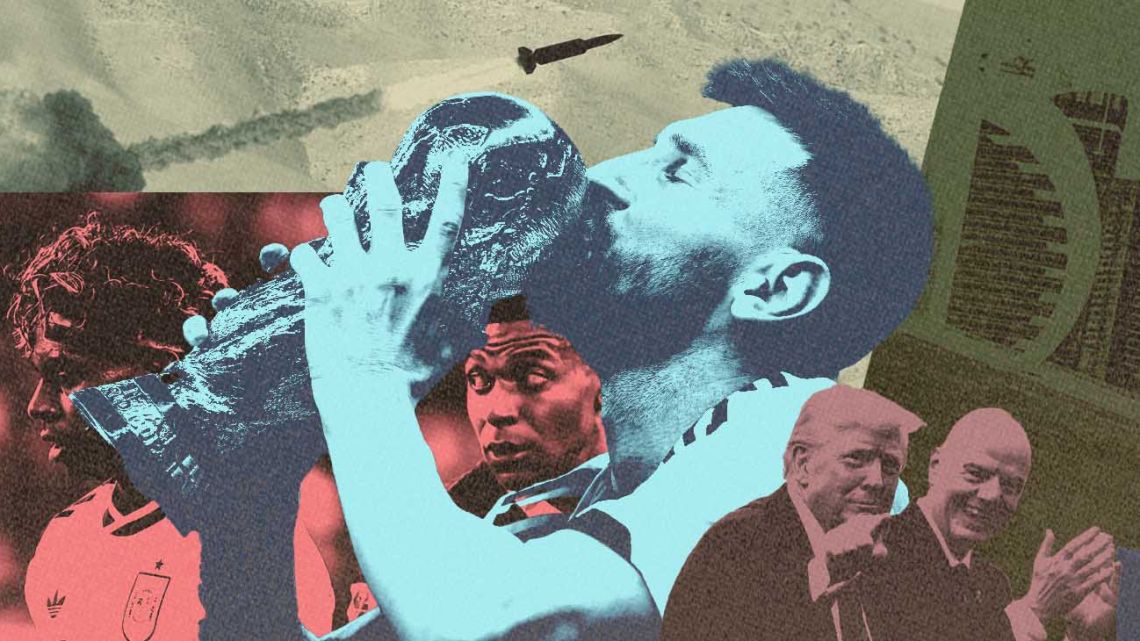
The power of football – not even the full fury of Middle East conflict could avert the Finalissima between Argentina and Spain, cancelled 16 weeks ago but now set for tomorrow. Obviously destined to be. Previews of tomorrow’s final will be a dime a dozen and also something of a fool’s errand between an apparently invincible Argentina snatching victory from the jaws of defeat in the closing minutes time after time against a Spain conceding only one goal in the entire tournament, plus Argentina’s last title defence falling just short in Italy in 1990. This column will also refrain from adding to the saturation coverage of Wednesday’s triumph (taking Argentina’s World Cup semi-final record up to seven out of seven), apart from being unable to resist the comment that England trainer Thomas Tuchel’s decision to play the last 10 minutes in pure defence was positively suicidal – the Bavarian thus merely confirmed the curse of a foreign coach never winning the World Cup.
Instead we will stick to a global rather than national perspective. This column’s forecast that the expanded tournament would not change the balance of power despite several surprises along the way stands vindicated – any chance of a new champion already perished in the quarter-finals with all four semi-finalists ex-champs. Only eight of the 184 World Cup quarter-finalists since 1930 have come from outside Europe or South America and only three of the 92 semi-finalists, none of them reaching the finals (with Europe supplying 29 of the 46 finalists to date).
Europe and South America both have teams playing this weekend but we can now also already close the book on Africa and the rest of the Americas (the Asian and Oceanian figures were given last week). African teams won 11 matches, drew 12 and lost 19 while scoring 53 goals and conceding 63 – the fact that the goal difference is less negative than the overall balance between victories and defeats points to close matches (indeed the omission of a Tunisia 10 goals in the red would leave the rest of the continent even steven). The Americas between Alaska and Panama had nine triumphs, two draws and 13 losses with 33 goals in favour and 38 against – a somewhat better percentage than Africa (around 40 percent of the possible points as against about 35) but perhaps mostly due to the advantage of half of them being host nations, especially in Mexico’s case.
Next week’s closing column will not only give the final figures for every continent from this World Cup but also for the entire history completing a centenary in the next tournament so that is probably enough number-crunching for now.

Moving onto this column’s World Cup history with a focus on the special relationship between FIFA and the host countries, while in the past century all 16 tournaments were played in Europe or the Americas (with rigid alternation between the two as from 1958), the new millennium saw FIFA with its Swiss helm since 1998 seeking wider horizons. The 2002 World Cup had already seen the arena moved to Asia – also the only tournament until this year with multiple hosting between Japan and South Korea – and in 2010 it was Africa’s turn to make its debut with South Africa after a bidding process restricted to that continent. That title was won by tomorrow’s finalist Spain, the first champions to lose their opening match (which might make them feel better about their pathetic starting performance against humble Cape Verde this year).
Multiple champion and 2016 Olympics host Brazil seemed a natural enough choice for 2014 – their incredible 7-1 semi-final defeat to eventual champions Germany left the task of defending the South American monopoly of all tournaments staged in the hemisphere until then up to Argentina, which has now played in three of the last four World Cup finals. Up to and including Luiz Inácio Lula da Silva, there had been little enough controversy about the World Cup hosts – Japan’s Junichiro Koizumi (premier for over five years, a remarkable political longevity by Japanese standards) and South Korea’s Kim Dae-jung were conventional enough politicians even if Koizumi had longer hair than his colleagues and Kim was considered a tad to the left with his “Sunshine Policy” towards North Korea. German Chancellor and 2006 hostess Angela Merkel (2005-21) was too maternal a figure for any reproach.
The only exception was South Africa’s Jacob Zuma, whose 2009-2018 presidency was preceded by being defendant in a rape trial and ended in a storm of corruption scandals. And when the ‘FIFAgate’ scandal exploded in 2015, whistleblower Chuck Blazer pointed his finger at South Africa rather than Brazil for bidding process kickbacks. FIFAgate ended Sepp Blatter but not the underlying corruption. Oil dictated the next two choices – Russia under a Vladimir Putin who had already invaded the Crimea for 2018 and Qatar whose scorching summer temperatures obliged the 2022 contest to be moved to the pre-Christmas season with FIFA ignoring the opportunity to expand the World Cup to the one continent still missing with Australia, while resisting more attractive bids by the United States and Britain. North America this year while Spain accompanied by Portugal and Morocco crushed the hopes of a centennial Southern Cone tournament with its final in Montevideo’s Centenario stadium where it all began in 1930 but oil is doing the talking again with Saudi Arabia’s controversial Crown Prince Mohammed bin Salman scheduled for 2034.

Putin was so grateful to FIFA for its sportswashing that he said in 2015 that Blatter “must be awarded the Nobel Peace Prize.” Appropriately enough, the opening match of the 2018 World Cup was the Russia-Saudi Arabia “petro derby” in Moscow with Putin delivering his inaugural speech flanked on either side by Mohammed bin Salman and FIFA’s current polyglot president Gianni Infantino. In order to boost the crowds, Putin let spectators enter Russia without a visa. As for Qatar, the triumph of this tiny sheikhdom with zero football traditions in nailing a World Cup backfired somewhat by drawing attention to its treatment of construction workers, as well as its institutional deficiencies in human rights and democracy – as experienced by Argentina in 1978, hosting this jamboree can draw global attention to things régimes would rather stayed hidden.
At least those flawed tournaments had the best finals since Argentina last won in 1986 – France 4, Croatia 2 in Moscow (with the last French goal scored by a teenage Kylian Mbappé) while no reader should need a reminder of what happened in Qatar. Will that history repeat itself tomorrow?






Comments