
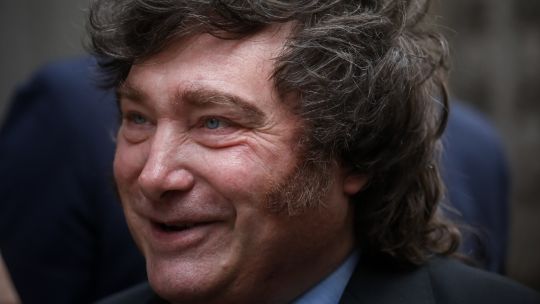
President Javier Milei’s address to the 81st General Assembly of the United Nations in New York was delivered at almost the exact midpoint of the week, but that was almost the only thing at all middling about it.
No attempt to endear himself to his hosts at the outset by describing them as ”a useless organisation which only serves to feed a caste of fatally arrogant parasites, disguised as well-meaning bureaucrats.” The next 20 minutes were dominated by his current hobbyhorse of Malvinas sovereignty (where his September 3 nationwide broadcast was repeated almost word for word), a “national cause” to the point of conditioning investment in Vaca Muerta shale and a fervid defence of Artificial Intelligence where he pronounced his faith that progress always results in progress (except, of course, when in the hands of progressives) – the sidebars of the speech included a critique of coronavirus pandemic lockdown to justify exit from the World Health Organisation (WHO) and a reiteration of “unambiguous” alignment with the United States and Israel as the keystone of his international policy before winding up on a “Make Argentina Great Again” note.
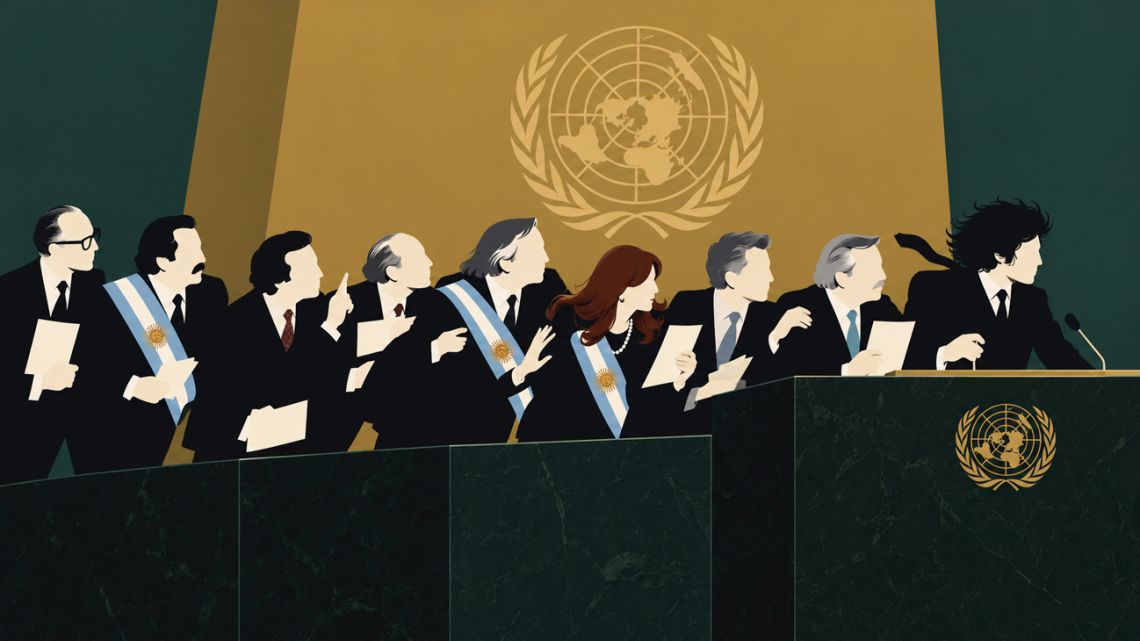
It is not the aim of this column to dig any deeper into the speech (which is covered in other pages of this newspaper) but instead supply the context of its predecessors. Argentina joined the United Nations as one of the 51 founding members (out of a current total of 193) on its very first day, October 24, 1945, but neither Juan Domingo Perón nor his military replacements could be bothered to take time off in September for the annual regular session of its General Assembly. President Arturo Frondizi at least showed up in 1960 (the year after Argentina’s first International Monetary Fund loan) without venturing to make a speech – he did speak in 1961 when he highlighted the risks of isolating a revolutionary Cuba then in its third year and the need for developing countries to give priority to heavy industry in line with his “steel not sweeties” economic policies.
Arturo Illia never spoke to the General Assembly but his 1963-1966 Presidency did see the first step towards the Malvinas sovereignty drive pushed by Milei this week via his UN ambassador, the late Lucio García del Solar – the famous Resolution 2065 of 1965 formally recognising a sovereignty dispute and calling on the two sides to negotiate it peacefully and bilaterally. The military régime displacing Illia (which considered Argentina to be the South Africa of this hemisphere) took no interest in the United Nations and neither did Perón in the last September of his life in 1973, with CGT secretary-general José Ignacio Rucci being assassinated by Montonero guerrillas in the same week. Ditto for his widow, Isabel Perón, and for the military juntas between 1976 and 1983, which takes us through to the return of democracy.

Raúl Alfonsín’s first speech to the UN General Assembly (and only the second by an Argentine president) was in the Orwellian year of 1984 – he called for developing countries to be given a break with their foreign debts and for an end to apartheid in South Africa (thus setting up his Foreign Minister Dante Caputo later to become UN General Assembly Speaker), virtually repeating the speech the following year but skipping the event thereafter as his domestic difficulties began to mount. The self-evident virtues of peace, human rights and democracy were also common denominators of both Alfonsín’s UN speeches, plus (of course) Malvinas sovereignty. He also seemed to interpret the New York venue as an occasion to address the relations between the United States and Argentina along with Latin America rather than with the wider world.
Unlike his predecessors, Carlos Menem relished his annual trips to the Big Apple during his decade in power (1989-1999), only missing out in 1996. Apart from expressing wishes for world peace like beauty contestants and at least a line vindicating Malvinas sovereignty claims, his themes tended to reflect “carnal relations” with the Washington Consensus – he took a keen interest in the Middle East in particular and UN peacekeeping in general while backing global action against drug-trafficking. On the economic front an initial focus on the foreign debt was replaced by objections to protectionism as the Brady bonds and debt-equity swaps started to sort the former problem out. Menem opposed the Brazilian bid for permanent Security Council membership, preferring a rotation which would include Argentina. Calls for transparency and critiques of corruption also crept into his later speeches, striking some observers as hypocrisy.
Alliance President Fernando de la Rúa had his UN speeches written for him by events at both his appearances in 2000 and 2001 – the former was all about the Millennium Agenda while the latter had to be held in November, due to the 9/11 terrorist attack whose 25th anniversary was marked earlier this month. Terrorism was obviously the elephant in the room in 2001 while De la Rúa’s contribution to the Millennium Agenda was to stress the link between poverty and violence, calling for the trade barriers against developing countries to be removed. He managed to squeeze Malvinas sovereignty into both speeches.

Caretaker president Eduardo Duhalde’s 2002 absence takes us straight through to the dozen years of Kirchners (2003-2015) with perfect attendance in that period. Néstor Kirchner’s first speech told foreign debt creditors that they were wasting their time if they expected repayment without permitting socially inclusive growth in debtor countries, adding criticisms of the International Monetary Fund in the following years – poverty, hunger and exclusion were threats to world security, he argued. He also upheld multilateralism against any US aspirations to hegemony while deploring the 1992 and 1994 terrorist attacks in Argentina of presumably Iranian origin. Human rights and Malvinas sovereignty were also constant themes, adding Latin American regional integration in his final year in 2007.
More of an orator than her husband, Cristina Fernández de Kirchner made full use of this occasion in her two terms (2007-2015). Space is lacking to cover in full the floods of rhetoric and the continuous boasts of the success of Kirchnerite economics but lambasting the IMF in 2012 and the “economic terrorism” of the “vulture funds” in 2013 and 2014 (replacing the 2008-2009 global financial meltdown as her target), her U-turn on the 1994 terrorist attack on the AMIA Jewish community centre (fiercely critical of Iran until 2010, when she also pushed Palestinian UN membership) and her omission of the Malvinas issue in 2015 (because she had already spoken for more than double her allotted 20 minutes and had to be interrupted) all stand out.
Regarding the UN as an international forum, Mauricio Macri tended to focus on a foreign policy of bringing Argentina back into the world, turning back the heat on Iran for the terrorist attacks here and blasting the Bolivarian régime in Venezuela. The unsuccessful bid of his Foreign Minister Susana Malcorra to become the new UN secretary-general also absorbed part of his agenda, while the 2018 financial crisis in Argentina placed him on the defensive on that front in his last two speeches. He missed the 2017 General Assembly for health reasons and was already a lame duck in 2019.

Macri did not omit the Malvinas issue and neither did his successor Alberto Fernández. Is any reader really interested in the latter’s UN speeches (generally a hard luck story with first the Covid-19 pandemic and then the Ukraine war while criticising the IMF-based “financial architecture”)? His 2022 speech was dominated by the attempted assassination of his veep Cristina Fernández de Kirchner at the start of the month.
Which brings us back to the start – Milei. His third UN speech already, but the most recent last Wednesday is the one which counts.





Comments