

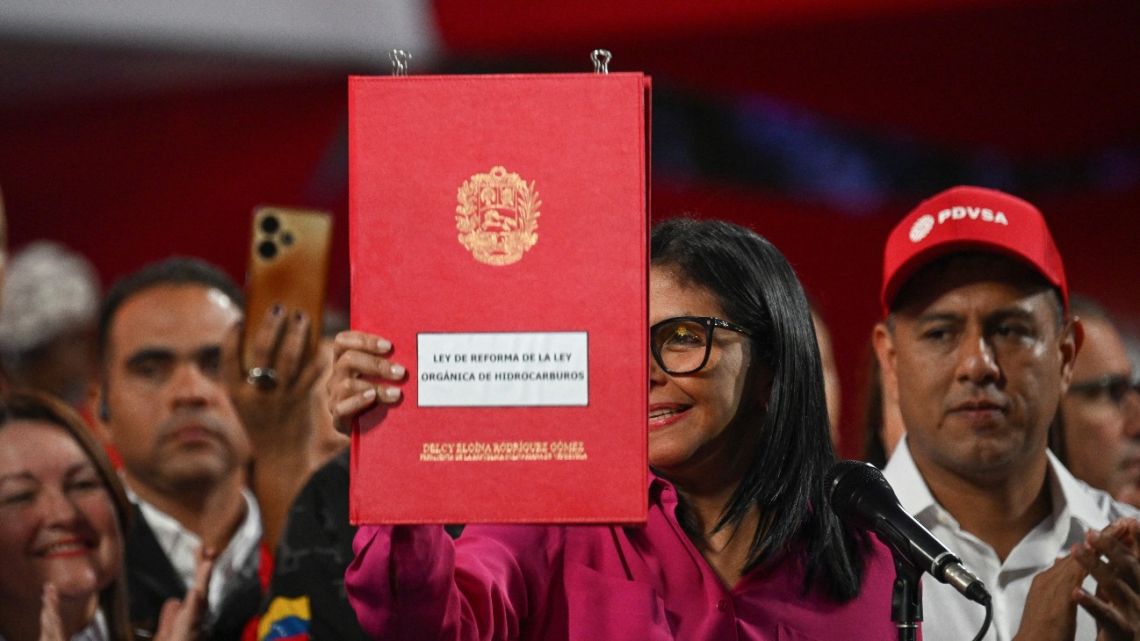
The United States on Thursday eased sanctions on Venezuela's oil industry after Venezuelan lawmakers passed reforms paving the way for US companies to return – a key goal of President Donald Trump's intervention in the country.
Within an hour of lawmakers in Caracas voting to open the oil industry to private investment, the US Treasury Department issued a general licence allowing US companies to trade with state oil firm PDVSA. The activities authorised include the refining of oil, the licence said.
Addressing oil industry workers, Venezuela's acting president Delcy Rodríguez hailed the reform as a "historical leap."
"We are taking historic steps," Rodríguez said after a call with Trump, who also announced the reopening of Venezuela's airspace.

Trump pressured Caracas to open up its oil fields to US investors after overthrowing socialist leader Nicolás Maduro in a deadly US raid on January 3.
The US president backed Maduro's deputy Rodríguez to take over, on the proviso that she give Washington access to the world's largest proven oil reserves.
Rodríguez has appeared eager to comply with his demands, arguing that an influx of foreign capital is needed to revive the battered Venezuelan economy.

The reform adopted Thursday paves the way for the return of US energy majors, two decades after socialist firebrand Hugo Chávez seized foreign oil fields.
It modifies a law dating to 2006 that forced foreign investors to form joint ventures with state oil company PDVSA, which insisted on a majority stake.
Jorge Rodríguez, president of the National Assembly and brother of Venezuela's interim leader, said the reform will help the country recover from years of living under US sanctions.

"Only good things will come after the suffering," he said as he gavelled through the law "for history, for the future."
Trump has said Washington is now "in charge" of Venezuela and Rodríguez will be "turning over" millions of barrels of oil to be sold at market price.
Rodríguez has already ploughed US$300 million from a first US sale of Venezuelan crude into shoring up the country's struggling currency, the bolívar.
Slow recovery
Venezuela sits on about a fifth of the world's oil reserves.
It was once a major crude supplier to the United States, and multiple US firms operated in the country until 2007, when Chávez led a new wave of nationalisations.
The industry is undergoing a slow recovery after being walloped by years of underinvestment, corruption, mismanagement and six years of US sanctions.
It reached production of 1.2 million barrels per day in 2025, a milestone compared to the 300,000 per day extracted in 2020, but far from the three million achieved at the start of the century.
Trump, who has lavished praise on Rodríguez, has been pressing oil executives to invest in Venezuela.
Exxon Mobil and ConocoPhillips exited in 2007 after refusing to cede majority control to the state.
Chevron is the only US firm still operating in Venezuela, under a special sanctions exemption.
The revised law offers greater guarantees to private players, relinquishes state control of exploration, and lowers taxes and royalties.
"This obviously completely dismantles Hugo Chávez's oil model," said oil analyst Francisco Monaldi, while pointing out that the state will retain some discretion over the issuing of contracts to private players.
The US Department of Energy has already unveiled a plan to develop Venezuela's oil industry and begun marketing Venezuelan crude.
Rodríguez says the reform will bring money for "new fields, to fields where there has never been investment, and to fields where there is no infrastructure."
The changes are cause for optimism for many in a country battling economic collapse and mass emigration.
"This hydrocarbons reform helps restore our dignity," Karina Rodríguez, a 53-year-old PDVSA employee told a recent rally.
Cuba threat
Trump signed an executive order Thursday threatening to impose additional tariffs on countries that sell oil to Cuba, further increasing pressure on the Communist-led island.
The order did not specify the value of the tariffs or which countries would be targeted, leaving those determinations up to his secretary of commerce.
Cuba, which has largely been under a US embargo since 1962, until recently received most of its oil from Venezuela.
But the United States has moved to block the flow after removing Maduro from power and effectively seizing control of Venezuelan oil exports.
Following the Venezuela operation, Trump vowed to completely cut off oil and money going to Cuba.
"I strongly suggest they make a deal, BEFORE IT IS TOO LATE," he threatened in a social media post.
The United States has been mum on what kind of deal it is seeking with the island's communist government.
Havana's Foreign Minister Bruno Rodríguez on Thursday called the latest move in a post on X a "brutal act of aggression against Cuba and its people, who for more than 65 years have been subjected to the longest and cruelest economic blockade ever imposed."
The order signed Thursday threatens added tariffs on any "country that directly or indirectly sells or otherwise provides any oil to Cuba."
The order invokes the International Emergency Economic Powers Act (IEEPA) and calls the Cuban government an "extraordinary threat" to US national security.
Other tariffs invoked under the IEEPA are currently being challenged at the Supreme Court.
Declaring a "national emergency" related to Cuba, Trump made similar claims to those made against Venezuela, such as providing support nations hostile to the United States.
"The regime aligns itself with – and provides support for – numerous hostile countries, transnational terrorist groups, and malign actors adverse to the United States," including Russia, China, and Iran, as well as the militant groups Hamas and Hezbollah, the order said.
The pressure comes as the communist island is in the throes of its worst economic crisis in decades, marked by recurring power outages of up to 20 hours a day and shortages of food and medicine that have created a mass exodus of Cubans.
US neighbour Mexico has become a significant provider oil to Cuba, though media reports have suggested that flows could be slowing under pressure from Trump.
– TIMES/AFP
related news
Lula, Macron push for stronger United Nations to face Trump 'Board of Peace'
The eclipse of traditional faith? The religious shift redefining Argentina and Latin America

‘I fear for my life’ – Video released of Argentine lawyer detained in Venezuela






Comments