

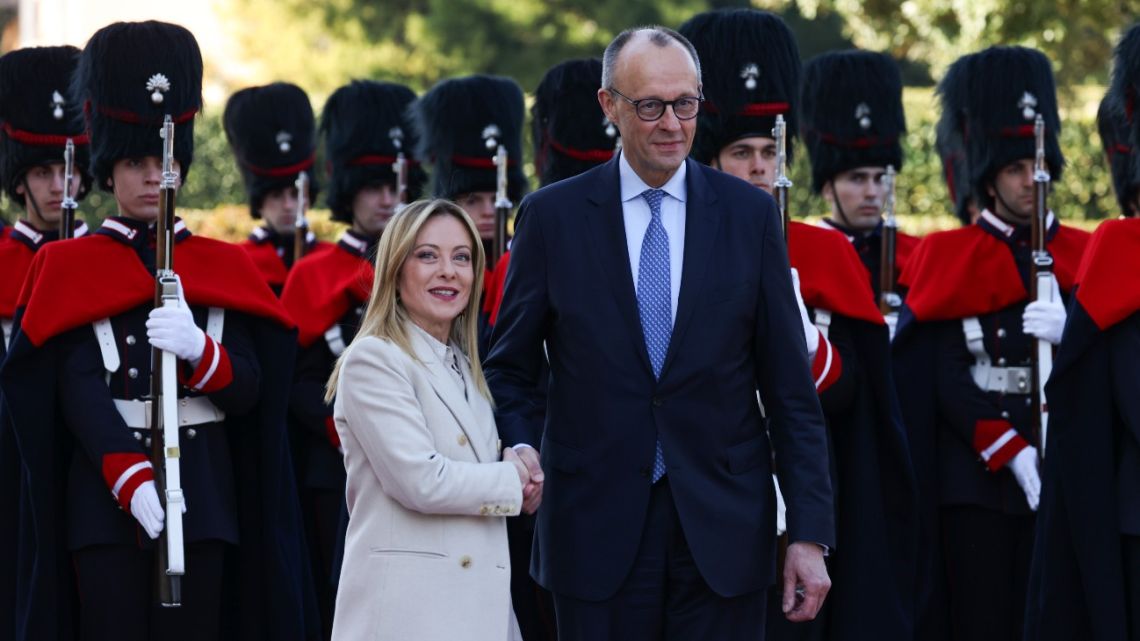
German Chancellor Friedrich Merz urged the European Union to implement a new trade agreement with South American countries on a provisional basis, effectively sidestepping a judicial review of the pact engineered by its opponents in the European Parliament.
The “democratic legitimacy” of the EU’s Mercosur deal with Argentina, Brazil, Uruguay and Paraguay is beyond doubt, Merz told reporters Friday after talks with Italian Prime Minister Giorgia Meloni in Rome. It can provisionally take effect as soon as the first of those South American nations ratifies it, he said.
“I regret very much that the European Parliament made its decision at a time when the world expects the European Union to demonstrate its ability to act,” Merz said. “We mustn’t let ourselves be held back by those who want to use the lever of trade policy to drive the weakening of Europe.”
The EU recently approved the Mercosur agreement after more than 25 years of negotiations, pushing it through over strong objections from France, which argued that the free-trade agreement would undermine European agriculture.

Meloni’s government also had initial doubts but ultimately backed the pact. Meloni reiterated that stance on Friday, saying it was a “balanced deal” in part thanks to her lobbying and should come into effect.
EU leaders raised the issue of applying the Mercosur agreement provisionally during a summit in Brussels on Thursday, according to European Commission President Ursula von der Leyen.
She said the Commission, which handles trade matters for the EU, hasn’t decided yet on applying the trade deal.

Merz and Meloni were speaking at a joint press conference after German-Italian government consultations with senior ministers from both countries.
Merz is seeking to deepen Germany’s ties with Italy having grown frustrated over widening divisions with French President Emmanuel Macron in policy areas like trade and defence, as well as how to deal with an increasingly erratic US President Donald Trump.
In a speech at the World Economic Forum in Davos on Thursday, the conservative German leader said he hoped the Berlin-Rome axis would produce “almost revolutionary ideas” to spur economic growth and help create “a fast, dynamic Europe.”

Merz and Meloni are not obvious political bedfellows – the Italian premier’s Brothers of Italy party has its roots in the country’s fascist movement ≠ but have agreed to present joint proposals on how to boost competitiveness to EU counterparts at a summit in Belgium on February 12.










Comments