

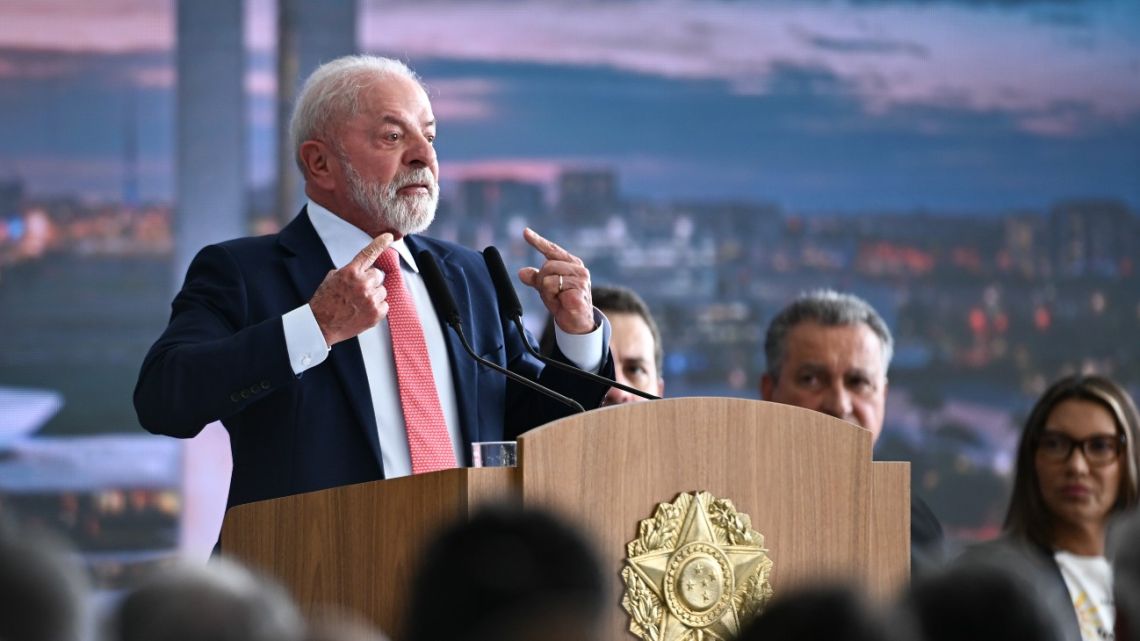
Brazil’s Luiz Inácio Lula da Silva returned to power vowing to revive South American political and economic unity. A regional event this week shows he’s now fighting to maintain clout in his own backyard.
The 80-year-old leftist icon is coming face-to-face with a new generation of younger, conservative presidents at the Latin America and Caribbean International Economic Forum – the “Davos of Latin America,” it’s been called – in Panama on Wednesday.
The event is the first gathering of regional heads of state since the United States captured Venezuela’s Nicolás Maduro, sparking outrage from Lula but praise from other leaders who will be in attendance.
Lula travelled to Panama City intent on ensuring the left is represented in talks that will be dominated by conservative figures more sympathetic to Donald Trump in the US and Argentina’s Javier Milei closer to home. But more than a political test, the event is a major trial of Lula’s longstanding efforts to integrate the region’s economies in ways that bolster trade, investment and infrastructure partnerships capable of enduring sharp political differences.

“Guided by pragmatism, we can overcome ideological differences and build solid and positive partnerships within and outside the region,” the Brazilian president said during the event’s opening session. “This is the only doctrine that suits us.”
Leaders from across the region echoed the message, with Panamanian host José Raúl Mulino calling on counterparts to put aside ideological differences to work together on common problems.
Even before the event started, Lula held a bilateral meeting late Tuesday with José Antonio Kast, the ultraconservative victor of Chile’s December presidential race. Kast, who’ll replace leftist Gabriel Boric in March, said afterward that they’d discussed opportunities to cooperate on energy and security issues, and on Wednesday stressed the need to work with Brazil.

“If Brazil does well, then Chile does well. If Brazil does well, then all of Latin America does well,” Kast said in his speech. “It’s like a big brother. You need to have a good relationship with your siblings.”
Lula, meanwhile, emphasised programmes to further integrate regional trade and economic routes with ports on the Chilean coast, Brazil’s government said in a statement about the meeting.
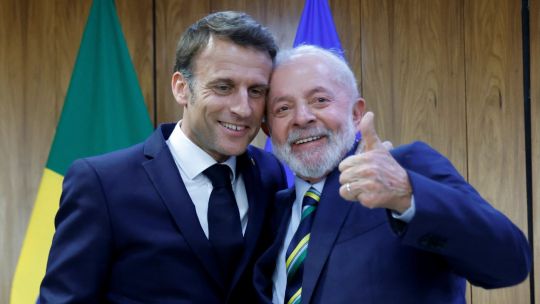
Brazilian officials say the encounter is in line with Lula’s history of overcoming ideological differences. Across his career, he’s forged close ties with leaders like Hugo Chávez on the left, Emmanuel Macron in the center and George W. Bush to his right. He spoke to Trump on Monday, and is planning a Washington visit in early March.

“We don’t focus on the political orientation of each leader,” Gisela Padovan, the secretary for Latin American and Caribbean affairs at Brazil’s Foreign Ministry, told reporters before the trip. “Our relationships, past and future, are far greater than the political moment here or there.”
Integrating Latin America’s economies has been a major goal of Lula’s since he reassumed the Presidency in 2023 as part of a leftist wave. He marked his return by rejoining the Community of Latin American and Caribbean States (CELAC), and early in his term gathered regional leaders in Brasília for an event meant to seek common ground on issues like infrastructure, the environment and health care.
But those efforts faltered in part because he used the gathering to defend Maduro, and faced perceptions from the region’s more conservative leaders that he was set on reviving Unasur, a leftist union of South American nations originally meant to counter US influence in the region.

Lula later deployed a team of campaign advisers to Argentina in a bid to thwart Milei’s rise, contributing to a deterioration of political relations with the neighbouring nation once the libertarian won. That victory ultimately heralded a regional rightward shift that has accelerated with victories by Ecuador’s Daniel Noboa, Bolivia’s Rodrigo Paz and Kast, all three of whom are also in Panama.
Brazil’s government has acknowledged shortcomings with that strategy: Lula’s regional integration push has run into “significant hurdles,” the country’s intelligence agency said in a report late last year, including a “misalignment with the political projects of neighbouring countries.”
But whether spearheaded by right- or left-leaning leaders, efforts to more closely link Latin America’s economies are facing challenges that stretch beyond politics: reaching consensus on anything has proved even more difficult in a world upended by US trade wars and Trump’s unpredictable – and highly personal – approach to global affairs.

Lula has recently found success by focusing on economic issues that cross ideological lines: Earlier this month, the Mercosur bloc of Brazil, Argentina, Uruguay and Paraguay finalised a free-trade deal with the European Union, an agreement that holds substantial promise for both him and Milei.
And with Trump putting Latin America in an increasingly difficult position between the United States and China, he isn’t alone in striking a more pragmatic tone on economic issues.
Milei once referred to Beijing’s Communist government as an “assassin” and pledged to sever ties with Brazil. But last week, the steadfast Trump ally praised China as a “great trading partner” while adopting a businesslike tone toward Lula – even though they still don’t talk.

“We have an adult relationship,” Milei said in an interview in Davos. “This isn’t an ideological contest of academic papers. In the middle are the lives of millions of human beings.”
by Daniel Carvalho, Bloomberg






Comments