

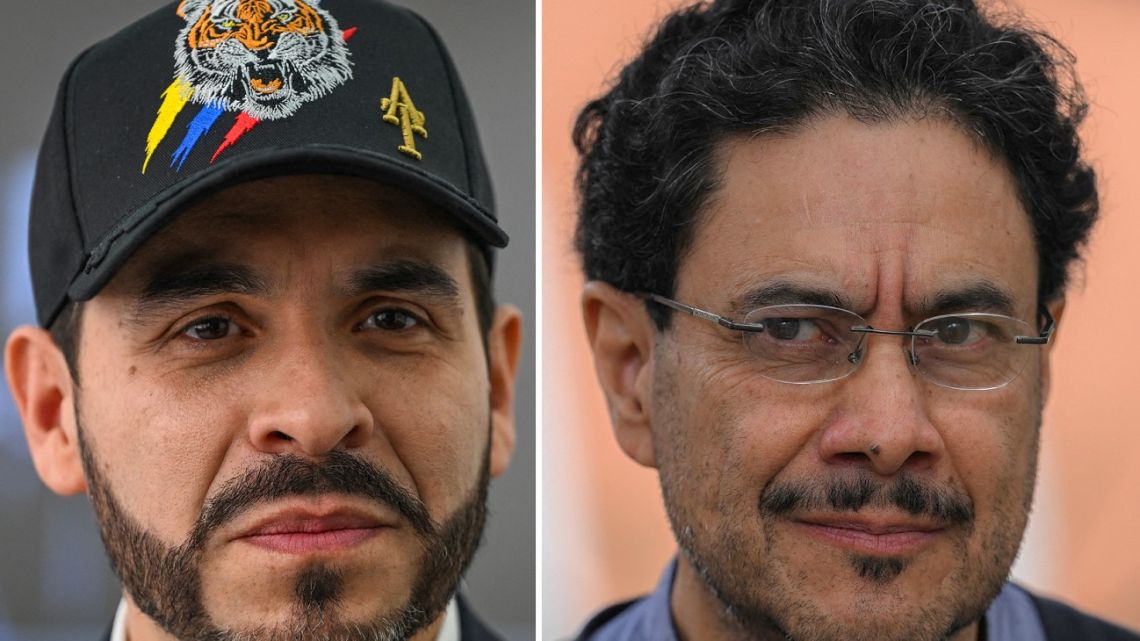
A hard-right Donald Trump fan and a leftist senator on Monday threw themselves into campaigning for Colombia's presidential run-off, a day after leading a first-round vote dominated by drug-related guerrilla violence.
Right-wing lawyer Abelardo de la Espriella was the surprise winner of Sunday's vote, garnering over 43 percent to 41 percent for the favourite, senator Iván Cepeda.
De la Espriella stormed from behind in recent weeks on a tough-on-crime platform that has resonated with voters across Latin America worried about surging violence by armed groups.
The millionaire self-described "Tiger," who has billed himself as a political norm-smashing outsider, vowed to end talks with cocaine-trafficking rebels and instead crush them with military force.

Cepeda, an acolyte of polarising left-wing President Gustavo Petro, campaigned on keeping the struggling peace process alive and expanding social programs to reduce inequality.
On Sunday night, he vowed to defeat the "fascist extreme right," linking his rival to mafia people and plutocrats.
He and Petro also questioned the accuracy of the results, leading De la Espriella on Monday to accuse them of trying to "steal democracy from us" and draw parallels with ousted Venezuelan strongman Nicolás Maduro.
Uphill battle
Cepeda faces an uphill battle to make up lost ground in the June 21 run-off.
Third-placed candidate Paloma Valencia, an establishment conservative who found herself outflanked by De la Espriella on the right, backed him against what she called Cepeda's "neo-communism."
De la Espriella "captured the spirit of anti-Petro sentiment and right-wing radicalism," Juan Nicolás Garzón, a professor of Political Science at the University of La Sabana, explained to AFP.
Cepeda, a philosopher and human rights activist who speaks in measured tones, needs to be "a bit more confrontational," Garzón added.
One of the questions hanging over the run-off is how centrists will vote.
Failed vice-presidential candidate Juan Daniel Oviedo, a centrist, lamented that the country was "caught between populist extremes" and he refused to endorse either finalist.
The campaign was marred by car bombs, drone attacks and the assassination of a leading presidential candidate and dozens of local political leaders.
De la Espriella addressed rallies from behind bulletproof glass.
He has vowed a "shock plan" to bombard armed groups, echoing the iron-fist rhetoric that has swept the right to power across Latin America.
"We'll start immediately with the bombing of narco-terrorist camps," he told AFP in an interview during the campaign.
He has also pledged to build 10 mega-prisons, modelled on El Salvador's brutal Terrorism Confinement Centre (CECOT), where inmates, he says, will survive on "bread and water."
While Colombia has thrived in the decade since a landmark peace accord with FARC guerrillas, pockets of the country are still under the grip of armed groups vying for control of cocaine routes, illegal gold mining and extortion.
'Radical extremes'
Many voters accuse Petro, who was constitutionally barred from seeking re-election, of allowing violence to flourish while pursuing peace.
Cepeda, 63, is the son of a leftist senator killed by right‑wing paramilitaries.
His supporters point to a higher minimum wage, increased education spending and land transfers to poor communities under the left.
Gloria Terranova, a 59-year-old coffee plantation worker, said she held out hope that Cepeda might still win the Presidency despite finishing second in the first round.
"Right now we are at radical extremes: one side wants peace, the other wants war," she said.
Who will be Colombia's next leader?
'The Tiger'
Abelardo de la Espriella, 47, is a millionaire lawyer and businessman who said he entered politics to prevent Colombia from being "destroyed" by the left.
He holds US President Donald Trump, Argentina's Javier Milei and El Salvador's Nayib Bukele in high esteem.
Sporting impeccable suits and, more recently, a bulletproof vest, his legal career saw him defend prominent Colombian figures including drug-traffickers and football stars.
Before launching his presidential bid, De la Espriella lived in Florence, Italy, where he dabbled in opera, jetted around in private planes and promoted his rum and wine businesses.
To combat drug-cartels in Colombia, the world's biggest cocaine producer, De la Espriella proposes a military alliance with the United States and Israel and the construction of mega-prisons, while also defending the right to carry weapons.
"Any criminal who does not surrender will be taken down as the law allows," he told AFP in an interview in February.
Branding himself "The Tiger," the candidate has a penchant for swearing and is known for his hot temper. He called for the Colombian left to be "gutted," but later toned down his language. He has also made remarks considered homophobic and sexist and frequently refers to his "balls."
Survivor
Iván Cepeda first appeared in public in 1994, in his early 30s, next to the corpse of his father, a Communist senator who was assassinated by paramilitaries.
Standing in front of a bullet-riddled truck, his call for justice was televised. "Let this crime not go unpunished," Cepeda told reporters in a measured tone, during a period of persecution that saw more than 5,700 leftist leaders killed.
The 63-year-old has previously lived in exile in the former Czechoslovakia, Bulgaria, Cuba and France. Returning to Colombia, he advocated for armed conflict victims and played a key role in the historic 2016 peace accord, which led to the disarmament of the rebel army FARC -- formerly the country's largest armed group.
His adversaries accuse him of having ties to FARC and reproach him for having devised outgoing President Gustavo Petro's "total peace" plan.
"I have survived genocide, stigmatization and relentless persecution. And here I am, still standing," he said during the campaign.
Typically wearing a traditional Caribbean shirt, Cepeda forgoes a tie, which he considers a symbol of oligarchy. The senator led the investigation into former president Álvaro Uribe's ties with paramilitaries before it went to court, where Uribe became the first Colombian leader to be convicted of a crime last year.
Although a judge later overturned the ruling, the incident established Cepeda as the right-wing leader's main political enemy and an icon of the left.
– TIMES/AFP
related news

by Valentín Díaz, AFP







Comments