

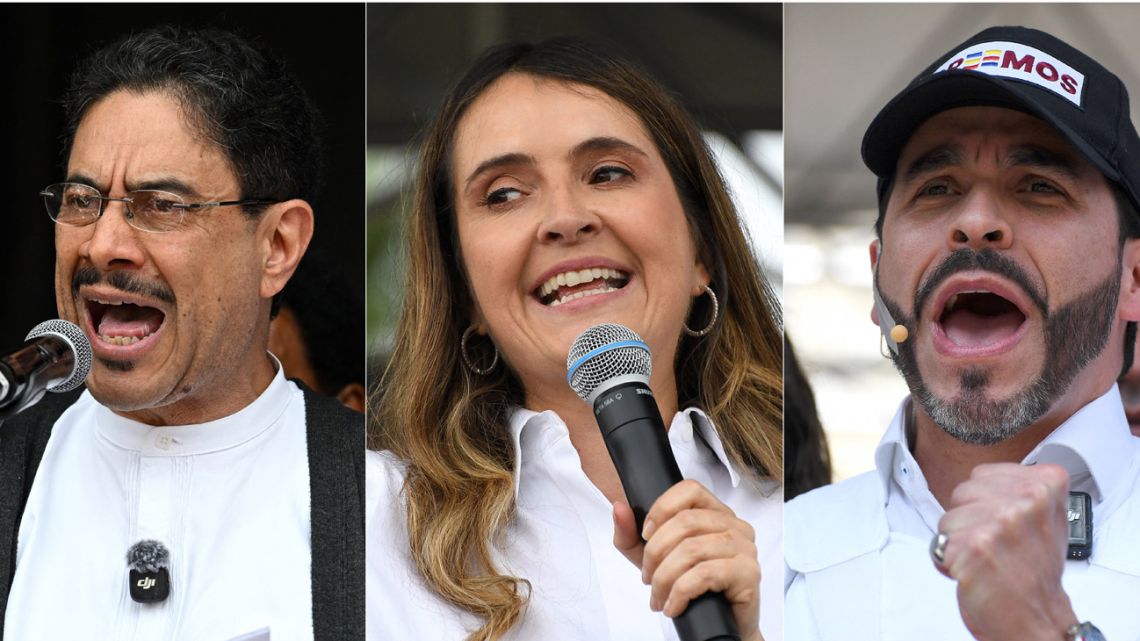
Colombians vote Sunday in a presidential election overshadowed by a surge in violence, facing a stark choice between extending four years of leftist rule or shifting sharply right.
Barred from re-election, President Gustavo Petro leaves office after a turbulent term marked by car bombs, explosive drones and the assassination of a presidential candidate.
But joblessness has fallen and wages have risen, and polls show Petro's protegé, leftist Senator Iván Cepeda, 63, as the front‑runner.
The son of a slain senator, Cepeda has pledged to extend social programmes and continue peace talks with armed groups, despite limited results.

"I give him my vote because my life changed under this government," said 23-year-old Natalia Rojas, a design student in Bogotá and a beneficiary of a subsidised education program.
To win outright, Cepeda must secure more than half the vote.
Polls predict a June 21 run-off against right‑wing lawyer Abelardo de la Espriella.

Nicknamed "the Tiger," the 47‑year‑old millionaire has no political experience and runs an eccentric campaign. He campaigns in a bulletproof vest and delivers a hardline security message.
In an interview during the campaign, he told AFP he would seek US backing for a 90-day campaign of airstrikes and crop fumigation against cocaine-producing armed groups if elected.
"What De la Espriella wants is to put the house in order," said Wilmer Bolívar, a 47‑year‑old ex‑soldier.

He compared the approach to El Salvador's popular president Nayib Bukele.
The comparison is not accidental. De la Espriella has backed building Bukele-style megaprisons and his facial hair bears more than a passing resemblance to the Salvadoran leader.
But De la Espriella faces a tight race for second against opposition Senator Paloma Valencia, aged 50. She is backed by political kingmaker and former president Álvaro Uribe.
Deeply polarising
Petro led Colombia's first-ever leftist government and has been deeply polarizing.
Poorer Colombians cheer his investment in social programs and the raising of the minimum wage. Unemployment fell, partly driven by state hiring.
The country remains one of the most economically unequal in the world.
"This election is marked by class struggle," said political scientist Álvaro Forero. "That is Petro’s main electoral ammunition," he told AFP.
To critics, Petro is erratic and his policy of "total peace" has let armed groups run rampant.
The policy has so far failed to demobilise armed groups that survived the 2016 FARC peace deal.
Experts say armed groups used talks to strengthen themselves.
Colombia remains the world's largest cocaine producer, and much of the violence is tied to drug-trafficking.
Juanita Goebertus of Human Rights Watch said "2025 was a very bad year" for the country. Kidnappings more than doubled and displacement hit its highest level in nearly 20 years.
Challenges
Each candidate has faced serious threats throughout the campaign.
Last year's killing of right‑wing candidate Miguel Uribe has left many Colombians nervous about a return to the bad old days.
Rising drug trafficking also strained relations between Petro and US President Donald Trump. The dispute escalated into mutual insults and nearly derailed longstanding security cooperation.
Whoever wins will inherit a country with serious security problems and a fiscal deficit that has ballooned to seven percent of GDP.
Petro inherited a weak post‑pandemic economy, but since then tax collection has severely lagged behind bumper social spending.
"What's at stake is continuing Petro's change agenda or rejecting it," Forero said.
Leftist icon, millionaire lawyer or conservative senator: Who will be Colombia's next leader?
The Survivor
Ivàn Cepeda first appeared in public in 1994, in his early 30s, next to the corpse of his father, a communist senator who was assassinated by paramilitaries.
Standing in front of a bullet-riddled truck, his call for justice was televised.
"Let this crime not go unpunished," Cepeda told reporters in a measured tone, during a period of persecution that saw more than 5,700 leftist leaders killed.
The 63-year-old has previously lived in exile in former Czechoslovakia, Bulgaria, Cuba and France.
Returning to Colombia, he advocated for armed conflict victims and played a key role in the historic 2016 peace accord, which led to the disarmament of the rebel army FARC – formerly the country's largest armed group.
His adversaries accuse him of having ties to FARC and reproach him for having devised Petro's "total peace" plan.
"I have survived genocide, stigmatisation and relentless persecution. And here I am, still standing," he said during the campaign.
Typically wearing a traditional Caribbean shirt, Cepeda forgoes a tie, which he considers a symbol of oligarchy.
The senator led the investigation into former president Uribe's ties with paramilitaries before it went to court, where Uribe became the first Colombian leader to be convicted of a crime last year.
Although a judge later overturned the ruling, the incident established Cepeda as the right-wing leader's main political enemy and an icon of the left.
'The Tiger'
Abelardo de la Espriella, 47, is a millionaire lawyer and businessman who said he entered politics to prevent Colombia from being "destroyed" by the left.
He holds US President Donald Trump, Argentina's Javier Milei and El Salvador's Nayib Bukele in high esteem.
Sporting impeccable suits and, more recently, a bulletproof vest, his legal career saw him defend prominent Colombian figures including drug traffickers and soccer stars.
Before launching his presidential bid, De la Espriella lived in Florence, Italy, where he dabbled in opera, jetted around in private planes and promoted his rum and wine businesses.
To combat drug cartels in Colombia, the world's biggest cocaine producer, De la Espriella proposes a military alliance with the United States and Israel and the construction of mega-prisons, while also defending the right to carry weapons.
"Any criminal who does not surrender will be taken down as the law allows," he told AFP in an interview in February.
Branding himself "The Tiger," the candidate has a penchant for swearing and is known for his hot temper.
He called for the Colombian left to be "gutted," but later toned down his language.
He has also made remarks considered homophobic and sexist and frequently refers to his "balls."
Uribe's 'daughter'
Paloma Valencia, 50, belongs to one of Colombia's most powerful families and is the granddaughter of Guillermo Leon Valencia, a conservative in office from 1962 to 1966.
Her grandfather confronted Colombia's first guerrilla groups and aligned the country with Washington to clamp down on communism on the continent.
Valencia is hoping to become Colombia's first woman president, and as a senator has gained a reputation as one of the most virulent critics of guerrilla groups and the left.
The philosopher, lawyer and reformist member of Colombia's main opposition party considers Uribe her "father."
Like him, she opposed the 2016 peace deal with FARC and favours Uribe-style militarization.
"We are going to put an end to 'total peace' in order to impose total security," she declared in a speech in March.
She takes a conservative stance on LGBTQ rights and is in favour of fracking, an environmentally destructive process of extracting natural gas and petroleum from subterranean bedrock.
– TIMES/AFP
related news
House committee chair warned Rubio of China risk in Milei’s dredging contract
Embattled Bolivia leader Rodrigo Paz promises 'to listen' to protesters
United States indicts former Cuban president Raúl Castro as pressure builds

KKR consortium warns White House of ‘bias’ in US$10-billion Argentina auction
by Lina Vanegas & David Salazar, AFP



Comments