

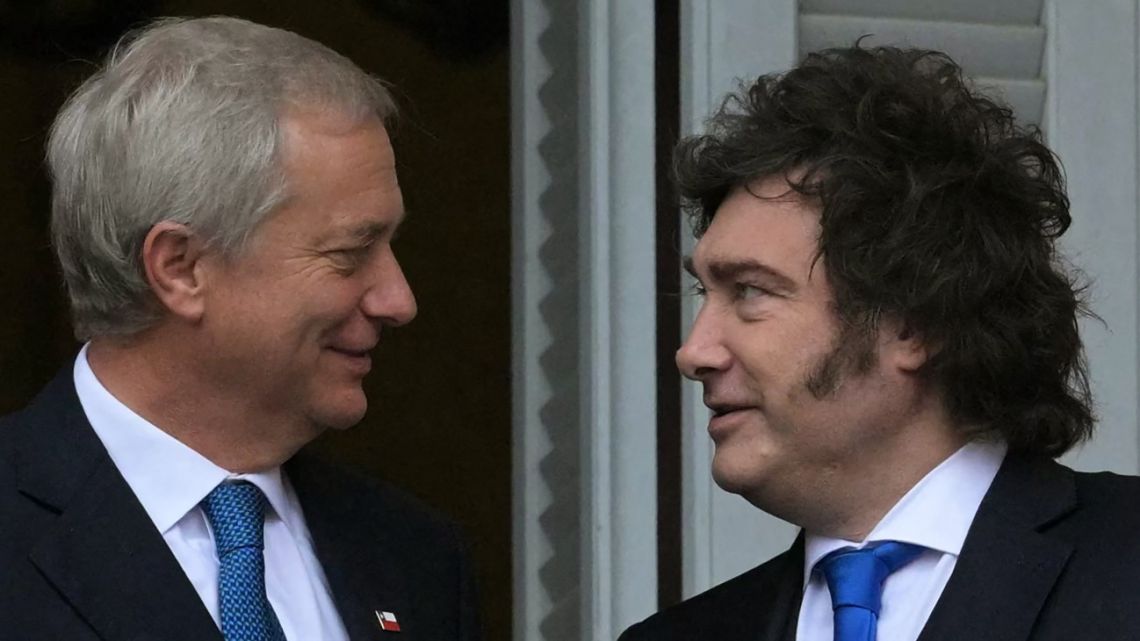
President Javier Milei met his Chilean counterpart José Antonio Kast in Buenos Aires on Monday, the far-right leader’s first official trip abroad since taking office on March 11.
Kast’s visit was part of an effort to deepen ties between neighbouring nations now led by ideologically aligned presidents, though it came in the wake of the failed arrest in Argentina of a high-profile former Chilean guerrilla fighter wanted by authorities in Santiago.
The two presidents met at the Casa Rosada for more than an hour, though no details were released about the topics discussed.
Argentina’s Foreign Minister Pablo Quino and Chile’s Foreign Minister Francisco Pérez Mackenna attended the meeting, along with other top officials from both governments.

Kast’s visit follows the tradition of Chilean presidents making Argentina their first official foreign stop overseas, reflecting the importance of the relationship between the two countries, which is one of Santiago’s main trading partners.
“Today more than ever it is important to develop joint projects. We have major ideas in mining, energy, border crossings and the fight against organised crime,” Foreign Minister Pérez Mackenna told reporters on Sunday prior to the visit.
Milei and Kast are looking to boost ties and counter the regional influence of Brazilian President Luiz Inácio Lula da Silva’s left-wing government.

The meeting also marked a reset in bilateral relations after periods of tension during the presidency of Chile’s left-wing former leader Gabriel Boric, whose government often clashed politically with Milei.
Kast was accompanied to Buenos Aires by Foreign Minister Francisco Pérez Mackenna, Security Minister Trinidad Steinert, Public Works Minister Martín Arrau and International Economic Relations Undersecretary Paula Estévez.
Milei and Kast are ideologically aligned and maintain a close alignment with the United States government led by Donald Trump, particularly on economic and foreign policy positions.

Both leaders advocate liberal economic policies, smaller government and tougher positions on immigration and security.
Ex-guerrilla on run

Kast’s visit comes days after the failed arrest of Chilean national Galvarino Apablaza.
Apablaza, also known by the nom de guerre “Commander Salvador,” was a senior leader of the Frente Patriótico Manuel Rodríguez (FPMR), a guerrilla group linked to the Chilean Communist Party that fought the dictatorship of Augusto Pinochet in the 1980s.
The former guerrilla leader is accused of participating in the 1991 assassination of former senator Jaime Guzmán, a leading figure from the Chilean right and one of the main ideologues behind the country’s 1980 constitution.

Chilean courts also link him to the 1991 kidnapping of Cristián Edwards, the son of the owner of the El Mercurio national newspaper.
Apablaza fled to Argentina in 1993 and was later located living under a false identity in Buenos Aires Province in the early 2000s.
Argentina’s Supreme Court approved his extradition to Chile in 2010, ruling that the crimes he was accused of could not be considered political offences.

However, later that year Argentina granted him political refugee status, a decision that blocked his extradition and triggered years of diplomatic tension between Buenos Aires and Santiago.
The case remained tied up in Argentine courts for years as Apablaza appealed rulings related to his refugee status.
A court revoked his status in February this year, reopening the possibility of extradition. But when his arrest was ordered last Wednesday, police were unable to find him and his whereabouts remain unknown.

“Sooner or later Mr Apablaza will have to answer before Chilean justice and we will carry out all the necessary steps with the Argentine government,” Pérez Mackenna said during Kast’s visit.
Argentina’s National Security Ministry last Friday announced a reward of around US$14,000 “for anyone who provides information leading to the location and arrest” of Apablaza.
Apablaza’s lawyer, Rodolfo Yanzón, told the AFP news agency that any attempt to detain his client would be “illegal,” given that all legal avenues to prevent him losing refugee status have not yet been exhausted.

Yanzón added that he would appeal the decision before international bodies.
Kast and Milei last met in Buenos Aires in December, two days after the Chilean leader won a run-off vote and with it the presidency. They were photographed holding a chainsaw, the symbol Milei uses to represent his fierce fiscal spending cuts.
Kast has also moved to cut public spending since taking office, echoing the path trodden by Milei.
Chile and Argentina share a border of around 5,300 kilometres.
Argentina is Chile’s second-largest trading partner in Latin America, with bilateral trade totalling around US$7.983 billion in 2025.
– TIMES/AFP/NA/PERFIL








Comments