

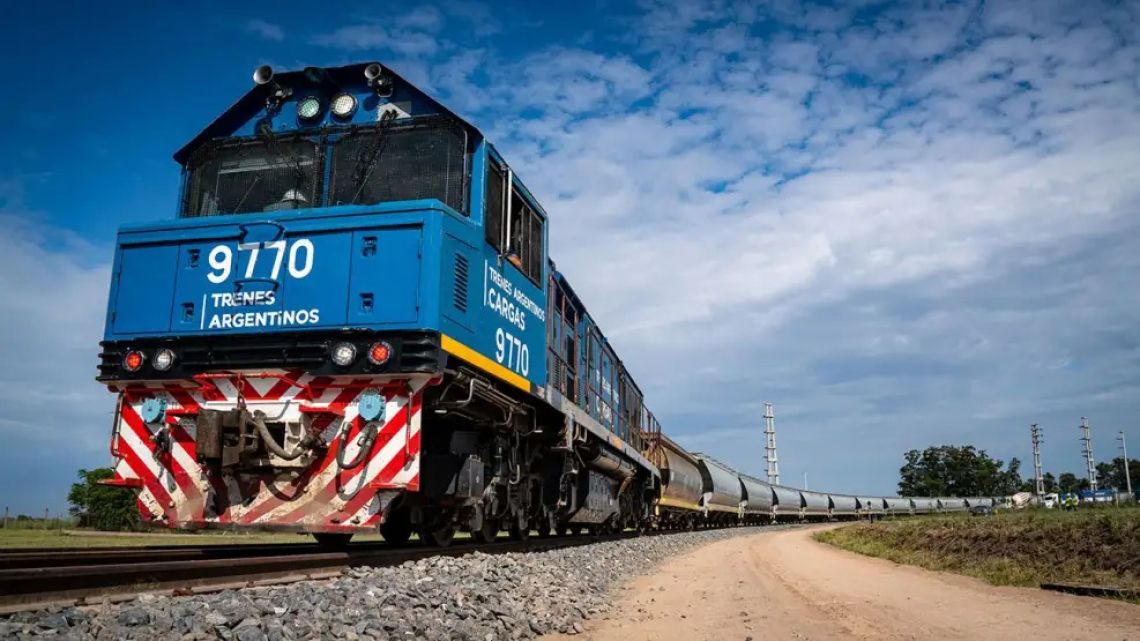
President Javier Milei’s government is launching a tender for the Belgrano Cargas freight line, the state company included on a list of firms to be privatised in the ‘Ley de Bases’ mega-reform of 2024.
The imminent tender comes after the La Libertad Avanza administration explained the main lines and deadlines of its plan for the firm to business representatives and officials at the ‘Argentina Week’ roadshow in New York last month.
Milei’s government has proposed the so-called ‘Open Access’ model, permitting free use of train tracks even ahead of formal possession, as well as vertical disintegration, whereby leases for operating trains and maintaining infrastructure do not necessarily end up in the same hands.
The parameters have unsettled the firms interested in competing because they do not match the normal international criteria applying to the sector.

The Open Access model implies any company being able to use the tracks, despite the lease not having been adjudicated to them – something not applicable to freight services anywhere else in the world. In Europe, this is only permitted for passenger transport, rather than cargo, with state participation subsidising the line.
Regarding the disintegration of Argentina’s current railway administration, Milei’s government wants to open up the field, leasing tracks one way, rolling stock another and workshops a third still. The sell-off further stipulates that different companies can present themselves, so that if a given investor group wants to control more than one operation, they would have to change company registration.
The network to be privatised covers 7,594 kilometres of tracks via the Belgrano, San Martín and Urquiza freight lines, running through 16 provinces nationwide, connecting five international passes to Chile, Bolivia, Paraguay, Brazil and Uruguay.

Argentina’s government calculates an investment of US$755 million, consisting of US$420 million for the San Martín line, US$260 million for the Belgrano and US$75 million for the Urquiza with a financing floor of US$435 million for the whole project.
The government’s recent presentation in the United States fixed a timetable for launching the tender before the end of March, with 90 days from that point to present offers.
Once the deadline has expired, a month is designated to evaluate the proposals and a further 30 days to sign a contract some time midyear. In continuation, there would be a 90-day transition period with final acquisition going to the adjudicated offer in December.

Up until now the only international company showing a firm interest in participating in the tender is Grupo México, a private firm operating in both Mexican territory and the United States. Expressing their interest, representatives marked out their differences with the Argentine government’s model, underlining the need to be able to concentrate the entire operation in a single offer, contemplating an investment of US$3 billion.
Pushing for the same multi-million business are Argentina’s main exporters of farm produce united in a consortium: Aceitera General Deheza (AGD), Asociación de Cooperativas Argentinas (ACA), Bunge, Louis Dreyfus Company (LDC) and Cargill.
by Joaquín Morosi, Noticias Argentinas












Comments