

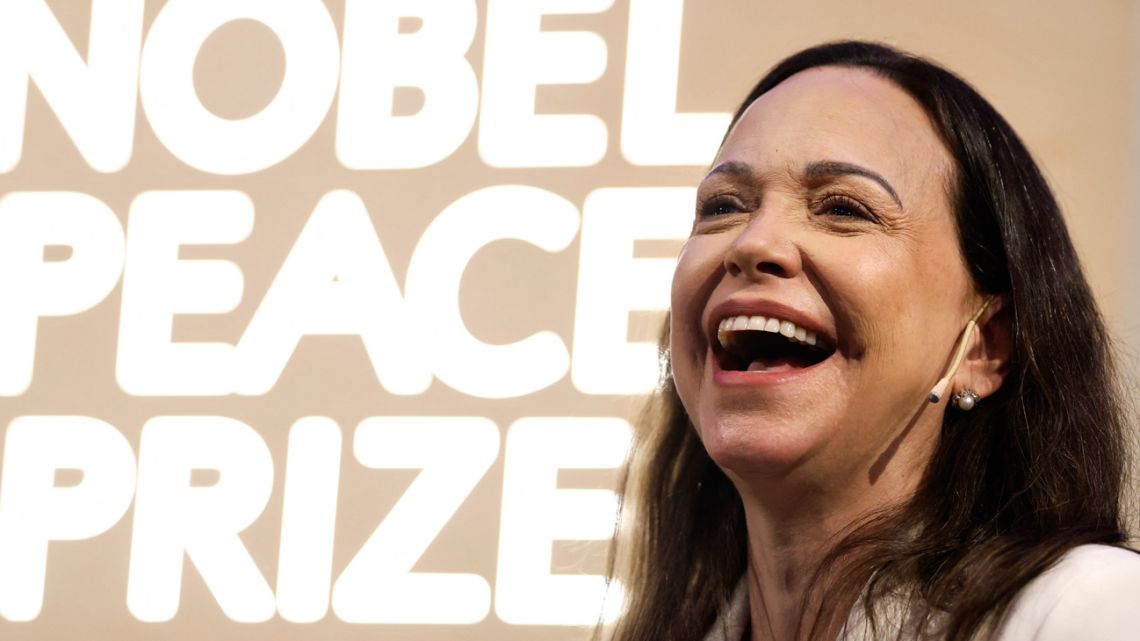
New Nobel Peace Prize laureate Maria Corina Machado raised the stakes for Nicolás Maduro this week, challenging the Venezuelan leader’s hold on her country by slipping past the authorities and flying to Europe to receive the honour.
Machado, 58, revealed at a press conference in Oslo on Thursday that the United States helped her get to Norway from hiding in Venezuela.
Once again expressing support for US military action against her country and Maduro’s regime, Machado promised Venezuelans that she would return home.
Machado, who vanished in January after challenging Maduro’s rule with a series of demonstrations, emerged on a hotel balcony in Oslo to cheering supporters early Thursday after several days of confusion over her whereabouts.

"We did get support from the United States government to get here," Machado told a press conference when asked about whether Washington had helped.
The Wall Street Journal reported that she wore a wig and a disguise on her high-risk journey.
She left her hide-out in a Caracas suburb on Monday for a coastal fishing village, where she took a fishing skiff across the Caribbean Sea to Curaça, said the newspaper.

The US military was informed to avoid the boat being targeted by airstrikes. Once on the island, she took a private jet to Oslo early on Wednesday.
Machado thanked those who "risked their lives" to get her to Norway but it was not immediately clear how or when she will return to Venezuela, which has said it would consider her a fugitive if she left.
"Of course, the risk of going back, perhaps it's higher, but it's always worthwhile. And I'll be back in Venezuela, I have no doubt," she said.

"I will not say when that is or how it's going to be," she commented, but added that she wanted "to end with this tyranny very soon and have a free Venezuela".
Machado has been hailed for her fight for democracy but also criticised for aligning herself with US President Donald Trump – to whom she has dedicated her Nobel – and for inviting foreign intervention in her country.
Military build-up
The United States has launched a military build-up in the Caribbean in recent weeks and deadly strikes on what Washington says are drug-smuggling boats.
"I believe every country has the right to defend themselves," Machado told reporters Thursday.
"I believe that President Trump's actions have been decisive to reach the point where we are right now, in which the regime is weaker than ever, because the regime previously thought that they could do anything," she continued.
Speaking about threats to her safety, Machado told reporters: "Anyone who lives in Venezuela and who wants to speak the truth is in danger.”
Late Wednesday, Trump said the United States had seized a "very large" oil tanker near Venezuela, which Caracas denounced as "blatant theft."
Maduro maintains that US operations are aimed at toppling his government and seizing Venezuela's oil reserves.
'Political risk'
Machado won the Nobel Peace Prize for "her struggle to achieve a just and peaceful transition from dictatorship to democracy."
She has accused Maduro of stealing Venezuela's July 2024 election, from which she was banned – a claim backed by much of the international community.
Machado last appeared in public on January 9 in Caracas, where she protested Maduro's inauguration for his third term.
The decision to leave Venezuela and join the Nobel festivities in Oslo comes at both personal and political risk.
"She risks being arrested if she returns even if the authorities have shown more restraint with her than with many others, because arresting her would have a very strong symbolic value," said Benedicte Bull, a professor specialising in Latin America at the University of Oslo.
While Machado is the " undisputed" leader of the opposition, "if she were to stay away in exile for a long time, I think that would change and she would gradually lose political influence," Bull said.
‘Crimes against humanity’
Venezuela's national guard has committed "serious human rights violations and crimes against humanity" for more than a decade, a United Nations-mandated investigation said Thursday.
The Bolivarian National Guard (GNB), a military force tasked with maintaining public order, was a central actor in the persecution of Maduro's opponents, a crime against humanity, the UN's independent international fact-finding mission on Venezuela determined in its latest report.
"GNB officials perpetrated arbitrary deprivation of life, arbitrary detentions, sexual and gender-based violence, as well as torture and other cruel, inhuman or degrading treatment during law enforcement operations in the context of protests and in actions of targeted political persecution since 2014," the mission said.
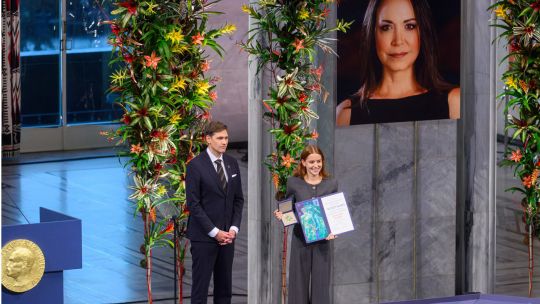
In her Nobel acceptance speech read by one of her daughters Wednesday, Machado denounced kidnappings and torture under Maduro's tenure, calling them "crimes against humanity" and "state terrorism, deployed to bury the will of the people.”
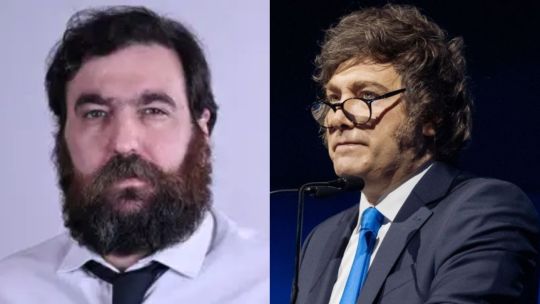
Several Latin American leaders, including President Javier Milei (Argentina), President Santiago Peña (Paraguay), José Raúl Molino (Panama) and Edmundo González Urrutia, the opposition Venezuela leader who ran for president against Maduro, travelled to Oslo for the Nobel ceremony.
Since 2013, more than seven million Venezuelans have fled the country to escape the economic and political crisis, often to other nations in Latin America.
– TIMES/AFP






Comments