

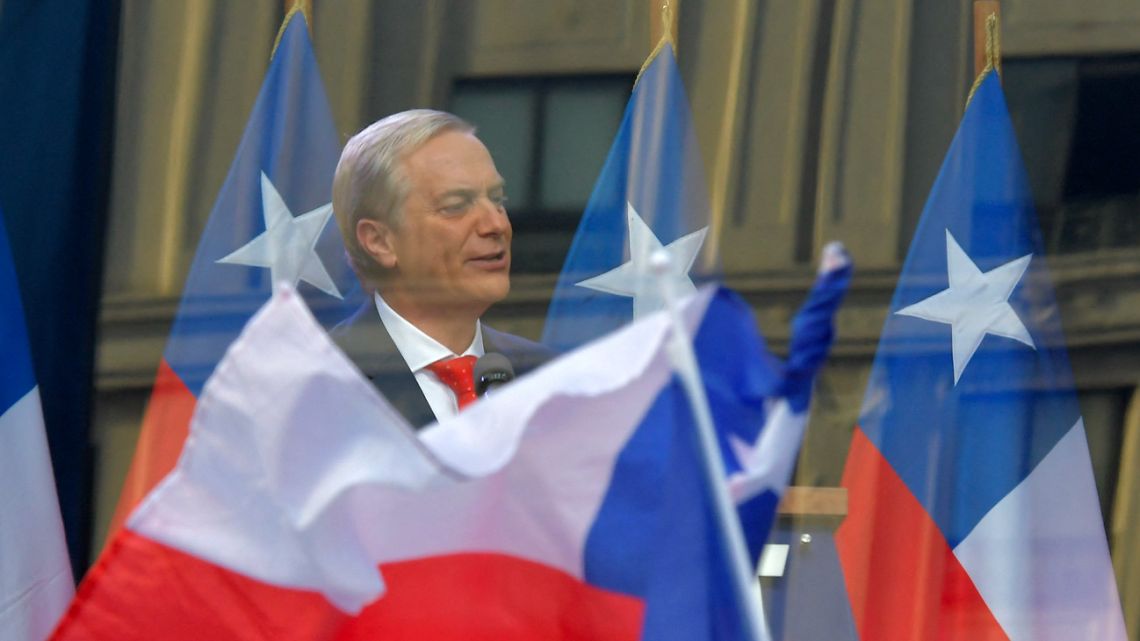
Chileans will elect a new president on Sunday, with an arch-conservative who has promised to expel hundreds of thousands of migrants strongly tipped to beat his leftist rival.
After a campaign dominated by fears over crime and immigration, José Antonio Kast –, a veteran politician, devout Catholic and father of nine – is on course to become Chile's first hard-right leader since the end of Augusto Pinochet's dictatorship in 1990.
His opponent, Jeannette Jara, a Communist who leads the centre-left coalition, won the first round of voting in November.
But she looks set to be punished for the incumbent government's perceived failure to tackle rising crime and a stalled economy.

Before the country was "much safer," said 50-year-old mining consultant Claudio Benítez.
"The type of crime is different; now your life is in danger," he said.
Against this fearful backdrop, right-wing candidates collectively garnered more than 50 percent of the vote in the first round.

Polls predict a thumping Kast victory in the second round run-off.
If those predictions are correct, Chile would become the latest in a string of Latin American nations to swing from left to right, after Argentina, Bolivia, and Honduras – often with a nudge from US President Donald Trump.
Back foot
For decades, Chile was the envy of much of the region for its safe streets, robust economy, vibrant democracy, stable institutions and abundant natural resources.
But the Covid-19 pandemic and an explosion of transnational crime put Chilean authorities on the back foot.
"We need security and order," said 47-year-old architect Rafael Urzua, who lives on the outskirts of Santiago.
"We know that if we continue with Jara, there won't be any change. With Kast, it's a complete change of course," he told AFP.
The reality may be more complex: an influx of foreign gangs from Brazil, Ecuador, Peru and Venezuela has brought an increase in violent crime – albeit from a low base.
Homicide rates have risen 140 percent in the last decade.
But with six murders a year per 100,000 people, Chile remains far below the Latin American average of 15 murders a year per 100,000 people, according to UN figures.
And the government of leftist President Gabriel Boric has made some inroads to reduce violent crime rates.
For many voters, it is not enough.
Kast, a 59-year-old on his third attempt for the presidency, has amplified concerns about crime and immigration.
He has warned 337,000 undocumented foreigners that the clock is ticking for them to "take their things and leave Chile freely" before being deported.
"If they don't do it voluntarily, we will come and get them" to expel them, he says.
He has also vowed to build a wall on the Bolivian border, give police more firepower, and send troops into critical areas.
Kast's hardline security policies, past praise for Pinochet's brutal dictatorship, and his opposition to contraception have many worried that his government would curb personal freedoms.
But some see his likely victory as evidence of Chile's centrism.
In every democratic election since 2006, Chileans have opted to remove the government and replace it with one from the other side of the political spectrum.
Biographer Amanda Marton told AFP that Kast does not have the same tear-it-all-down stridency as other firebrand Latin American leaders like Argentina's Javier Milei or Brazil's Jair Bolsonaro, who is now in jail for abetting a coup.
"He's a hard-right leader, but he's a Chilean hard-right leader," Marton said of Kast. "He knows the institutions very well, and is more reserved."
Youngest of 10
Kast is the youngest of 10 children born to German parents who emigrated to Chile, where his father built a thriving sausage business.
Journalistic investigations revealed in 2021 that his father, who was born in Germany, was a member of Adolf Hitler's Nazi party. But Kast claimed that his father was a forced recruit in the German Army during World War II and denied that he was a supporter of the Nazi movement.
Kast was a lawmaker for 16 years. In 2016, he resigned from the Unión Demócrata Independiente (UDI), the party he had been a member of for decades, believing that it had abandoned its conservative principles.
In 2019, he founded the Partido Republicano, which he leads with a mixture of "personal sympathy" and "strong control," said Javiera González, co-author of the book Kast, el mesías de la derecha chilena (“Kast, the Messiah of the Chilean Right").
"He is a very closed-minded person," said journalist Lily Zúñiga, who worked with him at the UDI.
But Mara Sedini, Kast’s campaign spokesperson, defends his character. "When it comes to things he needs to be stubborn about, he is stubborn," but he is also capable of "being flexible and learning."
Spectre of history
Jara, a 51-year-old ex-labour minister, has tried to campaign on bread-and-butter issues, promising to raise the basic salary.
But she has been forced to pivot to security, promising to tackle the root causes of crime.
"No candidate is more committed to our security: security in combating crime and security to reach the end of the month," she said.
JAra has promised to control clandestine migration routes and to screen undocumented migrants for past crimes.
But her long-standing membership of the Communist Party – she joined aged 14 – has caused problems in what is still a relatively conservative nation.
For decades during the dictatorship, Communists were maligned, arrested and killed.
Jara is from the party’s liberal wing. "She presents herself as a dissident," journalist Alejandra Carmona, author of the biography Jeannette.
Jara's working-class origins contrast with the elite of Chilean politics.
"For the first time ... a person from the working class can come to power," Jara said before the first round.
Many in Chile see evidence of the left's failures in authoritarian states like Venezuela and Cuba, though Jara has said she does not consider those countries to be democracies.
"There is a spectre that looms over any Communist candidate, and so it is with Jara; it has weighed heavily on her," said Chilean analyst Alejandro Olivares.
– TIMES/AFP
related news


by Paulina Abramovich & Andrew Beatty, AFP











Comments