

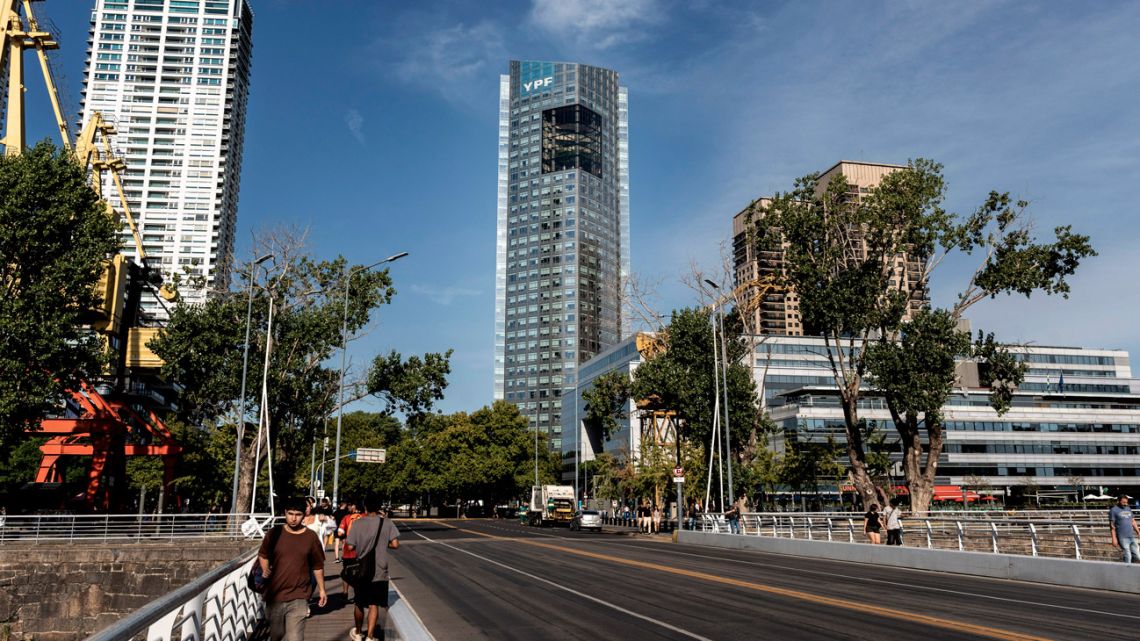
YPF SA is setting aside funds to keep spending in the fast-growing Vaca Muerta basin even if oil prices fall this year as management handpicked by libertarian President Javier Milei looks to build the state-run company into a global shale star.
“We’ve prepared ourselves,” Chief Executive Officer Horacio Marín said Wednesday during an interview in Buenos Aires. “We’ve managed our portfolio very well, so that in a low oil-price environment we don’t need to reduce investment. Our capex doesn’t change whether a barrel is worth US$70 or US$55.”
YPF, easily Argentina’s biggest oil producer, invested US$3.5 billion upstream in the 12 months through September. Marín is keen for spending to stay around that level in order to maintain momentum for the company’s shale push and, in turn, make good on a promise of big returns for investors. A fresh policy move from Milei to spur crude investments should help too.
“This is the key year,” said Marín, a 62-year-old oil veteran who’ll lay out YPF’s full strategy for 2026 in a February 27 earnings call. “Because it’s the final year of our transition – and then we can lift off.”

YPF wants to surpass 200,000 barrels a day of shale oil this year, Marín said, up from 170,000 in the third quarter of 2025, after two years of aggressive cost-cutting and divestments. That push included two recent asset sales that raised an extra US$1 billion for the company’s war chest and a pending deal to exit natural gas distributor Metrogas SA.
If the plan to grow profits succeeds over the next few years, YPF is targeting its first shareholder dividend payouts in a decade. Its New York-traded shares have gained 127 percent since Milei took office and are worth about US$38. Marín’s target for the end of 2027, when Milei finishes his term, is to reach US$60.
The Vaca Muerta shale patch in Patagonia is key to Milei’s plan to stabilise Argentina’s crisis-prone economy because it can drive huge energy trade surpluses, including the biggest on record last year. That’s why the government stretched out its marquee investor incentives programme on Thursday to include shale oil drilling.

Previously, the oil element of the programme, known by its Spanish acronym RIGI, only included upstream features like separation plants, pipelines, as well as offshore exploration. Expanding it to shale oil wells — the minimum investment in a single project is US$600 million — will spur more production to “accelerate use of pipeline and export infrastructure and, at the same time, enhance competitiveness,” the government said in a decree.
“It will be great for the industry,” Marin said from his corner suite overlooking the River Plate estuary.
RIGI’s tax, currency and customs benefits, which greatly improve the economics of energy and mining projects, may help to lure US independents looking to take their shale expertise abroad as so-called Tier 1 acreage runs out in the Permian Basin.

Continental Resources Inc, owned by shale billionaire Harold Hamm, recently became the first of those independents to place a bet on the Vaca Muerta. Marín said he has chatted loosely – not to do a deal – with Continental and also with Devon Energy Corp, which earlier this month moved to become one of the world’s biggest shale companies by agreeing to acquire Coterra Energy Inc.
“Argentina is a logical destination for those companies to continue growing,” Marín said. “Their geologists like Vaca Muerta – we’ve discussed that informally.”
RIGI may also help against the backdrop of a potential re-birth of the vast oil industry in Venezuela, where Marín worked for several years.

While Venezuela churns out heavy and sour crude, versus Argentina’s light and sweet shale, the YPF chief highlighted how extra regional production accentuates the need to keep costs down. “We can’t have spurious costs because that’s exactly what takes you out of the competition,” Marín said.
As well as shale oil, Marin is overseeing Argentina’s signature liquefied gas export project, a venture with Italy’s Eni SpA and Abu Dhabi National Oil Co.’s XRG that will ship at least 12 million tons a year of LNG, along with plenty of associated natural gas liquids.
With XRG now confirmed as a partner – it made the commitment binding last week – the search for at least US$14 billion in financing is now heating up. By any account, that would be the biggest project finance deal in Argentine history. Marin compared gathering the cash, a chunk of which could come from export credit agencies, to a jigsaw puzzle.

“We have to see how we’ll put it together,” he said. “There are several banks that are offering initial tickets that are very expensive.”
by Jonathan Gilbert, Bloomberg











Comments