

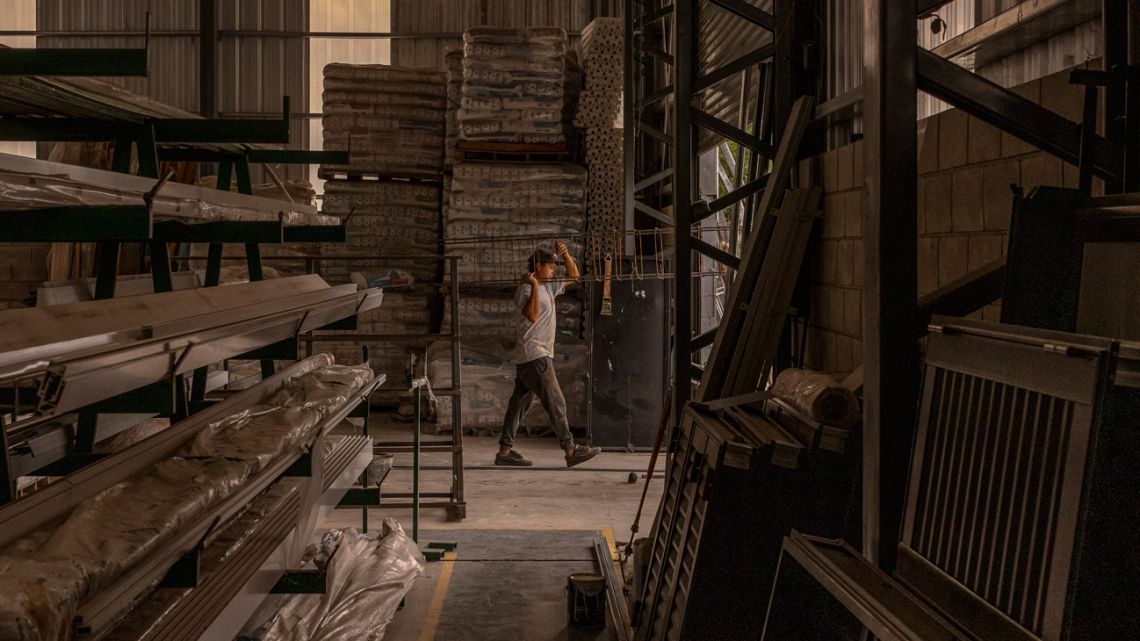
Deep in Argentina’s rust belt, the decades of duress that have hollowed out the steel-making port town of Villa Constitución are everywhere on display.
Next to fields strewn with scrap metal, the Paraná River has become so shallow after years of drought that ships run aground and fishermen are left idle. Drug violence from nearby Rosario has crept closer. And the hulking steel plants that once offered a sense of surety instead symbolise Argentina’s gruelling decline, driven by excessive costs, outdated laws and pendulum-swing politics.
“Getting a stable job here is now a pipe dream,” said Mayor Jorge Berti, who has governed the dusty town three hours north of Buenos Aires for a decade, from his modest municipal office flanked by flags and wood-framed windows.
President Javier Milei promises his flagship labour reform, the next step in his efforts to remake the Argentine economy, will streamline expenses, boost investment and bring well-paying employment back to the country – and few places need that more than Villa Constitución.

But towns like this are also where Milei’s reform stands to hurt the most, making it a barometer of the change ahead and a likely battleground for the inevitable stand-off with labour unions that are the bedrock of Argentina’s Peronist opposition.
In Villa Constitución, a factory job once promised security for life, with unions anchoring both wages and identity. But the steel industry, dependent almost entirely on domestic demand, has risen and fallen alongside Argentina’s volatile economy. In the 1990s, then-president Carlos Menem’s market overhauls brought sweeping layoffs. More cuts followed after Mauricio Macri won the Presidency, including the 2015 closure of an auto-parts plant whose rusting sign still lines the main road. Now, under Milei’s austerity drive, the erosion has deepened.
Since taking office in late 2023, the libertarian president has dismantled protectionist trade barriers and frozen hundreds of state-funded infrastructure projects.

Now Milei is trying to muscle through his most politically charged bet: a labour reform meant to overhaul rules around hiring, firing, severance and collective bargaining. Supporters and detractors alike see it as long overdue. But critics fear it will land hardest just as Argentina’s labour-intensive industries that long relied on the state’s cheque-book buckle from decimated private and public spending, eroded further by competition from China.
After clearing the Senate 42-30, the bill headed to a lower house vote. Foreign investors are watching the congressional proceedings for signals of Milei’s political strength.
But the country’s largest labour federation planned a 24-hour strike in a bid to stop it. And even if approved, it must return to the Senate after Milei stripped out a provision that would have cut sick-leave pay in half in some cases – a measure that threatened to sink the legislation, highlighting the risks of taking on entrenched labour protections in Argentina.

Approval might lead to lower interest rates and position the government to return to international bond markets after a sovereign default in 2020. Failure would cast doubt on the durability of Milei’s reform agenda and his chances to deliver Argentina from its chronic boom and bust cycle.
ArcelorMittal-owned Acindar, which once employed thousands in Villa Constitución, now has about 1,700 workers between contractors and permanent employees in a town of 52,000 people. That’s down from some 2,300 in 2023, according to local leadership for metallurgy union UOM. The company declined to comment on the figures, but said in a statement steel demand had fallen 40 percent from 2023.

Across the country, formal salaried jobs are down more than 270,000 in that time, led by losses in the public sector, as well as construction and manufacturing.
The losses at Acindar could have been steeper, said Pablo González, who has led the local UOM chapter for the last decade. Jobs at the factory and other associated roles were cut through contracts not being renewed and voluntary retirement plans. Argentina’s strong labour protections – and aggressive collective action – helped shield workers from mass lay-offs.
“For us, it’s fundamental to be able to say that after two years and sales down by half, they haven’t fired anyone,” said González, sporting a black shirt with his name emblazoned on it.

That leverage is now at risk. Milei’s reform would further loosen dismissal rules, reduce severance costs and curb unions’ ability to paralyse plants. Under Milei’s earlier ‘Ley de Bases’ omnibus bill, unions lost the ability to fully block factories during strikes. The new reform would go further, limiting labour actions, for example, to just a quarter of essential operations.
Gone would be the days when workers shut down the factory to protest the attempted assassination in 2022 of leading Peronist and then-vice-president Cristina Fernández de Kirchner – or to celebrate Argentina’s World Cup victory later that year.
González believes many companies have stayed largely quiet about the pain points of Milei’s austerity and free-trade crusade because they see labour reform and future tax cuts as compensation. “It’s the prize they’ve been waiting for,” he said.

Strong worker protections – and high labour costs – have defined Argentina since the rise of Peronism in the 1940s. Unions negotiate national wage agreements, wield broad strike powers and remain deeply embedded in social life, particularly in places like Villa Constitución, where the union represents nearly every metal worker.
In the mayor’s office, Berti poured mate beneath a framed portrait of Eva Perón, the wife of movement founder Juan Domingo Perón and a patron saint of Argentine labour.
Even so, in 2023’s presidential run-off, Milei beat his Peronist opponent by just over 20 percentage points in Villa Constitución. His party won the October midterms here, too, though by a smaller margin.

“People have lost trust in those who historically represented workers,” Berti said.
Lucas Mendoza, 33, spent a decade working as a janitor at Acindar, submitting his résumé every year until he became a substitute crane worker. By early 2024, he was making about US$900 a month. Mendoza says he cast a blank ballot in the run-off, but he and his younger colleagues would get into heated arguments with the older, Peronist workers who swore Milei would spell the death of them. He now looks back fondly on those times.
“That job was the best thing that ever happened to me,” he said, sitting on the side of an empty running track at a park in Villa Constitución.

When his contract wasn’t renewed in May 2024, he spiralled into depression. He tried selling grilled fish until water levels dropped too low. Now he stays home during the day caring for his three-year-old son and works security shifts on weekends at a nightclub, earning about US$20 per night, without health insurance. He struggles with anxiety attacks and gets into arguments with his girlfriend over her long shifts as a waitress.
“I can’t be at home, looking at my girlfriend and my son, and have my kid say, ‘Dad, don’t we have money for yogurt?’” he said. “It breaks me.”
In many ways, Argentina’s job-market tailspin makes Milei’s case for a reform. For the first time in 30 years, Argentina’s economy grew in 2025 but the formal private-sector workforce shrank, according to argendata, a research website.
Argentine companies have the same number of salaried, payroll jobs that they did a decade ago, even as the overall population is up by three million in that time. Argentina has the highest tax burden for employers of major Latin American economies — triple Chile’s rate and more than double Mexico’s, according to data compiled by JPMorgan Chase & Co.
Legal uncertainty compounds the problem. A labyrinth of pro-labour laws leaves companies unsure how much severance they ultimately owe and encourages litigation. Lawsuits can last years and cost millions of dollars. Workplace injury rates in Argentina are similar to peer countries, yet lawsuits for accidents far exceed them, according to research by labour economist Laura Caullo at the IERAL think tank.
“The economy has barely budged the past five years, but the rules of the game give perverse incentives,” says Caullo, a professor at the University of Córdoba.
More manufacturing employers anticipate lay-offs over the next few months than they did during the peak of the Covid-19 pandemic, according to government data.
Many Argentines who lose higher-quality jobs with income and benefits often take up gig-work to make ends meet where they declare a small portion or none of their income. Informal employment has added about one million jobs over the past decade, while the number of independent contractors has risen by roughly 700,000.
But the labour reform is not only about jobs. It is central to convincing investors that Milei’s pro-market overhaul is durable – and that Argentina’s pendulum will not swing back to the left. Economy Minister Luis Caputo has signalled that the government wants the reform passed before attempting a return to bond markets.
Diego Argutti, 48, runs a small construction firm in Villa Constitución that sells steel and refurbishes office spaces for banks. With 14 employees, his company now has half its workforce at the end of 2023.
“We either have to keep going, shut down, or go bankrupt,” said Argutti, who doubles as vice-president of the local manufacturing chamber, lamenting the flood of cheap steel from China. “The labour laws need to be adapted to the times. But I don’t believe the reform by itself will create jobs. If I had the chance to grow, I would hire regardless of the reform.”
When Mariquena Ramírez, 31, landed a job working substitute crane shifts at Acindar alongside Mendoza in late 2020, she said her dad, who’s made fertiliser for the past 20 years, “acted like I’d gotten into Harvard.”
She rented an apartment in downtown San Nicolás, the much nicer town next door, renewed her wardrobe, collected overtime shifts and travelled across Argentina with her friend from the factory. The job paid more than US$900 a month by the time her contract wasn’t renewed in mid-2024. After that, she cycled through a string of off-the-books jobs – selling kitchen machinery on commission, working at a bakery, then a dairy plant – while her credit-card debt ballooned.
Last year, her sister moved to Germany to start over. She and her boyfriend made their own wager. He sold his beloved Ford Focus, she took on more debt, and she now runs a small pasta shop, dressed in a white button-down stitched with her logo in green: a fork twirling pasta. Sales are steady early in the month, then thin as pay-cheques run out.
Her friend’s coworking space nearby lasted six months. A dance studio next door closed after three months.
“Sometimes I have my bad days and I think I’ll have to shut this all down,” she said. “But now that we’re in this, it’s the only way. We have to keep dancing.”
by Manuela Tobias & Patrick Gillespie, Bloomberg










Comments