

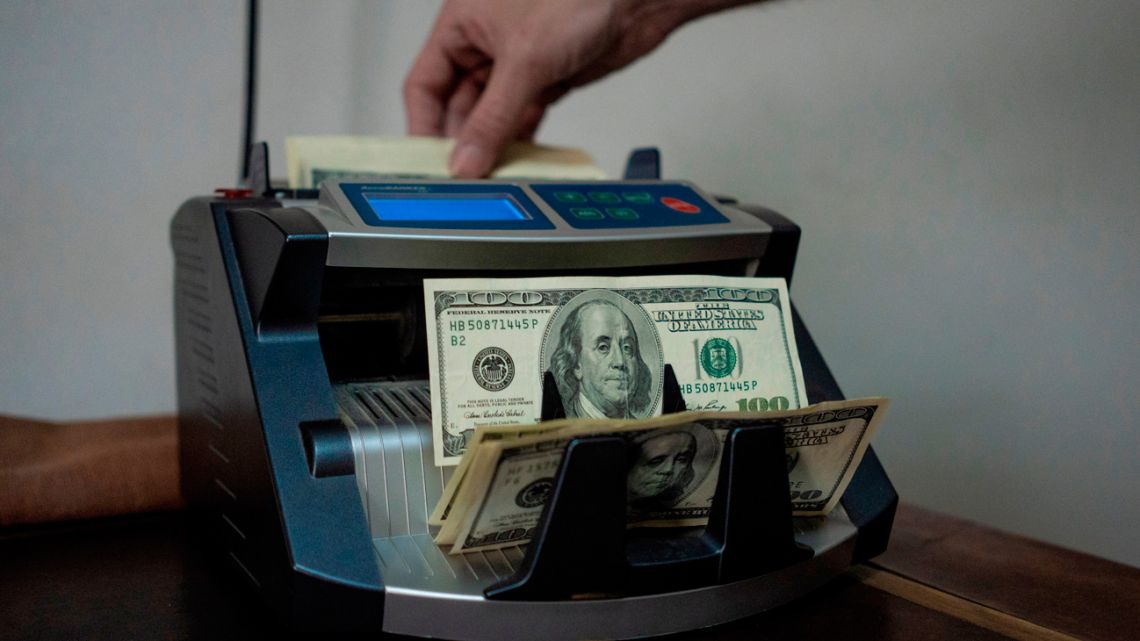
President Javier Milei is looking to sweep aside one of Argentina’s biggest financial taboos: offering dollar loans to people and companies that don’t earn in dollars.
Ever since the country’s 2001 debt debacle, local banks have effectively been barred from lending dollars to borrowers who don’t generate income in the US currency. It was, after all, a shortage of dollars that accelerated the meltdown back then and the economic collapse that followed.
Now Milei’s government is betting that the one-time powder keg can be turned into an engine for growth.
Economy Minister Luis Caputo raised the idea during a radio interview Monday, saying the country needs more dollar-based loans to help fuel an expansion that’s been tepid for most of Milei’s two years in office. The government intends to repeal the law in Congress before year-end and change Central Bank regulations, a person familiar with the matter told Bloomberg News on the condition they not be identified speaking about internal deliberations.

The pitch is straightforward: Give banks a profitable use for the dollars sitting idle in their branches by directing them to “high-profile” borrowers – individuals and firms with strong credit profiles, including real-estate developers – who can use the funds to invest in the country.
“Banks will have cheap funding. They’ll pay people, say, four percent, and they’ll be able to finance real-estate developments, mortgages,” Caputo said. “All of that reactivates the economy.”
The risks haven’t gone away, though. The peso has crashed repeatedly over the years, leaving it down 99 percent against the dollar in the last decade alone. Should it plunge again under Milei, as some economists fear, it’d leave Argentines with huge bills to pay on their new dollar debts.

Individual borrowers may not be sophisticated enough to fully understand those risks as they take out their dollar loans, said Daniel Marx, an economist who was Argentina’s finance secretary in 2001 and is now a partner and director at Quantum Finanzas, a private consultancy.
Corporate managers are “generally better equipped to handle this kind of dollar credit than the average household,” he said.
Dollar credit has long been a political third rail in Argentina, with the government effectively prohibiting it through a 2002 decree and Central Bank rules. The post-crisis framework allowed foreign-currency deposits only if they were used exclusively to finance foreign-trade operations and related activities.

If Milei can mobilise even a slice of the country’s dollar savings, it could in theory lift investment and expand a financial system that is too small for the economy it serves.
Caputo has tried repeatedly to coax Argentines into using their own dollars – first via a tax amnesty, then by allowing more transactions to be conducted in dollars, and most recently through a “fiscal innocence” plan meant to ease scrutiny of funds not suspected of criminal activity.
His broader argument is that Argentines are sitting on a mountain of cash outside the system, a hoard the Central Bank estimates to be roughly US$170 billion. The government’s push on “fiscal innocence” is designed, in part, to speed the return of at least some of that money to banks.

To reduce blowback, the Central Bank is expected to impose prudential safeguards on borrower qualification, collateral, and the share of deposits that can be lent, the person familiar said.
Details of the plan are still scarce. One likely destination for a large share of new dollar credit lines, however, is mortgages – a form of financing Argentines have only enjoyed in brief windows of economic stability, according to the same person.
by Ignacio Olivera Doll, Bloomberg














Comments