

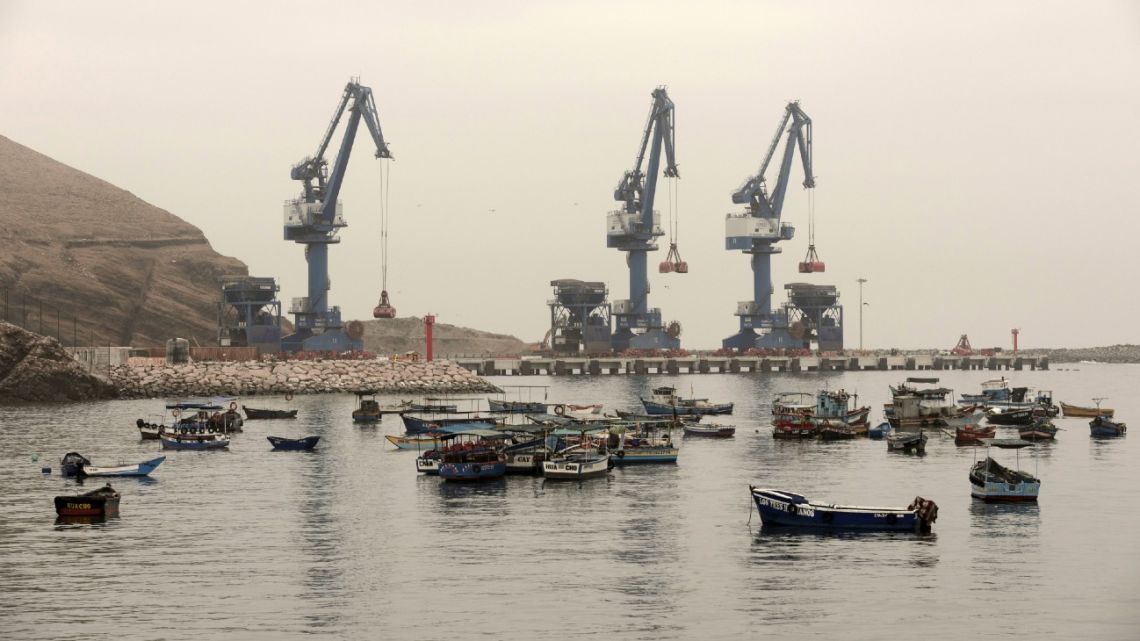
Latin America braced for a colossal blow when President Donald Trump’s tariffs upended global trade last year. But it’s never been a better time for the region’s exports.
On Tuesday, Argentina said its shipments abroad last year were the second highest in its history. The release followed data from Brazil and Chile, both of which reported this month that their own exports hit records in 2025. In coming days, figures from Mexico and Peru will likely also reveal milestones.
At a time when regions like Europe are grappling with Trump’s renewed tariff threats, Latin America is heading into 2026 even better positioned to withstand any trade shocks from Washington. Exporters are benefiting from improved logistics, the ability to redirect shipments toward emerging markets and, above all, deeper ties with China. The world’s second-largest economy is snapping up the region’s commodity exports, such as soybeans, copper and iron ore.
“Strong export performance last year looks counter-intuitive given the tariff noise, but it was driven by a combination of increasing prices, volumes and geopolitics,” said Andres Abadia, chief Latin America economist at Pantheon Macroeconomics. “Key exports in the region should remain relatively resilient.”

Latin America has hurdled to the forefront of global geopolitics as Trump’s administration aggressively seeks to assert its influence across the Western Hemisphere. When it comes to trade, the reality on the ground in most of the region’s countries is that China is more entrenched than ever.
China’s diversification

The regional trade shift in 2025 was especially visible in food and agricultural goods. China’s efforts to diversify sourcing boosted shipments of frozen Brazilian beef, which climbed nearly 50 percent from a year earlier. Greater soybean purchases from Argentina, spurred by a temporary suspension of export taxes, helped offset reduced US supply amid ongoing trade frictions.
Meanwhile, in Peru, Chinese purchases of gold and copper drove exports to Beijing, underscoring how the Asian giant’s industrial and energy transition needs are reshaping Latin America’s trade flows.
“There is a global friction between US and China, both of them are fighting for markets,” said Alberto Ramos, chief Latin America economist at Goldman Sachs Group Inc. “China is already a significant trading partner for most Latin American economies.”

Mexico is an outlier, given that roughly 80 percent of its exports go to the United States, and overall shipments to its northern neighbour were up seven percent year-to-date through November 2025. Furthermore, in late November, President Claudia Sheinbaum’s government approved tariffs on 1,463 products – mostly from China – signalling an even closer alignment with Washington.
Chile posted record overseas sales of copper – a key input for clean energy technologies – to both China and the US as prices and consumption rose.
Treading carefully
Going forward, exports from Brazil, Chile, Colombia, Mexico and Peru will benefit from demand for raw materials and agroindustrial products, according to Abadia, from Pantheon Macroeconomics.
Brazil’s government sees exports this year hitting US$340 billion to US$380 billion, following shipments of US$348.7 billion in 2025. Chile’s Central Bank expects exports of goods and services to rise 1.8 percent after the 2025 mark of US$107 billion.
In Argentina, exports will hit US$91.4 billion this year, according to a Central Bank survey from December. That figure compares to $87.1 billion in 2025.
In that context, regional leaders are avoiding overtly picking sides. Argentina under President Javier Milei, one of Trump’s most outspoken global allies, continues to rely on China as the top destination for its exports, stopping short of a full break with Xi Jinping.
Brazil’s leftist leader Luiz Inácio Lula da Silva is also treading carefully to avoid conflicts. Relations with the US have improved after he succeeded in rolling back a large share of the massive tariffs imposed by Trump in 2025.
“Trump’s recent actions have shown US willingness to support politically aligned governments in the region,” said Dan Pan, an economist at Standard Chartered. “But even the most far-right leaders in the region will have to be pragmatic when it comes down to dealing with the largest buyers of the regions’ commodity exports.”
related news



by Beatriz Reis and Giovanna Serafim, Bloomberg












Comments