

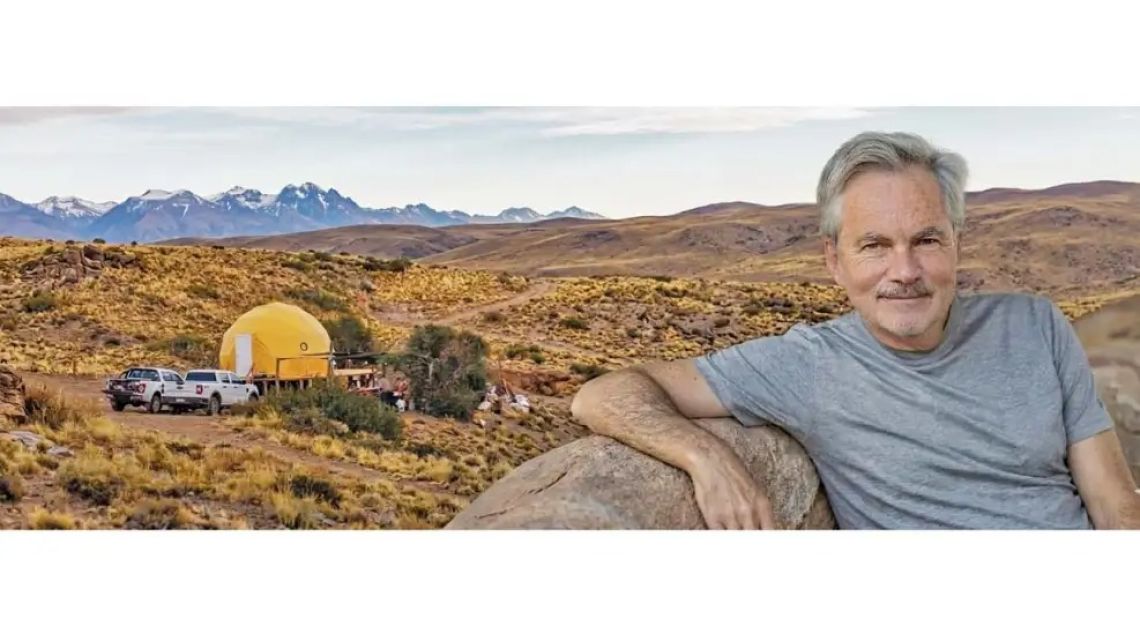
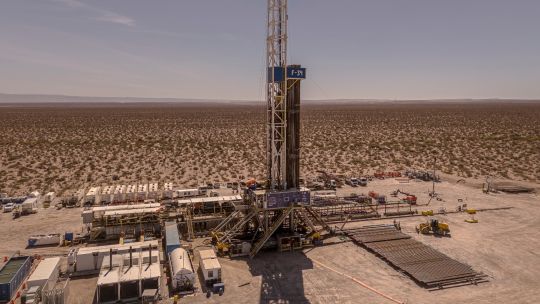
The Wamani complex in Mendoza Province, spearheaded by billionaire Martín Varsavsky, has gone from an airtight corporate secret to a geopolitical dilemma of global scale.
The 32,000-hectare estate, located in the San Carlos foothills, shot to prominence after a Financial Times article featuring an interview with the Argentine businessman that revealed the complex's true purpose: to operate as an apocalypse insurance policy for Silicon Valley magnates in the event of a "Third World War."
Behind Campo Wamani SA, the company that controls this vast estate in a border security zone, lies a structure designed for self-sufficient survival in the event of a hypothetical nuclear conflict.
Varsavsky, a member of the Silicon Valley elite, controls the project, which includes decentralised artificial intelligence servers, a private airstrip and exclusive access to four pristine springs – entirely in keeping with US tech billionaire Peter Thiel's doctrine of strategic retreat.

Faced with international uproar and local debate over access to water – this in a province already suffering from a water emergency – Varsavsky was forced to launch damage control in the local Mendoza media. Within hours, the project's messaging shifted from it being a nuclear refuge for the global elite to "an ordinary farm for having an asado." Some see this double narrative as a way of concealing political power, sovereignty and strategic resources under a cloak of a "tourism experience."
The Oxenford paradox
A striking detail emerges from a review of Campo Wamani SA's corporate structure. Varsavsky's main partner is Argentina's current ambassador to the United States and founder of the landmark tech platforms DeRemate and OLX, Alejandro ‘Alec’ Oxenford. His stake in the bunker places him in an institutional bind: the overlap between his public role and his private business dealings.

As Argentina's top diplomatic representative to the White House, Oxenford endorsed the signing in Washington on June 26 of the ‘Pax Silica,’ an opaque initiative seeking to manage and regulate the global supply of critical minerals for the development of advanced technologies. It represents an attempt by the Donald Trump administration to control the flow of resources key to the development of artificial intelligence and, in doing so, "slow" China's progress in the field.
This international agreement has already featured in previous reporting. On July 24, Perfil journalist Giselle Leclercq exposed the Milei government's strict secrecy around the deal. That lack of transparency prompted a formal information request to the Executive filed on July 21 by national deputy Maximiliano Ferraro, who told this outlet that the real obligations Argentina has taken on remain unknown.
Beyond the secrecy surrounding the ‘Pax Silica,’ the Wamani estate exposes "the Oxenford paradox." In a strictly private capacity, Ambassador Oxenford is a partner in a firm planning to install decentralised artificial intelligence servers in the Mendoza foothills. The project also guarantees total autonomy in ultra-pure water and food in the event of a hypothetical nuclear conflict in the northern hemisphere – the exact opposite of what the US government is pursuing: the decentralisation of resources.

Perfil contacted the diplomatic mission in Washington to ask for the Argentine ambassador's position. A questionnaire sent specifically for the purpose asked whether Oxenford shared Varsavsky's exact characterisations to the Financial Times – that the world is going through "the Third World War" and that the Mendoza estate functions as an apocalypse insurance policy.
The response came through sources close to Oxenford himself, though they were strictly non-attributable. Sources in the ambassador's circle stated flatly that "his investment in Mendoza has no connection whatsoever to geopolitical considerations." They added: "It is a minority, passive financial investment. The ambassador is not involved in management, which is led by businessman Martín Varsavsky, nor in designing the project's marketing strategy."
Even so, that "minority, passive investment" confirms that Oxenford is "protecting" himself in Mendoza, hedging against the collapse of the very power before which he represents the Argentine state.
The anatomy of Wamani
The popular image of an underground concrete bunker is timeless, but Wamani rules that out simply due to the geography of the property, whose surface area is five times that of Buenos Aires City. As Varsavsky described it, the estate's security lies not in it being buried underground but in its physical distance from military targets in the north and the Southern Cone's natural immunity to atomic radiation currents. Its shield is geographic isolation, not civil engineering.
On top of that comes absolute control of critical survival resources: the property has four springs and its own ultra-pure aquifers deep in the foothills. In a province like Mendoza, mired in a structural, permanent water crisis, privatising water sources for a gated community immediately sparked political tension with local environmental groups.
To legalise this resource protection without raising alarms over foreign land ownership, Campo Wamani SA's bylaws list traditional activities such as winemaking and hospitality as its corporate purpose. The complex's infrastructure is rounded out by geodesic domes, solar panels and a private airstrip.
This key logistical asset allows total disconnection from the commercial transport system and reduces effective state oversight to a bare minimum. The same magnates who champion the dissolution of state borders for their global businesses are exploiting gaps in local sovereign law so that no-one monitors their airstrip. This is where Wamani's corporate structure becomes crucial.
The legal architecture behind the site reveals a cold piece of corporate engineering that began shortly before the change of government. The firm operates under the name Campo Wamani SA, which was registered with the Inspección General de Justicia (IGJ), Argentina's corporate registry, on October 17, 2023 – five days before the general presidential election..
The official record in the Official Gazette, filed under tax ID (CUIT) 30-71836505-4, lays bare the real centre of power: Varsavsky has 70 percent of the shares, while Alejandro Oxenford, Matías Nisenson and Alejandra De Kemmeter – an Argentine lawyer based in the same upscale Madrid neighbourhood where Varsavsky lives – split 10 percent each.
The acquisition of the 32,000 hectares in Pareditas, San Carlos, sidestepped state controls through a surgical exploitation of existing law. Because the land sits in a foothill border strip, it falls under the restrictions of the Border Security Zones (Decree-Law 15,385/44).
This legislation imposes severe restrictions on land purchases by foreigners, but does not prohibit transactions between local citizens. By registering the company in Argentina with a controlling majority held by native-born Argentines with national ID cards, the deal legally entered the books as a private transaction between nationals.
The file received swift technical clearance confirming no impact on national defence from the Comisión Nacional de Zonas de Seguridad (National Border Security Zones Commission) in the final days of December 2023, clearing the way for capital to later flow in from Varsavsky's US partners, including KIND protein bar magnate Dan Lubetzky.
To further shield the enclave, its real owners delegated the signatures. None of the main shareholders sits on the board of the public limited company. The chairmanship went to Matías Bergmann, who for 27 years has served as Varsavsky's personal executive assistant and administrative right-hand man.
Mario Lehrer, an 89-year-old electromechanical engineer from the businessman's inner family circle, was named alternate director. This tightly trusted board absorbs any legal notices while the estate's real strings are pulled from Madrid and Washington.
Marketing and the corporate matrix
The project's sudden appearance in the pages of the Financial Times appears to reflect a deliberate capital-raising strategy: Varsavsky is using the international spotlight as a premium pre-sale campaign to expand the original pool of investors and win over other Silicon Valley executives.
The business runs on two tracks: injecting millions of dollars to fund the property's autonomous technological development and the selling of luxury stays estimated to start at around US$200 a night. What is really being sold is the scarcest asset of the century: immunity from a potential global collapse.
The financial upside for the venture-capital community made the cost of Varsavsky's contradictory messaging on the local market worthwhile. Internationally, the entrepreneur justified the project by declaring: "We're already in world war three, the battle lines are already drawn," and insisted that "it makes sense to have a refuge."
But once the international coverage landed in Mendoza, the messaging shifted into a folksy, homespun register. Speaking to Mendoza media, the businessman said: "Wamani is a farm like any other, it doesn't have any bunker… we're normal people who like eating asado and empanadas." This dual messaging strategy lays bare the audience arbitrage of the digital age: nuclear survival opens wallets in San Francisco, while humble talk of traditional Argentine food reassures Mendoza society.
Wamani plans to install local servers running advanced decentralised artificial intelligence models, coordinated by partner Matías Nisenson. The goal, according to Varsavsky himself, is to keep a "complex society" alive in the Southern Cone once the networks of the north go down.
Varsavsky is so immersed in the subject that he is writing a novel imagining how the San Carlos estate becomes the last bastion of Western civilisation after a nuclear war.
The 32,000 hectares in Mendoza are the direct embodiment of the doctrine of territorial retreat that US tech billionaire Peter Thiel promotes on a global scale. This school of thought, devised by the PayPal co-founder and mastermind behind military intelligence firm Palantir, holds that the world's tech elite should use its financial power to acquire vast estates with critical resources in the southern hemisphere.
The purpose of this scheme is to establish enclaves of private sovereignty capable of operating self-sufficiently in the face of a hypothetical collapse of the powers of the global north.
The link between Varsavsky and Thiel is direct. Wamani's developer admitted to the Financial Times that he maintains a professional relationship with Thiel and has discussed at length "Argentina's geographical advantages in the event of a global conflagration."
Varsavsky has been part of the delegations accompanying President Milei on his meetings with the tech elite in San Francisco, an ecosystem in which Thiel acts as ideological and financial mentor – and from where he helped bankroll the career of US Vice-President JD Vance.
* This article originally appeared in the Perfil newspaper.







Comments