

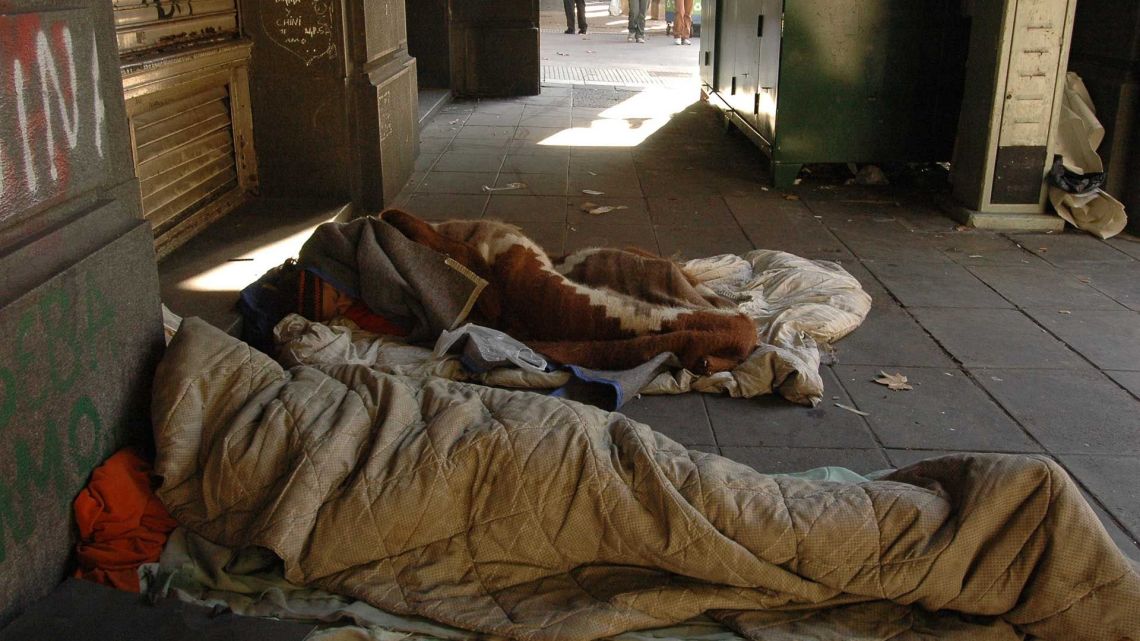
Buenos Aires City is a postcard that’s ever more crude. Over the last year, the number of people living on the street has increased by 30 percent. The figure comes from the official survey conducted in November by City Hall’s Human Development & Habitat Ministry together with the Buenos Aires City Statistics and Census Bureau, a nightly “snapshot” which counted 5,176 homeless people.
Out of the more than 5,000 people on the streets, 1,613 were sleeping directly on the pavement, in squares, underground station entrances and hospitals, with 3,563 housed in Social Inclusion Centres (CISs), the City’s shelters for the homeless. As of November 2024, 1,236 people were recorded to be living outdoors – hence the 30-percent year-to-year leap.
The data become more significant when considering origin. Nearly 70 percent of homeless people are not from the nation’s capital at all. Breaking down the numbers, 39.5 percent were born in Buenos Aires Province, 19.3 percent in other provinces and 8.2 percent were born overseas. Only three out of every ten hail from the City.
The phenomenon, far from being a local problem, reveals a metropolitan and federal dynamic, where the capital works as a last resort to those who lose their job, housing and safety net.
By barrio
Territorial concentration is clear. Some 49 percent of the 1,613 people sleeping on the streets are located in Communes 1 and 3 (the neighbourhoods of Retiro, San Nicolás, Puerto Madero, San Telmo, Monserrat, Constitución, Balvanera and San Cristóbal).
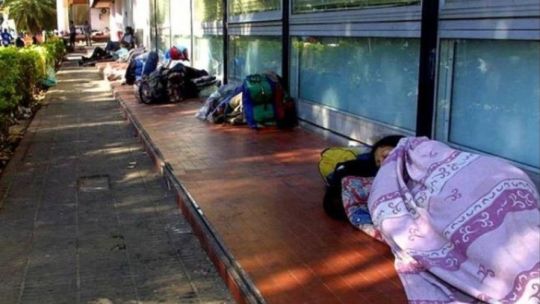
The administrative and financial heart of the country thus cohabits with this devastating situation. Improvised mattresses are installed in galleries, pieces of cardboard are placed on wide sections of pavement and precarious shelters in the vicinity of hospitals and stations.
The official census is conducted twice a year (in April or May and November) by means of a 12-hour operation with 85 teams comprising a driver, a census-taker, care staff and an inspector from the City Ombudsman’s Office. Starting in 2021, people housed in shelters were included, and as from April 2024, they have been interviewed in person to improve the quality of data collection.
The Buenos Aires City government, today under the control of Mayor Jorge Macri, holds that its 58 Social Inclusion Centres, with 4,900 spots – and segmentation by profile, family, age, mental health issues, problematic use or even people with pets – are not overcrowded.
However, the Third Homeless People Census, presented at the City Legislature and conducted by over 30 social organisations between June 26 and 29 by way of territorial “combing” for four days, produced much higher figures: 7,898 people sleeping on the streets and 3,994 in shelters, 11,892 in all.
Of those, 37.9 percent of them had become homeless over the past year. Almost two-thirds, 64 percent, reported health deterioration and 80.7 percent denounced institutional violence. The methodological gap does not conceal the same trend: growth is sustained.
Causes
The causes for homelessness combine economic and health factors. Job loss, precarious employment and family conflicts are the most common motives. Out of those surveyed, 45 percent had spent one year without making contact with their relatives.
Yet there is another increasingly central element: mental health issues. Just over 68 percent have been in the street for over a year and 31 percent acknowledge they have been in that situation for over three years – a fact often associated with severe depression, addiction and psychiatric pathologies that have been left untreated.
In that context, the defunding and dismantling of Argentina’s national health programmes over the last two years is a factor worsening the situation. Reports from healthcare organisations warn about reduced access to medication, fewer community devices and services and weakened mental health policies.
One prime example is the running of the Laura Bonaparte National Mental Health Hospital, which is in a precarious state. Many patients have been left unprotected. When treatments are interrupted and territorial aid is withdrawn, the risk of exclusion multiplies. The street becomes a destination and then, an imprisonment without walls.
Maricruz, a nurse at the Ramos Mejía Hospital in the south of the capital, describes it with a mix of professionalism and anguish.
“The number of people coming to sleep at night near the hospital is striking. A few years ago, we had a kind of tent on Urquiza street; then it was removed and almost nobody came. But for months now more than 15 or 20 people have been sleeping in the vicinity,” she explained.
“Some stay in the corridors, others on the seats of the Accident and Emergency Department. We try to assist them but it’s impossible to help them all. Many have nowhere to go, spend days without a shower and use our toilets to relieve themselves. There’s a lot of neglect,” said Maricruz.
The scene summarises the merging of a social and healthcare crisis.
Solidarity
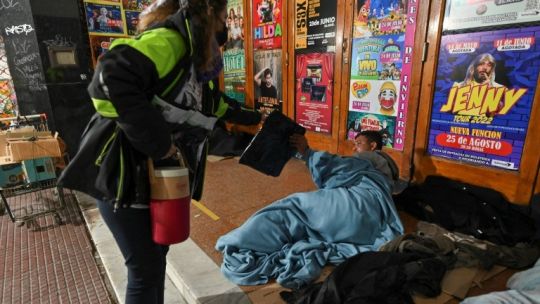
Esther, one of the 150 volunteers from the Vida Solidaria association, walks the streets of Buenos Aires with food and warm clothes. The organisation for which she works conducts humanitarian work, oversees donations and provides direct assistance to people living in a vulnerable situation.
“You do what your heart tells you, but we know it’s a drop in the bucket. There are people who only eat what we give them. Every night we meet people from all over the country who live outdoors. Some of them tell us how they got to be in that situation, others are lost like children without parents. This is upsetting because they’re human beings left high and dry,” she said.
The average age of the homeless, between 20 and 50 years old, reveals that it is not only historic marginality, but also adults of working age who have been expelled from the system.
The Buenos Aires City Government receives on average 800 daily calls to the 108 hotline for warnings on homeless people. Micro-shelters have been added for overnight stays and washing and new shelters have been opened.
Yet the expansion of the phenomenon forces a comprehensive outlook which exceeds the logic of an emergency. That 30-percent increase in a year, with seven out of every 10 people hailing from outside the City, speaks of a fragile economic fabric, of broken family networks and an eroded healthcare system.
On the pavements of the city centre, between historic buildings and glazed offices, destitution has stopped being the exception. It has become part of the everyday landscape.
Every number of the census is, in actuality, a suspended biography. And while statisticians discuss methodologies, the nighttime in Buenos Aires City sees more mattresses, blankets or pieces of cardboard added to the pavement as the homeless make their improvised beds for the night.













Comments