

Diego Maradona would be happy, his fans say.
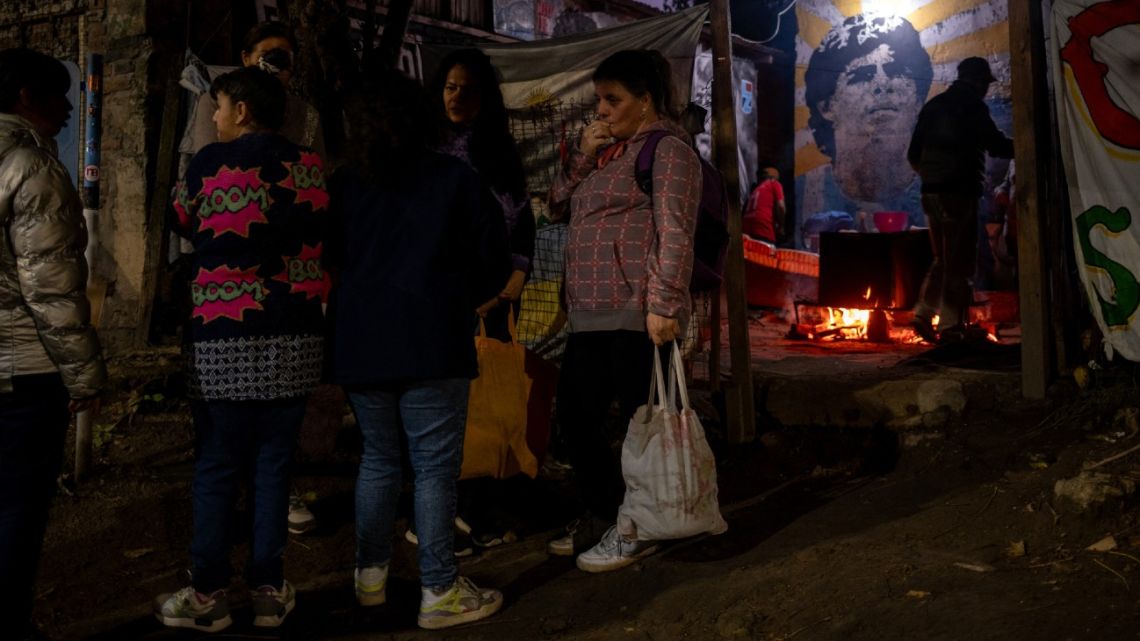
The childhood home of the late national football legend has been transformed into a soup kitchen for people squeezed by President Javier Milei's austerity policies.
The needy can also ask for clothing at 523 Amazor street in the Buenos Aires City suburb of Villa Fiorito, where the player dubbed Argentina's "Golden Boy" grew up in grinding poverty.
In this neighborhood of around 50,000 people living in modest brick homes, dozens of murals depict key moments in the career of the illustrious number 10, who died in 2020 at the age of 60.

On Tuesday, a new trial for criminal negligence began for the seven-strong medical team that was caring for Maradona in his final days, as he was recovering from brain surgery.
In Fiorito, neighbours come and go to "Diego's house," as they call it, lugging containers which volunteers fill with chicken stew or other meals cooked in giant cauldrons in the yard.
Cumbia music – the music Maradona loved – blares from speakers.

If he were alive "Diego would say there is a lot of hunger and we have to help, because the need is so great," said Diego Gavilán, one of the kitchen's beneficiaries.
Gavilán is unemployed. He collects cardboard and scrap metal for a living but it no longer puts food on the table.
He started coming to the soup kitchen after Milei was elected in December 2023 and embarked on a radical free-market agenda of deregulation and steep cuts to public spending.

“There’s more poverty, you have to go out ‘cartonear.’ Now exports have been opened up, so they pay you less for metals and cardboard,” he said.
"You can’t make ends meet," Gavilan said.
Although statistics show a decrease in poverty under Milei, mainly due to a sharp drop in inflation, family finances are in crisis, according to Central Bank reports.

A surge in imports and a collapse in consumption have resulted in the closure of 22,000 businesses, according to official reports.
Gavilán said he was glad to accept help from Maradona's old home.
"He suffered so much hunger here as a child. For the people of the neighbourhood to receive a plate of food is special," he said.

Fiorito, less than an hour from the Obelisk in central Buenos Aires, is a neighbourhood of dirt roads and need.
“Here you have to look for soup kitchens every day, because people – I mean, the cartonero no longer collects cardboard, the street sweeper no longer sweeps. So people go hungry all the time,” explained María Torres, a cook at the centre.
There are no tables or chairs for diners. The food prepared by volunteers over open fires in the yard is handed out in bags to people queueing at the door. A fallen tree serves as a communal bench.

Maradona often spoke of his humble beginnings in a community that lacked running water and paved streets.
Sixty-six years after his birth, hardship is etched in the faces of those queueing for food.
"People are going hungry," Maria Torres, one of the center's cooks, told AFP, adding she was convinced Maradona would be very happy at the sight of his old home being used for a charitable cause.

“It’s incredible for the neighbourhood, to come to Diego’s house to get a plate of food – who would have imagined it? No-one,” Torres said.
Father Leonardo Torres is one of the driving forces behind the soup kitchen.
The priest recalls Maradona recounting how his mother, Dalma "Tota" Franco, would go without food so he could eat his fill.

"Diego said that his mother would pretend her stomach hurt so he could eat," he said.
"We want many 'Totas' and many 'Diegos' to leave here with a full stomach," he added.
Rosa, a mother of several children who is unemployed, is among those receiving help in a place whose history is not lost on her.
“For Argentines, Diego is a passion, an idol,” she summed up.
– TIMES/AFP











Comments