

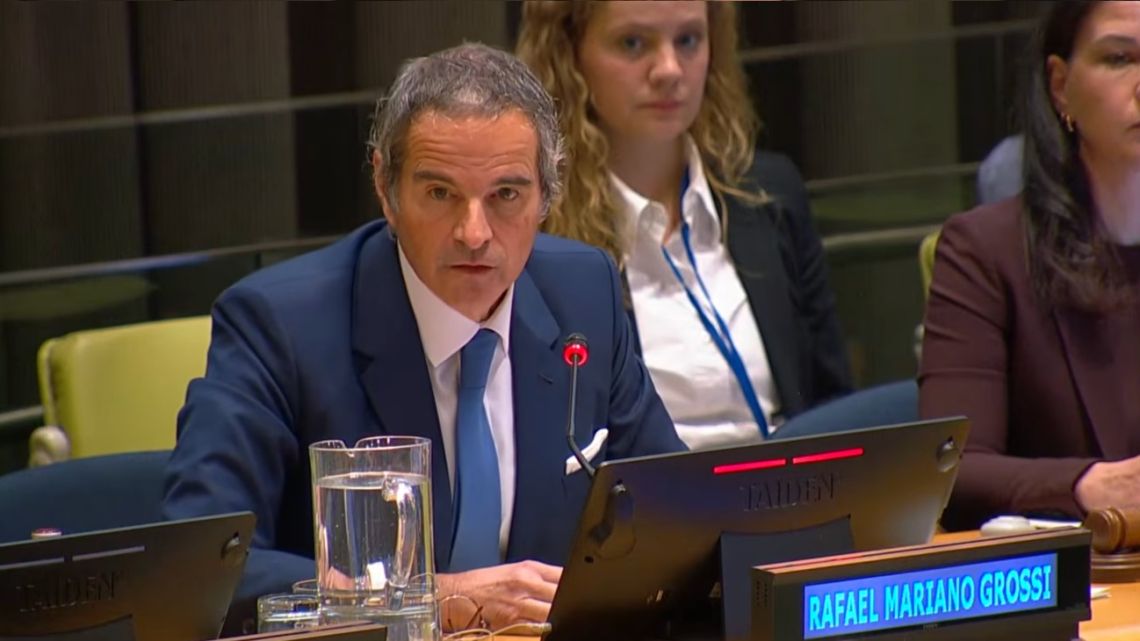
Experienced Argentine diplomat Rafael Mariano Grossi told United Nations member states on Tuesday that the institution needs reform and impartial leadership as he pitched his candidacy for secretary-general.
Grossi, the head of the International Atomic Energy Agency (IAEA), aired criticism of the multilateral institution and pitched a future of pragmatic leadership and achievement in a three-hour hearing at UN headquarters in New York.
The IAEA chief, who has won plaudits for his handling of the Iranian nuclear dispute and mediation in the Russia-Ukraine conflict in Eastern Europe, repeatedly highlighted his ‘boots-on-the-ground’ approach to diplomacy, declaring at one point that “the UN doesn’t need more conferences” but more action.
The young generation do not have a good opinion of the UN, Grossi warned, arguing that the institution needed more clarity, better communication and to make a difference.

“This is why, in choosing the person who is going to be working with you, with the 193 member states of this organisation is, at this point, so important,” said the candidate, who is seeking to succeed current UN chief António Guterres, whose term in office ends on January 1, 2027.
"Principles are there and they must be there as our compass, but this house was not created to be an institution propelling messages from an ivory tower. It is supposed to be solving problems on the ground – this means adapting to situations, this means talking when we need to talk, this means engaging with all, even when they are at war with each other,” said Grossi.
“My view is of an institution that will be out there, that will be acting with equal determination on all fronts,” he continued.

“This does not come from a few well-written pages, but from my own experience as director-general of an organisation that is at the heart of current efforts to ensure peace and security in many places,” Grossi added, referring to his experience leading the IAEA.
Taking questions about his leadership style and how he planned to juggle conflicting interests at a time of global instability, the veteran Argentine diplomat offered a front-footed approach of “enlightened pragmatism.”
“Impartiality is exactly what is needed,” stressed Grossi, adding that the UN secretary-general “has to open doors when none are open.”

“Impartiality is a very lonely place but it's something that needs to be done – it does not mean indifference but you must talk to those who are at each other’s throats sometimes,” said Grossi.
Appearing before the press after his appearance at UN headquarters, the IAEA chief was asked why he stressed the importance of impartial leadership.
As secretary-general, "you are not there to lecture a political leader," he responded. "You are there to help find a solution. And for you to be accepted by both [sides], you need to be impartial. Which means, that neither A or B will see you as embracing the other side's position."

Grossi also spoke about his plans to tackle the institution’s "liquidity crisis” but stressed funding issues were ultimately the responsibility of member states.
‘Most consequential’

In his opening statement presenting his vision, Grossi said he would listen to member state’s concerns but stressed the need for reform of the institution. “This is a conversation among colleagues who care for the UN,” he began.
“History is never linear and subject to interpretation, but in mine, this particular selection process of a new secretary-general for the United Nations, 80 years after its creation, is one of the most consequential ones we will have,” continued the IAEA chief.
Grossi, 65, outlined two reasons for that claim: a world fraught with tension, polarisation and fragmentation, and the cynicism and frustration that surrounds the United Nations, which he said faced “enormous doubts” about its ability to solve global problems.

Arguing that “the direction in which the United Nations is moving is not one we would all like to see,” the IAEA chief said the institution should return to its founding principles and lead efforts to establish peace anywhere in the world.
“There is no continent that has not known the return of war” in recent years, cautioned Grossi, citing conflicts in the Middle East, Europe, Africa and the Americas.
In the question-and-answer session, Grossi – who was named one of Time magazine’s 100 most influential people last week – responded to a number of queries from regional blocs and smaller states.

“We are the global house and we need to be reflective of different perceptions,” acknowledged Grossi, who promised to be in “constant dialogue” with members of the UN Security Council, if elected, to ensure a proactive approach to solving conflict.
“There is no good war, or bad war, or less important breach of international law,” said the candidate, who stressed his support for key UN policies on human rights, sustainable development and humanitarian missions.
“We have to convince everybody that the UN is the best possible investment – much better than wars and cheaper, as well,” he said in response to one question.

Asked by an African representative about his views on reform of the UN Security Council, Grossi said there was “widespread recognition that the imbalance of African representation is something that needs to be addressed.”
“There is a progressive convergence of views,” he added.
Grossi also responded to a question on smaller island states, noting the importance of engaging with all parts of the world and all sectors and their “unique” challenges.
In one of final questions from member states, the IAEA chief was asked how he would “lead immobilisation against impunity” as secretary-general.
At that point, the Buenos Aires-born diplomat made his one and only reference to his homeland, noting that “it takes two to tango.”
“We need to establish this credibility,” he noted.
Before closing the session, an Irish representative took the opportunity to ask Grossi for his view on reforming the secretary-general post, whether by opposing a one-term limits or extending the post-holder’s time in office.
“Dear ambassador, up to you,” responded Grossi to laughter from the hall, carefully sidestepping the issue.
Bachelet kicks off
The Argentine diplomat’s appearance followed that of former Chile president Michelle Bachelet, who is also seeking the UN’s top post.
In comments after her appearance at UN headquarters, she told a group of reporters that she hoped the world is finally "ready" to appoint a woman as secretary-general.
All nine UN chiefs have been male, though many countries have advocated for a female candidate in recent years.
"If I am polite, I would say the world was not prepared for it. Is it prepared now? I hope so," Bachelet told reporters after her three-hour hearing. "It will be a very good signal. It could give hope to many people."
The 74-year-old said she intended to rebuild trust in the UN via reform and advocated for a secretary-general who would be "present in the field."
The next secretary-general should have a “moral voice" and a "diplomatic stature that can be heard" by powerful states, said the former president.
However, Bachelet said there is no magic formula to the UN’s pressing issues. While distrust of the UN is often illustrated by the Security Council's paralysis on many pressing issues, she acknowledged that she had no "magic formula" to change things.
Asked what makes her the best candidate to succeed current post-holder António Guterres, Bachelet emphasised her "experience." She brushed off questions about her age, quipping: "I have accumulative youth."
Tomorrow, member states and diplomats will hear from the two other candidates in the race, economist and former Costa Rican vice-president Rebeca Grynspan and former Senegalese president Macky Sall.
Latin American hope?
Following a tradition of geographical rotation that is not always observed, the position of UN secretary-general is being sought this time by Latin America.
Some states are still urging that a woman hold the post for the first time.
The 15 members of the Security Council – particularly the five veto-wielding permanent members (United States, China, Russia, United Kingdom, France) – will play a critical role in the selection process, which will begin by the end of July.
It is only on the council's recommendation that the General Assembly, which comprises all UN member states, can elect a secretary-general for a five-year term, which is renewable once.
Grossi, born in Buenos Aires in 1961, studied political science at the Pontifical Catholic University of Argentina and later completed a master’s degree in international relations at the Graduate Institute of International and Development Studies.
He began his diplomatic career in 1983, going on to hold senior roles within Argentina’s Foreign Ministry and postings abroad, including as ambassador to Austria and representative to the United Nations.
Between 2010 and 2013, he served as deputy director-general of the IAEA. He also chaired the 2020 Review Conference of the Nuclear Non-Proliferation Treaty. He took office as the IAEA’s director-general in December 2019.
Grossi’s candidacy for the UN secretary-general post has been heralded by the CARI foreign policy think tank. He was formally nominated for the role by President Javier Milei’s government in November 2025.





Comments