

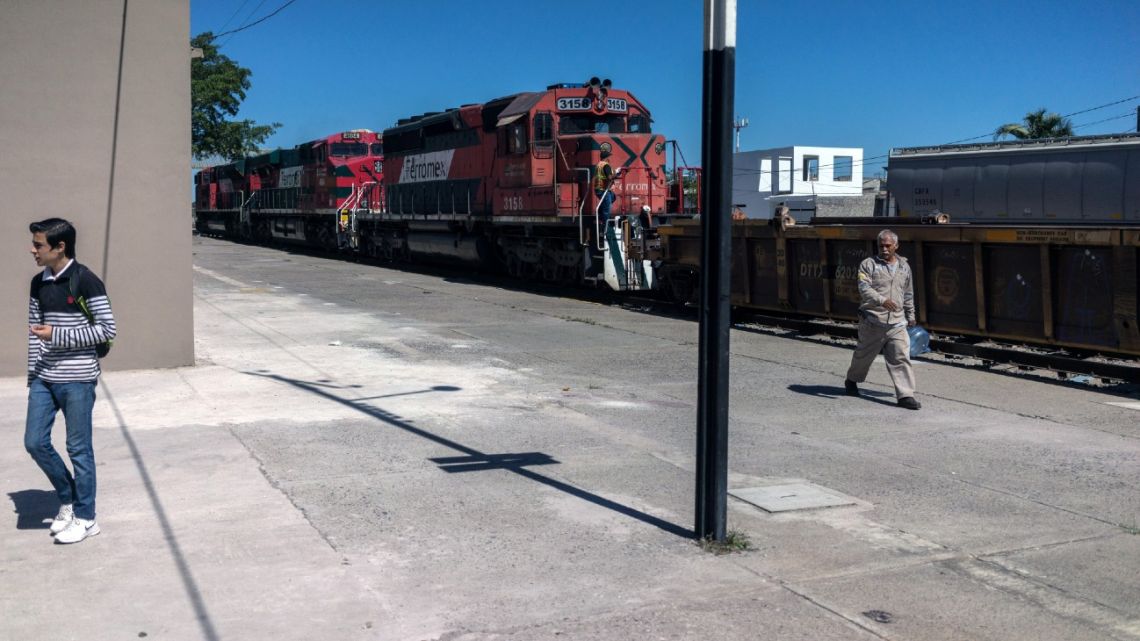
President Javier Milei is seeking billions in private capital to turn Argentina’s decaying freight railways into a key route for hauling grain and minerals to export ports.
But privatising the state-owned network is a daunting task – and one Argentina has failed at before. In the 1990s, the government’s first attempt to hand the railways to private operators unravelled as companies underinvested in infrastructure and abandoned unprofitable routes. Entire communities were left isolated, some turning into ghost towns, and the system was ultimately renationalised.
This time, Milei may be making the challenge even greater. The model his administration has chosen for the auction has drawn criticism from industry experts and risks sidelining one of the most prominent bidders: railroad giant Grupo Mexico, which has backing from the Trump administration. Other contenders could include a local Argentine operator and a consortium of grain exporters that includes Cargill Inc and Bunge Global SA.
The stakes are high. Without robust participation from major players, the auction could struggle to attract the level of investment needed to modernise the network, and turn it into a driver of growth at a time when Argentina’s economic recovery is losing momentum.

“If they don’t make a radical change in how they plan to tender, we’re not going to bid,” Grupo Mexico's Chief Executive Officer Fernando López Guerra said in an interview, describing the railway as the future backbone of the Argentine economy. “It’s not just another tender.”
The process also highlights the limits of US influence over one of its closest regional allies, even after the Treasury helped Argentina secure a US$20-billion bailout during a critical election year.
Today, Argentina's state-run operator has roughly 14,000 kilometres of freight rail, but so much of it is in disrepair that only about 7,600 kilometres are operational. Reviving the system could be transformative, lowering logistics costs, boosting exports and supporting economic growth.

How to unlock that potential is where the real dispute begins.
At the heart of Milei’s plan is a shift away from the current vertically integrated system, under which state-owned Belgrano Cargas controls infrastructure, trains and operations. The model is widely used across the Americas, including by private railroads in the United States, Mexico and Brazil.
Instead, the government plans to break Belgrano Cargas into nine separate auctions covering tracks, warehouses and operations across three corridors. Winners would be required to allow Open Access, a system in which multiple operators can run trains on the same infrastructure.

Officials, including Deregulation & State Transformation Minister Federico Sturzenegger, argue the approach is not only pro-competition but also legally grounded in a 2015 law passed under former president Cristina Fernandez de Kirchner. "It's key that Open Access exists so that there's competition in rail operations," Sturzenegger, who voted in favour of the law when he was a congressman, said in a written response.
Although Milei has dismantled many regulations passed by his predecessors, this one has remained.
“The Open Access law was kept because it’s totally aligned with the principles and values of this government. It’s a law that promotes competition,” said Alejandro Nuñez, head of Belgrano Cargas, who is leading the privatisation.

In a statement, the consortium of grain exporters voiced support for an Open Access model but said it cannot confirm whether it will bid until the government publishes the final tender documents. The group accounts for about 85 percent of Belgrano Cargas’ current freight.
“A more efficient Open Access operation can accelerate the modernisation the system has needed for decades, creating a railway for all Argentines,” the consortium said in a written response.
Grupo Mexico strongly disagrees — and its stance is emerging as one of the biggest risks to the auction’s success.

The conglomerate, controlled by billionaire Germán Larrea, has pledged an initial US$3-billion investment to rebuild Argentina’s rail system. But it wants to bid on the network as a whole, or at least secure an entire corridor, rather than compete for piecemeal assets under an Open Access regime. CEO López has travelled to Argentina five times since Milei took office to meet officials and inspect the network. So far, the sides have failed to reach common ground.
Nuñez, from Belgrano, argues that any company could implement its integrated model as long as it participates in each auction for a corridor, and allows others on the tracks. López says that Open Access undermines profitability, warning that “everyone loses money” under such a system.
Grupo Mexico points to its own track record. Following Mexico’s 1997 rail privatisation, the company helped transform a deteriorating network into a key artery for North American trade. It now sees similar potential in Argentina, particularly for boosting shipments of grain, minerals and supplies for oil production.

To strengthen its position, Grupo Mexico has sought support from Washington, as relations between Mexican and Argentine officials have cooled.
The company was accepted into the US Commerce Department’s Advocacy Center, which helps US-backed firms compete for overseas government contracts, according to people familiar with the matter. As part of the process, Grupo Mexico committed to sourcing locomotives and services from US manufacturers.
A Commerce Department spokesman didn't respond to requests for comment. The Trump administration has not taken an official stance on the privatization. Still, Nuñez said he has met with US policymakers to discuss the auction framework.

Beyond the political maneuvering, the debate reflects a deeper question: how should competition work in Argentina’s rail sector, when trucks already carry 95 percent of the country’s freight?
Government officials often point to Australia as an example of a successful Open Access system, highlighting its extensive freight network. But experts there caution that the model comes with significant trade-offs.
Australia’s railways operate under a patchwork of federal and state regulations, with multiple infrastructure managers. Operators frequently must negotiate access on a corridor-by-corridor basis, sometimes with direct competitors.

“The situation is quite complex,” said Rico Merkert of the University of Sydney. Compared to more integrated models, "the Australian multi-regime system is much more fragmented, decentralized, negotiated and historically path‑dependent."
Those concerns resonate with many Argentine academics and industry veterans, who argue the country’s failed privatisation in the 1990s was not the result of vertical integration itself.
Instead, they point to a lack of investment and unrealistic expectations in a sector where profitability is inherently difficult. There is broad agreement on one point: the need to achieve scale by increasing volumes, as transporting low-value commodities over long distances leaves little margin for error – or for additional layers of competition on the same tracks.
“It’s inviable in Argentina to think that somebody would buy locomotives and rail cars to operate on a line where there’s another competitor,” said Jorge Waddel, an engineering professor at the University of Buenos Aires. “A vertically integrated concession with closed access is the only viable option.”
Henry Posner III, whose Railroad Development Corp participated in the 1990s privatisations, recalls a system already weakened by decades of state ownership and burdened by overly optimistic projections. He warns that Open Access could make matters worse.
“It’s a race to the bottom,” Posner said. “Successful railways in Latin America have been vertically integrated.”
That leaves Milei’s government facing a fundamental question – and growing scepticism from experts.
Globally, Open Access systems tend to be more costly, bureaucratic and prone to disputes. According to research by MIT-trained engineer Francisco Furtado, Europe requires roughly seven times more trains than the United States to move the same volume of freight under its more fragmented model.
Furtado also points to gaps in Argentina’s plan, including the absence of a clear regulatory framework to resolve conflicts between infrastructure owners and train operators. Government officials dismiss this argument, saying the undersecretary of transport can handle any conflicts.
For critics, the concern is that ideology may be shaping policy more than practical considerations.
“You can live in the real world or you can live in ideology,” Furtado said. “Open Access is not going to magically fix Argentina’s rail system.”
by Patrick Gillespie & Michael O'Boyle, Bloomberg














Comments